
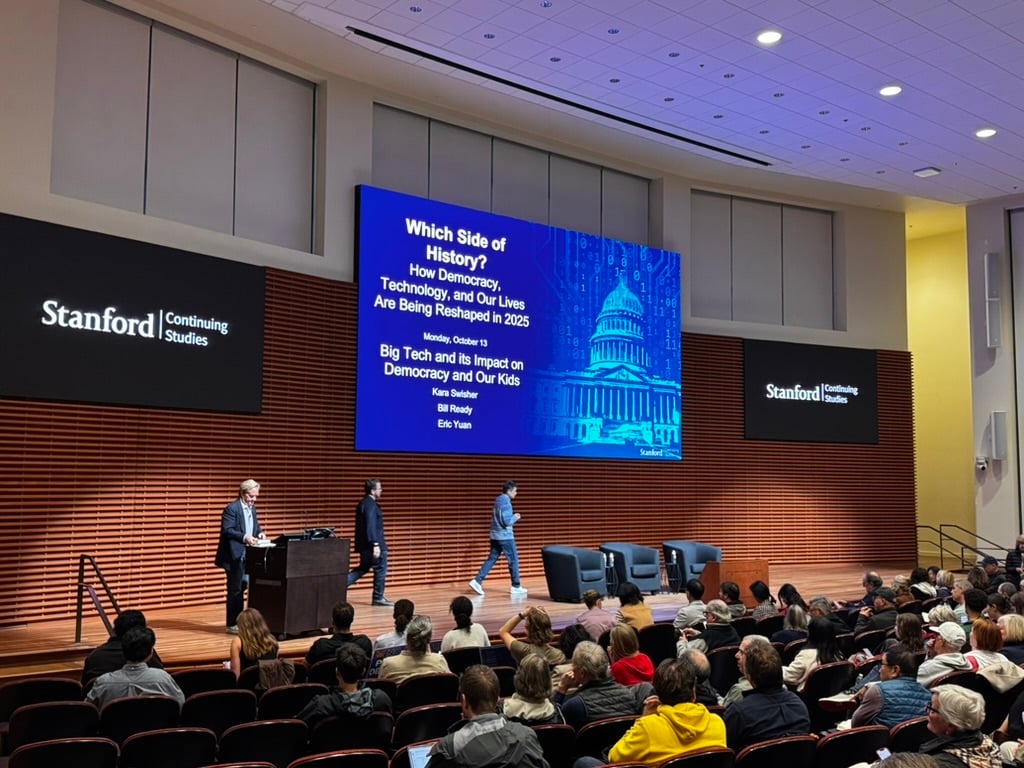
On Monday evening, two leading tech CEOs joined a veteran journalist in a debate over the corporate responsibilities of Big Tech, the role of government regulation and the societal costs of innovation in the age of artificial intelligence — focusing on the industry’s impact on democracy and children.
The discussion featured Pinterest CEO, Bill Ready and Zoom CEO, Eric Yuan, in a panel with award-winning technology journalist, Kara Swisher. The group presented at times overlapping but ultimately divergent visions for the future of technology, from market-driven ethics to calls for legal accountability and regulatory frameworks.
Moderated by the course’s professor and Common Sense Media CEO, Jim Steyer, the discussion was the latest of the political science speaker series, POLISCI 31: “Which Side of History? How Democracy, Technology, and Our Lives are Being Reshaped in 2025,” is offered through Stanford Continuing Studies. Steyer himself also actively participated in this conversation.
The conversation centered around the concentration of power among a handful of tech giants, which Yuan — a self-described engineer — defended the dominance of. He described large companies in the AI race as a simple matter of resources and engineering reality.
“You like it or not, that’s the way for technology innovation,” Yuan said, defending that the industry’s structure is an engineering reality. He argued that building foundational AI is like constructing the bottom layer of a pyramid, explaining that only giants can afford the billions required for the massive infrastructure project. “This is just purely from technology.”
Swisher rejected Yuan’s point.
“I have heard every one of the stupid excuses, and it’s always about how they need to be free to do whatever they want,” Swisher said, comparing the tech industry’s arguments to those made by railroad monopolists during the Gilded Age.
Ready argued that the profitability and positive social impact can actually coexist under what he called a “free market solution,” providing details about how Pinterest, which he became CEO of in 2022, has tuned its platform to be an “oasis away from toxicity” — an impression that he claimed is now what Gen Z primarily thinks about his platform.
“We wanted to prove there was a good business in positivity,” Ready said, citing the company’s decision to make accounts private for users under 16. He said that this focus on safety has become a key driver of growth, particularly among Gen Z users.
Yuan added that the core issue is a lack of digital literacy in this AI generation, ultimately boiled down to education, saying that society failed to educate children on the pros and cons of social media. He warned that the same mistake is now happening with AI, which requires provocative educational effort.
Ready contended that education alone is not a sufficient solution, calling social media use a “collective action problem.” He cited research showing nearly half of young people wish some social media did not exist at all but were compelled to participate. “They’re there because their friends are there,” he said.
Another central point of contention was on Section 230 of the Communications Decency Act, the 1996 law that shields online platforms from liability for user-posted content, which Steyer called a “get out of jail free card.”
Ready advocated for a nuanced approach, suggesting not to eliminate the law but to create minimum standards for the industry. “We need to have a baseline around safety,” he said, proposing a system of “crash test ratings” for tech platforms.
The panelists also exchanged views on AI’s effect on democracy. While Swisher said that AI could either be a “weapon or a tool,” whose status is entirely dependent on the rules and users that are in place, Ready offered a more systematic warning, arguing that AI is a powerful new medium whose algorithms inherently promote polarization to maximize user engagement.
“I think it’s really important to understand that the people that run these companies, myself included, are making a form of editorial choice in the way these algorithms are tuned. It’s not the same kind of editorial choices when you’re running a newspaper,” said Ready
In their closing advice to students, the speakers offered inspiration and encouragement. Swisher concluded with a call to action against feelings of helplessness against the AI giants.
“Don’t think you have no power; you have enormous amounts of power,” she said. “They convince you that they’re magicians or special or geniuses, and they’re not… Don’t let them take your power away from you.”
This article has been updated to reflect that the course is offered through the Stanford Continuing Studies program.