
As the saying goes, the truth is always somewhere in the middle.
Last week, The Daily’s news section published a piece titled, “Hoover-affiliated historian calls fascism fears a ‘category error’ amid No Kings protests.” As someone who attended the lecture titled, “Is this the End of the Post-WWII New World Order,“ I paid close attention to the commentary from two prize-winning historians, Niall Ferguson and David M. Kennedy, and former Secretary of Education Margaret Spellings. And for a talk that was two hours long, the title does a comically awful job at capturing the conversation’s complexity. Instead, it focused on a line that was insignificant for the larger discussion — that comparing President Donald Trump to 1930s European dictators is a “categorical error.” Ferguson, Kennedy and Spellings didn’t agree on many topics, but the fact that all three came together to reject the Trump-Hitler analogy is telling.
The piece’s antagonistic stance fed more ammunition to Ferguson’s argument that academic institutions are filled with leftist agitators, a point that struck a chord with the campus’s conservative counterweight, the Stanford Review. In their piece, “In Defense of Professor Niall Ferguson: Yes, Trump is Not Hitler,” the Stanford Review Board argued that Democrats have weaponized the word “fascism” against their political opponents, like Trump and his allies.
But to simply highlight this as a tool of the Democrats is also categorically false. At a Georgia rally days before the 2024 election, Trump said, “she’s a fascist,” referring to his opponent, Vice President Kamala Harris. This wasn’t just a one-off, but a recurring term used by Trump against his opponents. And while the Review deems the No Kings Protest as an example of peaceful, unobstructed protest, Republican Speaker of the House Mike Johnson called the protests “hate America” rallies,” while defending an AI-generated video of Trump dumping waste on the protesters as “satire.” So no, it’s not just Democrats raising the rhetoric; Trump and the Republicans are just as much at fault.
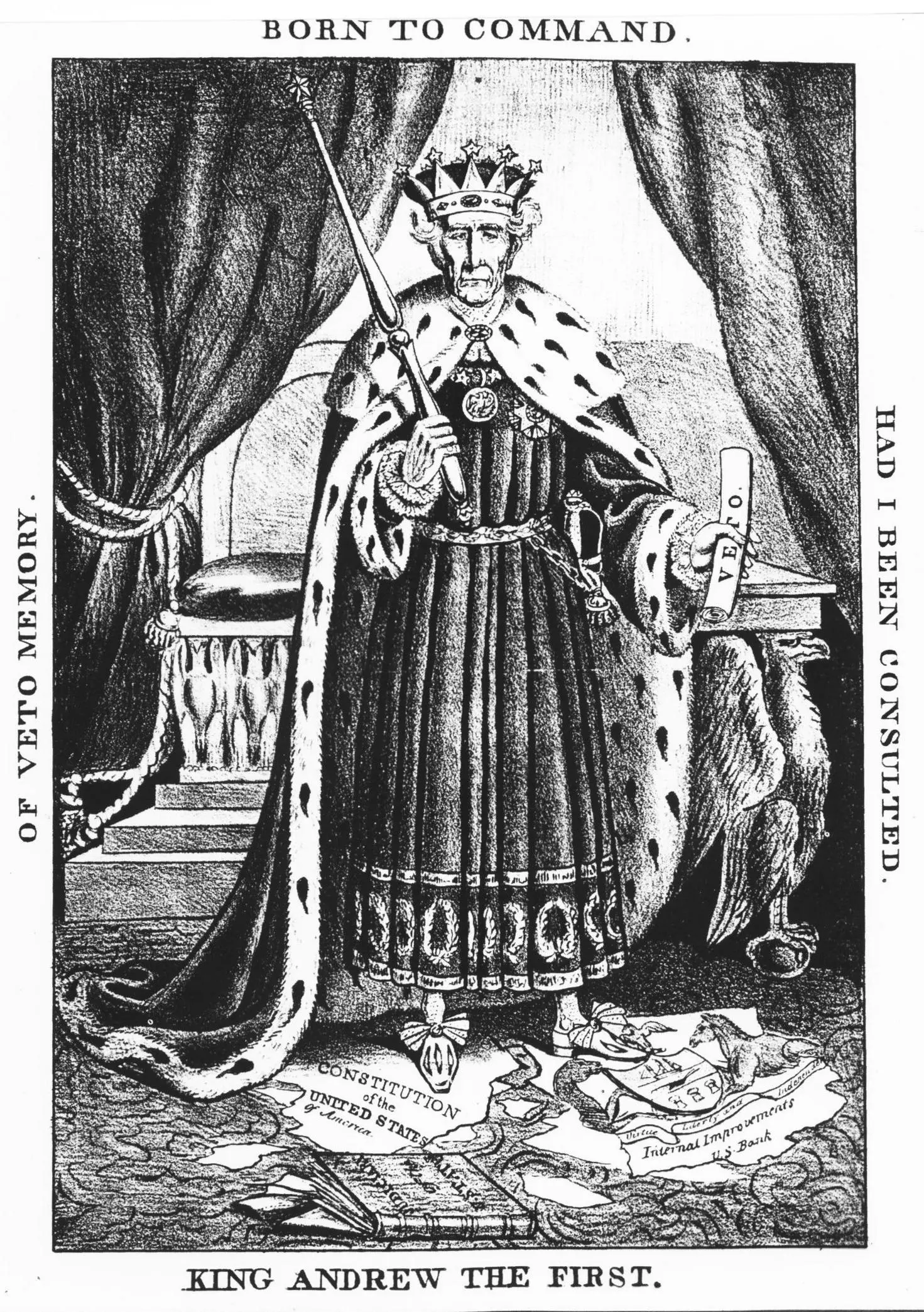
In between The Daily’s and the Stanford Review’s mudslinging and hyper-sensationalization, readers missed a characterization of Trump that has much graver implications for American democracy. Ferguson made a fascinating point that Trump comes from a uniquely American — not European — tradition of populism and an imperial executive. It’s a phenomenon that dates back to the presidency of Andrew Jackson in 1829, when he went after the credibility of the Second Bank of the US. One political cartoon decried him as “King Andrew The First,” echoing the spirit of the No Kings Protests today. Trump even brought back a portrait of Jackson to the Oval Office upon his second inauguration.
In addition to Jackson, Ferguson cites a more contemporary public figure that best explains the Trump phenomenon: Richard Nixon. As Ferguson pointed out, Nixon represented the politics of retribution against the liberalism of the 60s and early 70s. Ferguson cites a letter that Nixon wrote to Trump in 1987 saying, “whenever you decide to run for office you will be a winner!” The connections thicken as just this week, Trump was named the winner of the Richard Nixon Architect of Peace Award by the Nixon Foundation.
I’m disappointed that The Daily’s coverage quickly glossed over this important characterization and unsurprised that the Review completely ignored it, because the implications are far more consequential than any Trump-Hitler comparison. As Nixon conspired to cover up the White House’s connection to a botched robbery of the Democratic National Committee headquarters at the Watergate Hotel, Nixon even created an “enemies list” of people who he’d routinely harass through the federal agencies. And when subpoenaed during his impeachment proceedings, he refused to comply. Ultimately, Nixon chose to resign rather than face an increasingly likely impeachment.
As Princeton historian Julian Zelizer put it, “We still live in the era of Watergate.” Since Nixon, public faith in our elected officials declined and with it our trust in American institutions. Watergate marked the moment when Americans began assuming the worst about their leaders. While some skepticism toward government is healthy, outright rejection of it is something else entirely.
Trump’s drain-the-swamp messaging couldn’t have benefitted from a better political environment. During the 2016 Republican Primary, Trump separated himself from a GOP establishment that refused to take responsibility for the American interventions in Iraq and Afghanistan. In a now viral moment on the debate stage, Trump said, “They lied. They said there weapons of mass destruction. There were none.” Meanwhile in the General Election debates, Trump went after Democratic Candidate Hillary Clinton as “Crooked Hillary,” going so far as to say she’d be in jail if he were president.
But there’s one key difference between Nixon and Trump. Whereas Nixon was punished for his corruption, humiliated and rebuked by even his staunchest supporters, Trump has been rewarded for the same behavior. In the wake of his claims of a stolen election and an insurrection that he incited, despite being tried for 88 counts across 4 indictments, he was afforded a second term. Imagine if after resigning and being pardoned by his Vice President, Nixon returned to the political arena for a second term and won — now bent on finishing off the anti-democratic project he had started.
The takeaway is clear: When corruption wins, democracy loses. Let’s not dwell on hyperbolic comparisons that’ll only be met with eye rolls from the other side and a sense of hopelessness from our own. Simultaneously, let’s not downplay the serious threat that Trump poses to our democratic project. Ferguson may be right that Trump is Nixonian, but if that’s the case, we should be just as concerned. America has endured several wannabe Kings, but at what point does our system give in?