
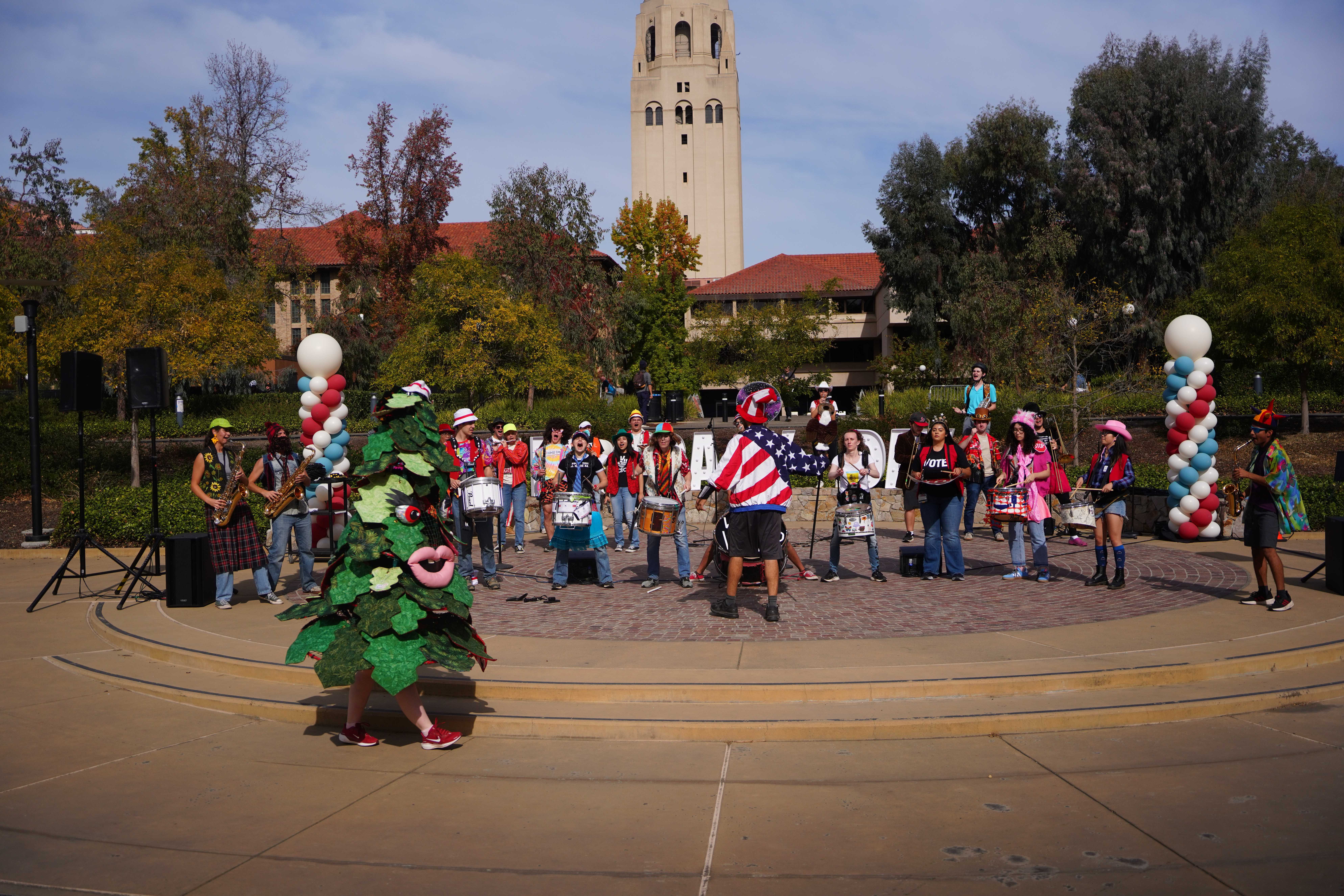
Stanford will celebrate its fifth annual Democracy Day on Nov. 4 in a day-long celebration of civic engagement marked by events, panels, mixers and activities. Despite it being a non-election year, the day will see double the volunteers from last year and an infusion of energy from its executive team.
While planning the conceptual foundations for the event this year, the Democracy Day executive team agreed that this year “should be more focused on that human to human connection, [and] that ability to agree to disagree with somebody,” said vice chair Jadon Urogdy ’27.
Democracy Day is the only all campus event that is student run and, notably, a day on which all professors must cancel class.
“Professors do not like to give up their classes… so the [student organizers] are really on the line to come through, to make it happen and make it successful,” said Haas Center Senior Program Director for Campus Partnerships Peggy Propp ’81, who serves as the Democracy Day staff advisor.
The executive team behind the day has been planning since February.
“You know, you only see the posters a week before, and then you show up to the events on election day. But Democracy Day is a 365 planning process,” Urogdy said.
Last year, the event saw over 2,000 student attendees. This year, the executive team expects to attract even more. Though the most attended event last year was the election results watch party, which will be replaced with the Dine and Dialogue event this year, Democracy Day chair Keira Chatwin ’27 said she can still feel the excitement of the student body leading up to the event this Tuesday.
“I initially expected there to be less engagement this year because it is a non-election year, but I think we’ve almost seen the opposite, and I think that’s because we are growing in our presence in the Stanford community,” Chatwin said.
Chatwin also emphasized the importance of student-run initiatives like Democracy Day in energizing the Stanford community.
“For some professors, it might just seem like administration is doing another bureaucratic, administrative thing in the name of democracy, whereas that’s just not what’s happening at all. It’s an initiative for students, by students, to make sure that we are achieving democratic priorities as a school student body,” she said.
Reid Smith ’28, a political science major, attended Democracy Day last year. He noted that the cancellation of classes across campus serves as a chance for students from varying academic backgrounds to engage in conversations.
“We all have voices and giving a break to really focus on that, no matter if you’re studying poli-sci or if you’re studying electrical engineering, is very important,” said Smith.
Chatwin also noted that she hopes Democracy Day can be further integrated into Stanford’s culture, becoming a holiday all students are aware of. The day’s organizers hope that Democracy Day will provide a space for civic conversation, even in an odd year.
“Having Democracy Day on a federal election year is amazing because there’s a lot of pomp and circumstance, but this year, it’s just a great moment in the Stanford community to sit down and think about how we can broaden our horizons past just voting,” said Urogdy.
And, as Propp notes, even on federal election years, Democracy Day has never been simply about the act of voting — since Democracy Day is held on Election Day, many attendees have already voted.
“Most people have made their decisions before election day, right? So, what we’re doing is laying the groundwork for how to think about elections, how to get involved,” said Propp.
Urogdy said that Democracy Day, in non-election years like this one, “transcends the idea of checking a box at the polls.”
The Democracy Day calendar this year is filled with events aimed at including every student, no matter their political ideology, identity or academic interests.
Among Tuesday’s events is an interactive pottery workshop in which participants can create art and engage in civic-minded conversations with their peers. Students may also attend the Interfaith Civic Mixer, where participants will discuss the intersection of religious and civic identities. There will also be an international panel where students can talk about their experiences with democracy overseas.
Urogdy noted that it is an essential part of the executive team’s role to create a safe space to facilitate diverse conversations on campus.
“It’s really hard to have a dialogue if you’re just in an echo chamber,” said Chatwin.
Chatwin and Urogdy noted that this Democracy Day, by nature, will look different to last year’s. But, for them, that has little impact on the day’s significance as an opportunity for civic engagement.
“Odd-years are not off-years,” said Chatwin.