
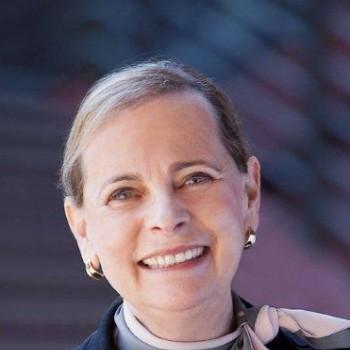
“Basic, curiosity-driven research is the crucible for all discoveries that lead to medical advances. That is what is needed to keep the country and the world healthy,” said Lucy Shapiro, the 2025 recipient of the Lasker-Koshland Special Achievement Award in Medical Science, often called the American Nobel Prize.
Shapiro received the award on Sept. 19 in New York City.
At Stanford, Shapiro is the Virginia and D.K. Ludwig Professor Emerita of Cancer Research and Director of the Beckman Center for Molecular and Genetic Medicine.
Shapiro is credited with being instrumental in the development of the field of systems biology. She was the first female chair at three different university departments, served as an advisor to two presidential administrations, spearheaded Stanford’s developmental biology program and has been a mentor to many.
Growing up in New York City, her family and she decided that she would attend the High School of Music and Art for high school, now the Fiorello H. LaGuardia High School of Music & Art and Performing Arts. This decision, she said, changed her life.
“It opened my eyes to a world where people were from all walks of life,” Shapiro said.
While Shapiro wanted to go away for college, financial constraints led to her enrolling in an experimental honors program at Brooklyn College, where she majored in Fine Arts. Her turn into the sciences is due to Ted Shedovsky, a physical chemist at Rockefeller University, she said. He attempted to keep creative thinkers in the sciences and he would often find young talents in the arts and convince them to enter the sciences.
“He convinced me to take an organic chemistry course,” said Shapiro, “Comparing my previous work with the newly discovered world of molecules, there was no contest. This was suddenly the world I knew I had to be in.”
Shapiro has often chosen the path less taken and chose to study the Caulobacter crescentus bacteria. She found that this cell was not as primitive as previously believed. Her research found that even the most basic cells function as chemical functions in space and time to create daughter cells, dismantling the belief that these cells lacked complexity.
“I don’t think this is the question I would have embarked upon if I was more schooled in microbiology. My lack of training didn’t let the thought that it was almost impossible enter my mind,” Shapiro said.
Shapiro says that if there is anything she could be known for she would want to be known for being human and getting the best out of people.
Michael Laub Ph.D. ’02, a professor at Massachusetts Institute of Technology (MIT) and Shapiro’s former graduate student, now models his mentoring after her. “She has this incredible optimism that makes you feel like you can do anything. Science can be hard, but she was always there to make you believe that it was going to work,” he said. “I never doubted if I could do it for a second, because she never doubted it.”
Meanwhile, Esteban Toro Ph.D. ’09, vice president of R&D at Twist Bioscience and a former graduate student of Shapiro, said, “in most thesis defenses, the [principal investigator] would have to quiet down the room to start the session. Not Lucy, she simply had to stand.”
“I learnt what it means to truly understand something from her,” he said.
Aside from academia, Shapiro also dabbled in entrepreneurship. She co-founded Anacor Pharmaceuticals in 2002, which was later sold to Pfizer for $5.2 billion. In 2015, she co-founded Boragen, LLC, which aims to use the boron containing library for crop protection.
“Passion for the problem you are trying to solve is important in both entrepreneurship and science,” she said.
Shapiro emphasized the continued importance of staying curious.
“The freedom to be in awe of the world around you is critical,” she said. “But it is not enough. You need the skills and tools to answer those questions.”
“Learning things is much more fun that trying to figure out what you want to be. Be curious and try things. The idea of succeeding young never occurred to me. I’m 85, and still succeeding. You’re at Stanford, give yourself the freedom to play intellectually,” she added.