
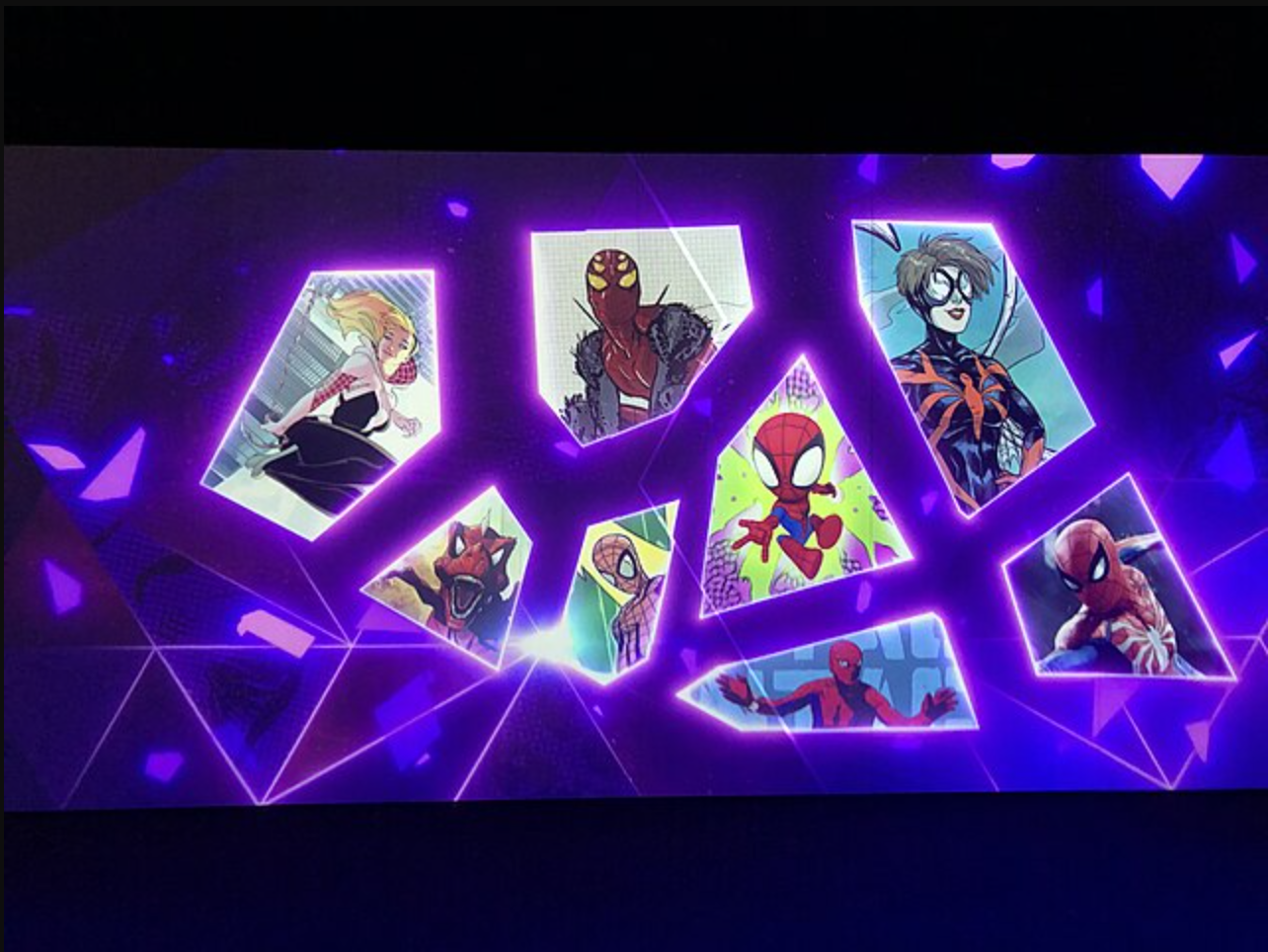
Wandering around campus this past Halloween, I found myself reflecting on one oddly enduring cultural fixation: superheroes. Beyond inspiring cheap costumes and keeping the spandex industry alive, superheroes occupy a unique space in popular culture. Once they reach a certain recognizability, they become what Stanford media theorist Shane Denson calls a “serial figure,” a “type of stock character inhabiting the popular-culture imagination of modernity.” These archetypal characters personify a consistent essence across ever-changing iterations in comics, films, television shows and video games. Think: Dracula, Tarzan or Sherlock Holmes.
Embodying the contemporary spirit, superheroes serve as modern mythological figures. Their problems mirror our own, and the changes they undergo with each new iteration often reflect broader cultural shifts. With this in mind, I think it’d be illuminating to examine one particular superhero — Spider-Man — as an emblem of one of our generation’s key issues: our complicated relationship with technology.
For those unfamiliar, Spider-Man first broke ground in a 1962 Marvel comic book, appearing as a relatable teenage superhero struggling to balance superpowers with ordinary life. Bitten by a radioactive spider, he gains superhuman strength, wall-climbing abilities and a special “spider-sense” — a precognitive instinct for imminent danger. Yet, while revisiting a recent Marvel-Disney film iteration of Spider-Man, “Spider-Man: Homecoming” (2017), I was struck by how subtly but crucially Spider-Man’s abilities have changed. Earlier versions present a hero whose powers are distinctly biological. In contrast, the newest iteration illustrates a more technologically mediated Spider-Man. His classic red-and-blue suit no longer acts solely as stylistic identity protection; rather, Disney’s Spider-Man now possesses a weaponized suit built by the ultimate tech superhero, Iron Man. Thus, the source of the newer Spider-Man’s strength becomes blurred: does his power come from himself or the technology he inhabits?
We may interpret this shift — from superpowers being organically embodied to technically exteriorized — as a sort of broader disenchantment of superheroes. Powers once magical now appear rationalized and mechanized. This trend is even openly acknowledged in the third movie of Disney’s Spider-Man series, “No Way Home” (2021), where an older variation of Spider-Man from an alternative dimension (Tobey Maguire) bewilders his fellow Spider-Men (Andrew Garfield and Tom Holland) after revealing that he shoots webs naturally from his skin. In this way, contemporary Spider-Men break from their predecessors by lacking “natural” super-powers. They are scientists whose powers stem from engineering rather than from instinct.
This over-reliance on technology is an issue any Stanford student, superhero nerd or not, can relate to. Like Spider-Man, we are constantly presented with new opportunities to adopt technical prosthetics — tools to heighten our bodily capabilities. Of course, humans have always been inseparable from tools, but today’s extensions are unprecedented in scope. Far beyond the personal computer and smartphone, artificial intelligence (AI) now amplifies our intelligence with large language models and even begins to replicate us via agents that may act on our behalf.
From Oura rings to ChatGPT, technology has seeped into every aspect of daily life: collecting data, optimizing decision making and shaping identity. Like Spider-Man’s AI-equipped suit (which most recently comes with a Siri-like personal assistant), our devices act not only as tools but as quasi-social companions, each treated as a personality in its own right.
From this perspective, a serial figure like Spider-Man allows us to reflect on how we are becoming more dependent on technology and less dependent on our own bodies. One of the first comic instantiations of a technological Spider-Man suit (the Spider-Armor MK II, debuting in 2011) was created to compensate for a loss of Spider-sense. I’d argue that the current Spider-Man’s automation of instinct and intuition reflects a growing anxiety that we are increasingly becoming over-reliant on technology (in particular, AI) for human-like tasks such as deep thinking or creativity.
Contemporary tellings of Spider-Man also highlight another cultural unease: the political and military uses of technology. The question of profiting from militarized technology has provoked recent discussion among students, who increasingly seem to hold aspirations for joining defense tech firms like Palantir. Disney similarly recognizes this dilemma, often making it central to its superhero narratives. For instance, the initiating conflict of the first Iron Man movie, whose popularity practically propelled the Marvel Cinematic Universe into being, was Tony Stark’s weapons being sold to terrorist groups. And though Disney likes to position its heroes as users of tech for good and freedom rather than terror, its increasing technologization of its characters nevertheless moralizes violent technologies. After all, it is slightly disconcerting that the newest iteration of the friendly neighborhood Spider-Man has an “instant kill” feature attached to his suit.
Part of Denson’s argument about serial figures is that they “function as markers and active agents of the very process of media change.” Viewing Spider-Man as such a serial character allows us to reflect on changes in our own media environment — one increasingly defined by prosthetic dependence.
Why do we glorify a technologically dependent hero? And what does it mean for our heroes to derive their power not from their bodies but from their tech, whose digital computations privilege optimization over intuition? Perhaps this hyper-technologized version of Spider-Man should urge us to question not only our heroes’ reliance on technology, but also our own.