
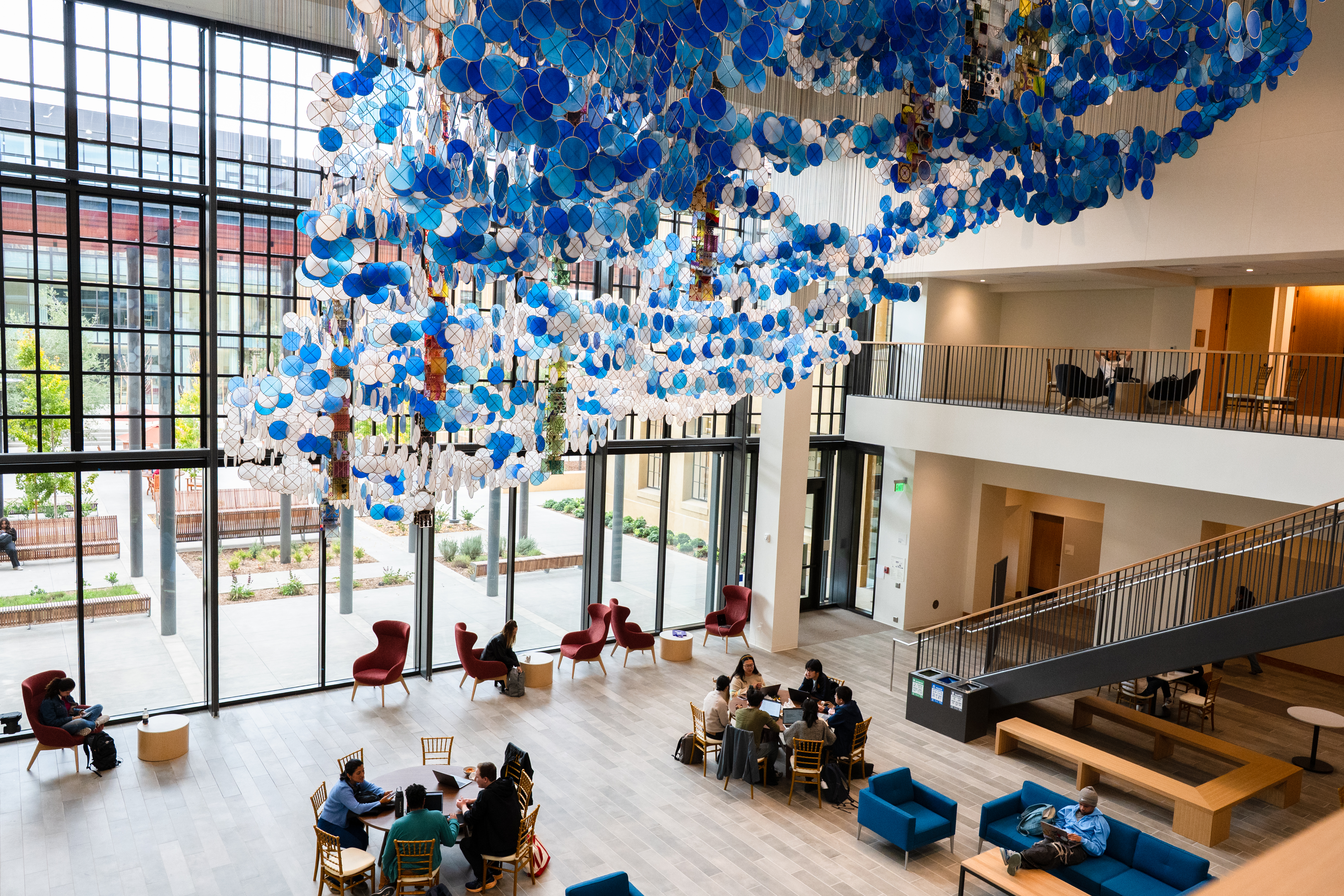
Graduate School of Education (GSE) Dean Dan Schwartz led celebrations for the commencement of classes Thursday, addressing students, faculty and administrators in the new, sunlight-filled campus.
“The possibilities brought forth in this new environment are really our interconnected opportunities to learn, create, grow, our possibilities to renew our passion and commitment to excellence,” Melissa Lewis, a fourth year Ph.D. in the developmental and psychological sciences program, said at the ceremony.
The buildings were designed by CAW Architects to bring in an abundance of natural light, with windows that span entire walls. The three buildings are connected by a 13,500 square foot courtyard that is home to the new Mary Bell Floyd Memorial Garden, an outdoor classroom and garden designed to be in-bloom year round. The garden is dedicated to Mary Bell Floyd, a former master’s student in education and former Stanford Hospital board member.
Adobe-beige walls and granulated red roofs juxtapose the new, sprawling windows. According to Schwartz, the buildings aim to integrate past and present.
“It reflects the GSE. We are grounded in the wisdom of the past, but we’re elevated by the boundless possibilities of the future,” Schwartz said.
The school also features an art installation, “The Gravity of the Sun,” which consists of a constellation of 6,500 white and blue kites strung up from the roof. According to Jacob Hashimoto, they represent play and possibility and a mix of culture, history and creativity in education.
“The faculty are inspired and present, and the students are electric. People are waving and shouting ‘hello’ at each other across the court. This just didn’t happen before,” University president Jonathan Levin ’94 said.
Education was one of the founding departments of Stanford when the University opened its doors in 1891. The original GSE campus first opened in 1938 at Lasuen Mall, using a modest gift of $7 million in current dollars.
Eighty-seven years after the original campus was opened and 15 years after the renovation process was initiated, the new GSE building filled the need to combine modern research with collaborative approaches, Schwartz said.
“A lot of the interdisciplinary depends on seeing the same person a couple of times. And then, the conversations get deeper and deeper. And in the old building, it was really impossible to see anybody the way it was designed,” Schwartz said.
Schwartz outlined the differences of the new campus in his address. There are over 25 conference rooms, four wellness rooms, dedicated research spaces, additional spaces for experimental teaching, a maker’s space that is open to students, an artificial intelligence (AI) maker space for educators, reconfigurable classrooms with built-in video conferencing and more.
The AI Tinkery — the GSE’s maker’s space — is different from other makeries on campus. Students do not need any specific qualifications to enter, and the space also serves as an interactive makery where guests can explore different uses of AI in the classroom, learn how to use an AI chatbot and ask ethics questions.
According to Schwartz, school districts, universities and even other countries have asked for an AI maker space kit they can replicate based on the GSE’s model.
“As we dedicate these buildings today, accepting them into Stanford, I’m also thinking about the dedication we all have to education, and the responsibility we have for the Stanford Graduate School of Education to use the possibilities that these spaces grant us,” Schwartz said.