
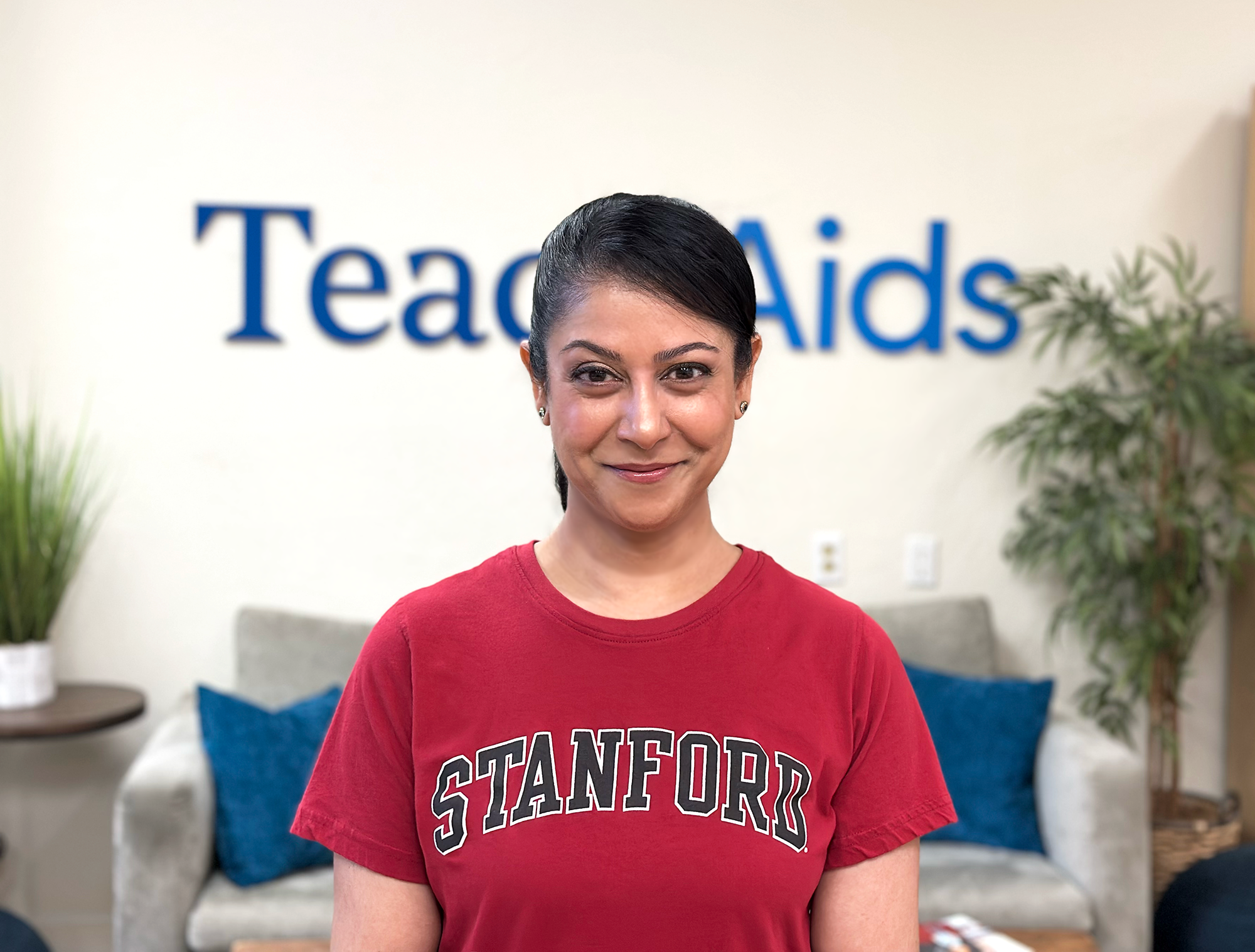
TeachAids, an award-winning health education nonprofit founded by Piya Sorcar M.A. ’06 Ph.D. ’09, Clifford Nass, Shuman Ghosemajumder and Ashwini Doshi M.S. ’06, has worked with the Stanford Program on International and Cross-Cultural Education (SPICE) for the last 15 years. Through the collaboration, the nonprofit has been able to create educational videos and materials about HIV/AIDS transmission that respect cultural norms and taboos on a global scale.
As a graduate student, Sorcar, the CEO of TeachAids, was “very interested in thinking about how to present information on HIV transmission against the backdrop of hesitant national governments around the world that weren’t willing to present useful information,” said Randall Stafford, a physician and professor of medicine at Stanford Medicine.
Sorcar’s graduate research, which went on to become TeachAids in 2009, attempted to present information on the sexual transmission of HIV in a way that was “nuanced, and not likely to raise people’s concerns about propriety and politeness,” Stafford said.
In a speech presented at a 2015 symposium at Stanford, Sorcar highlighted the difficulties of providing clear education regarding HIV/AIDS that meets learners at their comfort level. As an example, she pointed out how bans and restrictions on sexual education in certain parts of India led to “watered down” instruction — if any — on HIV/AIDS.
“Although hundreds of millions of dollars were pulled into HIV-related campaigns around the world, it did not necessarily mean that people were learning,” said Sorcar.
Hence, rather than simply spreading awareness, Sorcar took another approach, creating a series of animated shorts adapted for cultural norms that maximized both learner and educator comfort. For example, in India, Sorcar took inspiration from Bollywood films for her short animations.
Though seeing a cartoon of two people kissing would have made learners uncomfortable, showing two people getting close to each other before panning up at two birds kissing — a trope common in Bollywood movies — was effective at conveying the same message.
Even before graduating with her Ph.D. from Stanford, Sorcar’s pilot educational animated shorts had already been used in five countries. Since then, the nonprofit’s educational material has reached over half a billion young people across the globe.
Though Stanford waived the rights to Sorcar’s work following her graduation, collaboration with both Stanford and hundreds of other institutions, governments and other organizations has enabled TeachAids to have the global impact it does today.
SPICE, founded in 1976, is part of the Freeman Spogli Institute (FSI) for International Studies. Funded by FSI, private and government foundations and private donors, SPICE bridges Stanford with K-12 schools and community colleges by “developing multidisciplinary curricular materials on international topics,” according to their website.
SPICE has collaborated with TeachAids to distribute its materials and help schools around the world use them effectively.
“Partnerships like those between TeachAids and SPICE that bring together people from different backgrounds are essential because they allow us to see challenges through multiple lenses,” said Sorcar.
In the eyes of Doug Owens ’78 M.S. ’91, a professor of health policy who met Sorcar as a Ph.D. student and has served as her advisor since, at the heart of TeachAids lies a multidisciplinary approach. With expertise spanning the School of Education, the School of Medicine and more, TeachAids is an “amazing example of the impact that training [at Stanford]” has, said Owens.