
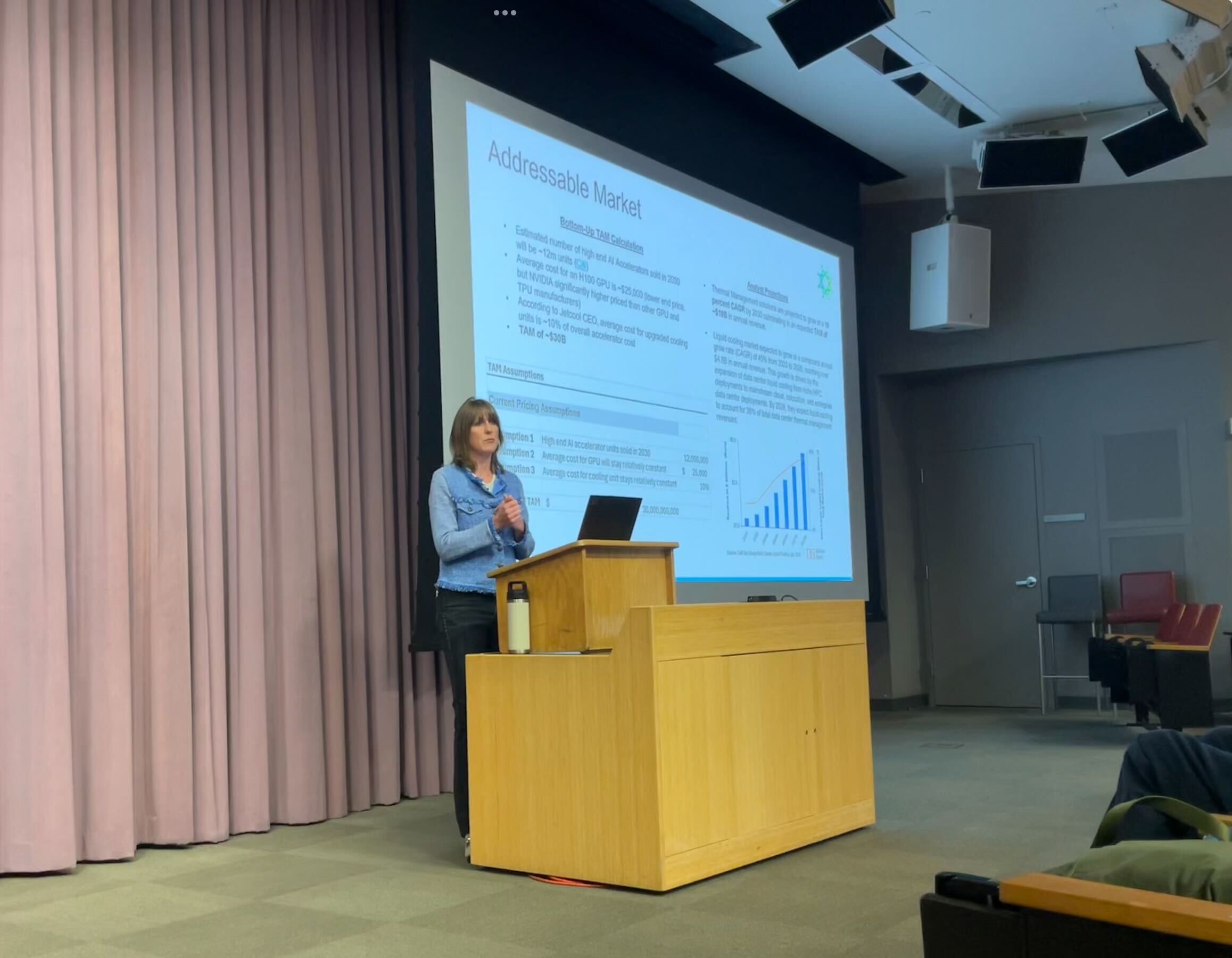
Libby Wayman, a partner at Breakthrough Energy Ventures, said the accelerating electricity demands of artificial intelligence are one of the most consequential challenges facing the global clean energy transition at the Stanford Energy Seminar on Monday.
Breakthrough Energy Ventures, founded by Bill Gates in 2015, invests in transformative technologies aimed at dramatically reducing greenhouse gas emissions. Drawing on her experiences at General Electric (GE), the Department of Energy and in climate-oriented venture investing, Wayman traced the rapid escalation of data center power needs and explained why electricity demand from AI is poised to reshape national energy planning, grid investment and climate innovation.
Wayman opened with a visual showing that U.S. electricity consumption remained almost perfectly flat for decades. Only in the past several years has demand begun to rise, a trend Wayman attributes largely to the construction of data centers.
While data centers currently make up around 4-5% of U.S. electricity consumption, Wayman explained that today’s estimates fail to capture the exponential nature of compute demand. Citing projections from Lawrence Berkeley National Lab, she noted that electricity use from data centers could exceed half a gigaton of emissions by 2030 and potentially reach 2-3 gigatons by 2050 if powered largely by the grid.
Total emissions in the United States from data center electricity usage were approximately 0.07 gigatons in 2023.
“Small changes initially really do add up to massive, massive impacts over time,” Wayman said. She noted that 2020 represented a key inflection point when, for the first time, compute workload overtook compute efficiency and demand for energy scaled rapidly. As a result, data centers began announcing projects at gigawatt scale, creating large and sometimes intermittent power loads that strain grid infrastructure and raise energy prices. Wayman cited recent findings from Carnegie Mellon University that data center growth is already increasing grid emissions and electricity costs across the United States.
For many students, Wayman’s talk expanded the conversation to consider energy use beyond AI. “It was interesting how Libby expanded the discussion beyond data centers to think about the electricity needs of other sectors of the economy,” Banks Vadeboncoeur ’29 said. Wayman noted that the electricity demand from electric vehicles is expected to surpass that of data centers before 2035, meaning that many of today’s AI-driven power challenges preview what is coming for transportation, manufacturing and other sectors as electrification accelerates.
Throughout the talk, Wayman emphasized that these challenges also create opportunities for technological advancement. She outlined numerous technologies, including power solutions, cooling, networking and compute architecture, that could “bend the curve” or, in other words, “do more with the power that we have,” Wayman said.
Wayman’s perspective as an investor offered an additional layer of insight for students. “As someone interested in pursuing a career in investing, it was great to hear how a real investor thinks about emerging technologies and how they measure what they will look like in the long-term,” said Paige Swid ’28.
Wayman concluded by encouraging students to view the present energy challenges not as obstacles, but as opportunities for innovation. She mentioned the Climate & Energy Ventures course she teaches at MIT, a class that has produced more than 60 companies that have raised billions of dollars in investment. Many of those founders, she noted, return to share their stories with new students each year.
“We can’t wait for more and more successful case studies to be out in the world for other entrepreneurs to learn from because we need all the smart minds and brilliant ideas that we can get to solve these tough problems,” Wayman said.
Management science and engineering professor John Weyant, who is also the director of the Energy Modeling Forum, praised the depth and precision of Wayman’s analysis. “You organized an incredible amount of information that was both comprehensive and systematically put together,” he told Wayman. “I don’t remember seeing a talk like that.”
For the audience, Wayman’s insights reframed AI not merely as a technological phenomenon, but as a crucial part of the energy sector–one that will define the next several decades of investment, policy and innovation. Wayman’s message was clear: the race to build AI is inseparable from the race to power it.
Correction: A previous version of this article misattributed one of Wayman’s quotes. The Daily regrets this error.