
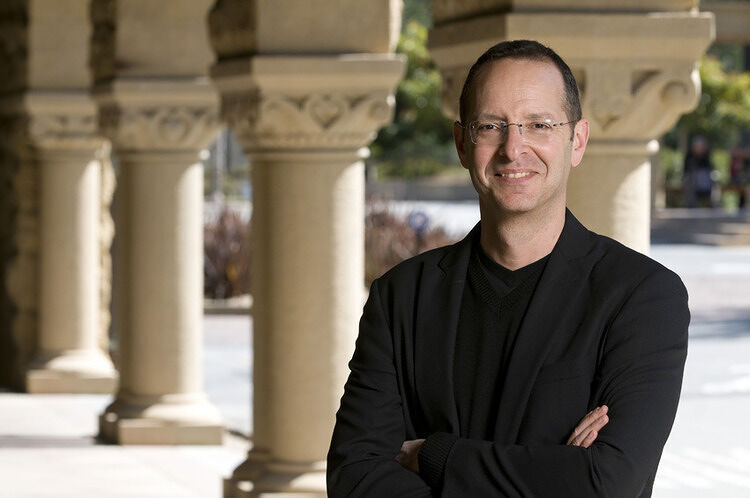
Within a matter of minutes, I feel the relativity of time work its wonder: it stops and slows as I’m submerged into another world of thinking. Thoughts tucked tightly into the crevices of my mind converge into consciousness. For 80 minutes, Amir Eshel, professor of humanistic studies and comparative literature, captivates the attention of 80-plus students during his guest lecture. The distance between theory and practice, student and student, collapses.
Without a PowerPoint or laptop in sight, our classroom is guided through a meditative reflection on Elizabeth Bishop’s poem, “The Moose.” I’m in the now, completely, looking down at my notebook only to copy quotes that I know I won’t be able to forgive myself for forgetting. One is circled in bright red: “If we treat literature as something about, we kill it.” I need to know if this is true of the human experience, too.
Walking out of class, questions continue to percolate. Themes of resonance, acceleration and alienation swarm in my mind — I need to know more. I email him as soon as I get back to my dorm, requesting another 30 minutes of his time.
The following week, as I enter his office, he welcomes me with a warm smile and gestures to the chair across from his wooden coffee table. I think about the decades of wisdom stored within his mind, and marvel at his offering to spend time entertaining my wonderings. I have several questions prepared, but the interview takes on its own character, forged naturally by his thoughtful contemplations. What emerges is a kind of, as Eshel coins, “poetic thinking.”
I’m eager to ask the question that brings me here. “If we treat literature as something about, we kill it,” his quote reads. I ask him if this is true of life itself.
Eshel says this in the context of explaining his research on literature as an event, rather than something to be mined purely for understanding, as something strictly “about.” When we appreciate a piece of literature, we are experiencing something framed by our personal histories, pouring itself onto the canvas of how we relate to the present piece of literature, the present moment.
In response, Eshel references Hartmut Rosa’s theory of Resonance. He explains that we exhaust ourselves of the experience of literature and life when we fail to appreciate the moments, which are ever present in our most mundane, human experiences. He acknowledges that this is especially challenging to appreciate in a collegiate ecosystem like Stanford, where excellence and striving is prized with a heightened sense of urgency.
“I’ll start with an image,” he explains. “On El Camino across Town and Country, there’s a billboard with four Stanford students. And it’s accompanied by a slogan, ‘only here.’ So what does that mean? Nowhere else? What happens across the street? Across the world?” This pressure is palpable and takes us away from the ability to appreciate the present moment, not just the exceptional ones. This billboard is an art form itself, and Eshel portrays the power of something as seemingly innocuous as the one that greets us at the entrance of Palm Drive.
Resonance, then, offers an alternative way of being. As Eshel says, “We humans have the capacity to experience something like resonance: when things in the world, other people, touch us in meaningful ways.” Resonance cannot be artificially produced. Instead, it simply emerges as we respond on our own, transforming it into something that brings us meaning. We must create the time and the space to allow for resonance to emerge naturally, like the Moose which “disrupts” the travelers in Bishop’s poem.
Resonance asks us to pay attention, to ask questions.
Eshel emphasizes that when we ask, “What is the meaning of life?” we “leave our lives behind and go into the domain of abstractions.” Instead, he asks us to consider, “Where do I feel a sense of belonging, a sense of being grounded or anchored?” In paying attention to those moments, we are better able to pursue meaning in our own lives.
This is particularly valuable in our age of acceleration, which “leaves us impoverished, as everything solid melts and we feel completely lonely.” Eshel affirms the value of technological advancement while simultaneously presenting the consequences if we fail to proceed with caution. When we commit ourselves to the logic of acceleration, “the world becomes just mute to us. It becomes ever distant to us. We don’t see trees or other human beings. We don’t see pain and suffering.” If we are unable to slow down, the world will become sapped of the beautiful, and often bruised, texture which makes it so valuable in the first place.
I ask him if he feels he experiences resonance more deeply or deliberately because of his studies, and I’m struck by his humility. “I’m describing my struggle,” Eshel acknowledges. “The only difference between me and all these other people is that I’m working on myself to cultivate the other part of me.”
The dialogue we share is a practice in poetic thinking, which Eshel describes as “thinking that is not committed to a certain goal, a certain cure, a certain solution. Thinking that is open, exploratory, experiential and not goal-oriented.” While he affirms the value of scientific thinking, he draws attention to the value of endowing our lives with meaning through “other ways of thinking that allow us to live as individuals and as communities in a more meaningful, richer, way.” The humanities are not just a way of learning, they are a way of being.
While most of our conversation will live with me, I resonate most with his response to my last question, “What makes us human?”
He responds, “The dual ability to experience joy and pain. And when I say to experience, I mean in a conscious manner: to develop a language for joy and pain. And not just verbal, but artistic. We humans have this capacity to experience in a very embodied manner, not just for ourselves but for others. We are that kind of creature that can sense not only one’s own joy, but also someone else’s joy. Not necessarily a human being, but an animal. And the same thing with pain.”
What Eshel remembers from our conversation, what I remember from our conversation, and what you will remember from reading this article, they will all differ.
I hope it rings with resonance.