
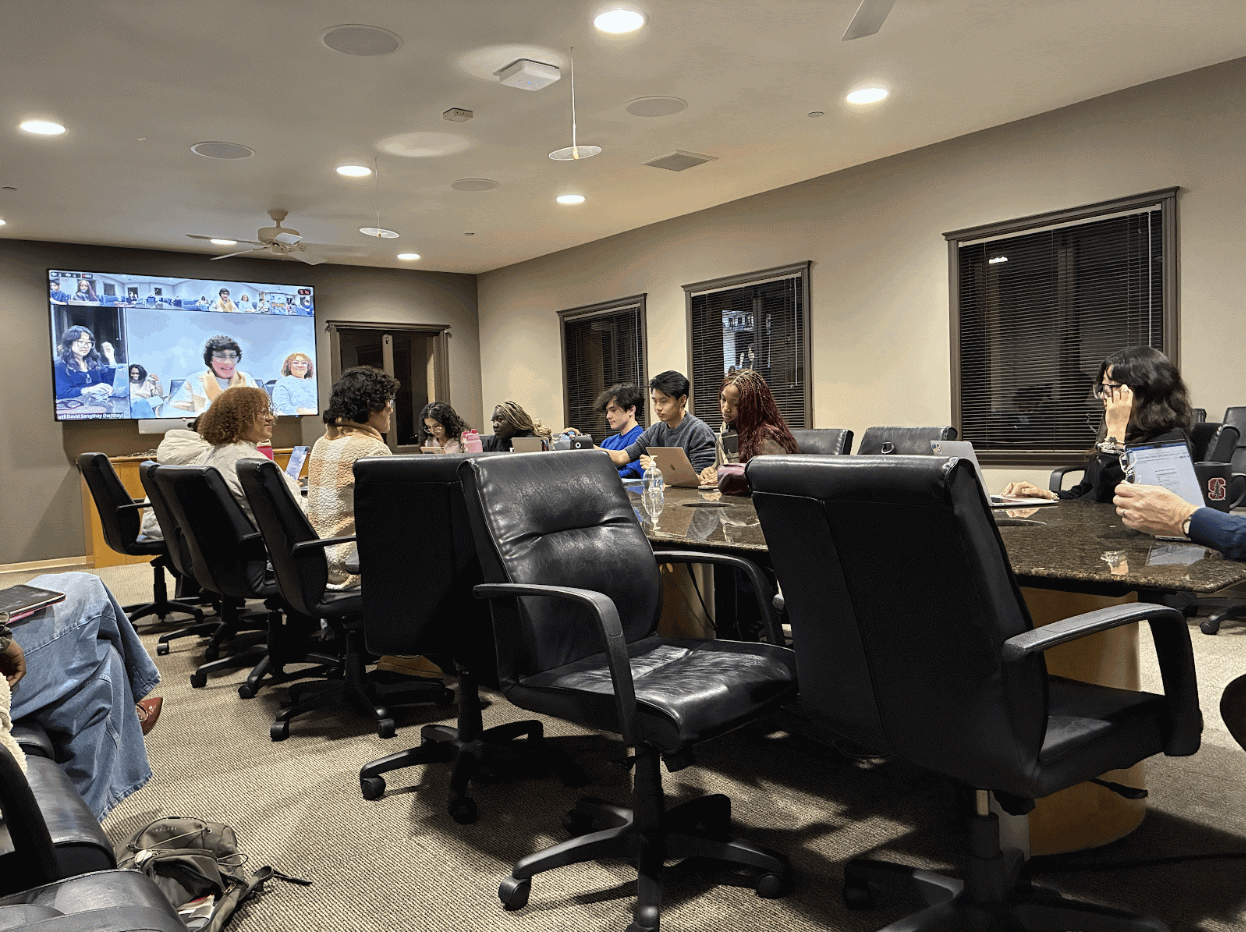
At its Wednesday meeting, the Undergraduate Senate (UGS) heard a presentation from Stanford Education and Democracy United (EDU) on the recent removal of student speakers from Stanford’s department commencement ceremonies.
This policy change was announced in an email to department heads, according to the presenters. The only public mention of the University’s policy change is in an op-ed from the American Association of University Professors published in The Daily in November.
EDU founder Turner Van Slyke ’28 said in the presentation that Stanford hasn’t publicly explained why they removed student speakers, but that many students and families had complained about pro-Palestine statements at departmental commencements last year. Van Slyke called the statements a “pointed piece of political speech,” but “not unique from other pieces of political speech.”
Van Slyke added that he believes the school’s decision to remove student speakers reflects their desire to minimize public pressure or other disruptions, demonstrating a climate of fear due to the federal government’s recent involvement in higher education.
“We believe that no student at Stanford deserves to feel harassed or unsafe; however, we also believe that disagreement is not violence, and political speech does not equal harassment,” Owen Rowe ’28, another EDU presenter, said during the meeting.
Rowe said that the blanket ban on student speakers is a much more stringent measure than other schools have taken towards student speech during commencements, citing examples at New York University (NYU) and Massachusetts Institute of Technology (MIT) where issues were addressed case-by-case and after speeches were made. Rowe also noted that Stanford already has existing policies against incitement, harassment and disruption at commencement ceremonies, which EDU believes are sufficient.
“It sends a troubling message about whose voices Stanford values and how students should be able to shape the future of our school,” Van Slyke said. He added that he believes that the reinstatement of student speakers is important to reaffirm academic freedom and to maintain trust between the administration and the student body.
“Commencement is for students – it’s a reflection of the achievements and experiences that students have gone through during their years at Stanford, so it only makes sense that students can speak on those experiences that comprise their time at this institution,” EDU presenter Georgia Allen ’28 said.
The Daily has reached out to the University for comment.
Following this presentation, the UGS introduced a bill calling for the reinstatement of student speakers, which will be voted on by the UGS at next week’s meeting.
The UGS also unanimously passed the Joint Resolution Calling for the Reinstatement of the ZAP RA and Immediate Action to Address Student Leader Staffing Vacancies. This bill calls for the reinstatement of former Zeta Alpha Phi (ZAP) RA, Emmanuel Angel Corona-Moreno ’26, who was fired for missing training while positive for COVID-19, as well as a public report from ResEd on RA vacancies and updates on RA employment practices.
Dawn Ariel Royster ’26, an RA for Branner Hall and a former contributor to The Daily, said that there may be a number of changes to the RA system next year, namely a decrease in the length of RA training to a week and a significant decrease in the number of RAs.
“In FloMo specifically, they’re going from 14 to nine [RAs],” Royster said.
This bill has already been passed unanimously by the Graduate Student Council (GSC).
The UGS also introduced the Joint Bill to Recommend a Nominee to Serve on the Board of Conduct Affairs (BCA).
This bill would recommend Tom Liu, sixth-year physics Ph.D. student and GSC member, to serve on the BCA, which oversees the Office of Community Standards (OCS) and helps interpret Stanford’s Honor Code. Liu has previously called for OCS reform; he was one of the authors on a bill which stated that the UGS and the GSC would only continue to collaborate with the OCS and BCA if meaningful progress towards OCS reform was made this year.