
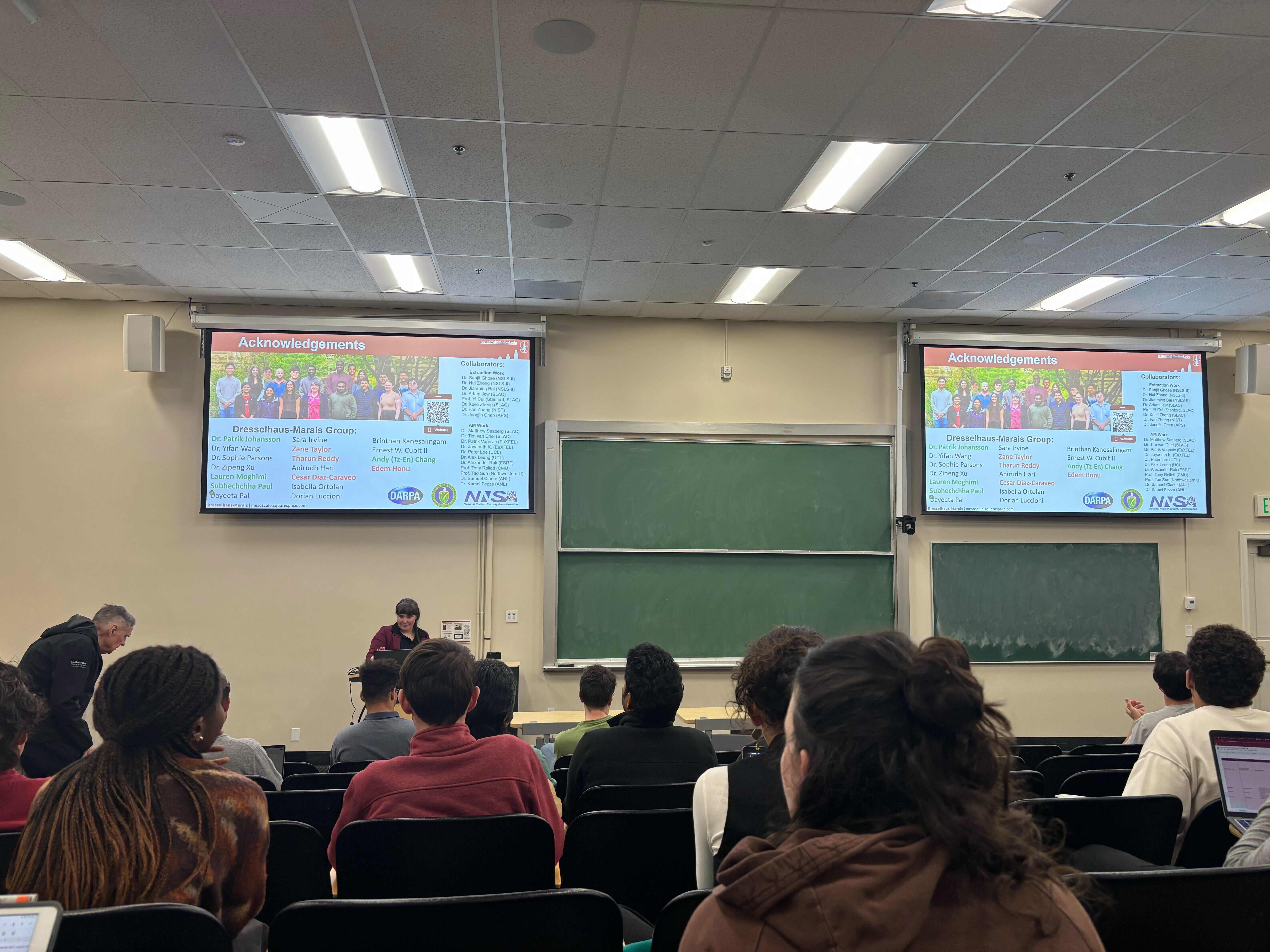
A Stanford Energy Seminar held on Jan. 12 examined one of the most carbon-intensive yet essential sectors of the global economy: metals. In the talk, Leora E. Dresselhaus-Marais, assistant professor of materials science and engineering, explained how scientific innovation could help reduce emissions across metals supply chains, from extraction to manufacturing.
The seminar comes as part of the Stanford Energy Seminar series, a program of the Precourt Institute for Energy that has brought energy-focused discussions to campus for nearly 20 years. According to John Weyant, professor of energy science engineering and advisor of the seminar course, metals production presents a particularly difficult decarbonization challenge.
“The metals industries are based on technologies that are about 100 years old and are very energy and carbon intensive,” Weyant said. He added that analysts consistently rank metals supply chains among the hardest to decarbonize, alongside long-range aviation and chemical production.
In the seminar talk, Dresselhaus-Marais focused on connecting fundamental materials science to real world engineering constraints. Metals such as steel remain foundational to modern society, supporting construction, transportation and manufacturing worldwide, yet their environmental impacts often go unnoticed, Dresselhaus-Marais said.
“Steelmaking accounts for 8% of the carbon dioxide that we emit globally, across every single industry,” Dresselhaus-Marais said.
Producing one kilogram of steel emits approximately 2.2 kilograms of carbon dioxide, with ironmaking responsible for the majority of those emissions.
About 73% of global crude steel is produced using basic oxygen steelmaking, a decades-old, carbon intensive process. Recycling and alternative sustainable steel production methods make up only a small portion of market share. According to Dresselhaus-Marais, transforming these systems is constrained by cost, risk and time.
“What we all [would] love is carbon-zero,” Dresselhaus-Marais said, noting that a full transition to sustainable steel production could take many decades. “No one solution is actually enough for the urgent timescale of climate change.”
To address these challenges, Dresselhaus-Marais described multiple research solutions that her team is pursuing, such as employing artificial intelligence to connect fundamental materials science to more sustainable metals manufacturing. By studying microstructural dynamics in real time, her group examines how dislocation motion, the movement of tiny defects in the metal’s atomic structure, and mass transport, the flow of atoms through the materials, influence the strength, durability and failure of metals under different conditions.
These insights can inform strategies to reduce emissions in steelmaking and improve metal 3D printing, enabling lighter, stronger components that reduce energy use across industrial and transportation systems.
For some students, the talk resonated directly with their own research. Kristen Ables, a fourth-year chemical engineering Ph.D. candidate, attended the seminar because of its overlap with her work.
“I’m a grad student working in an adjacent field, on metal extraction from wastewater, and it was interesting to hear Leora’s work on sustainable metal extraction,” Ables said.
Ables was particularly interested in Dresselhaus-Marais’ discussion of rare earth element extraction.
“I was really interested and excited to hear about her most recent project on the one step rare earth element extraction process,” she said, adding that she plans to learn more by following up after the talk.
A previous version of this article incorrectly named John Weyant as James Weyant. The Daily regrets this error.