
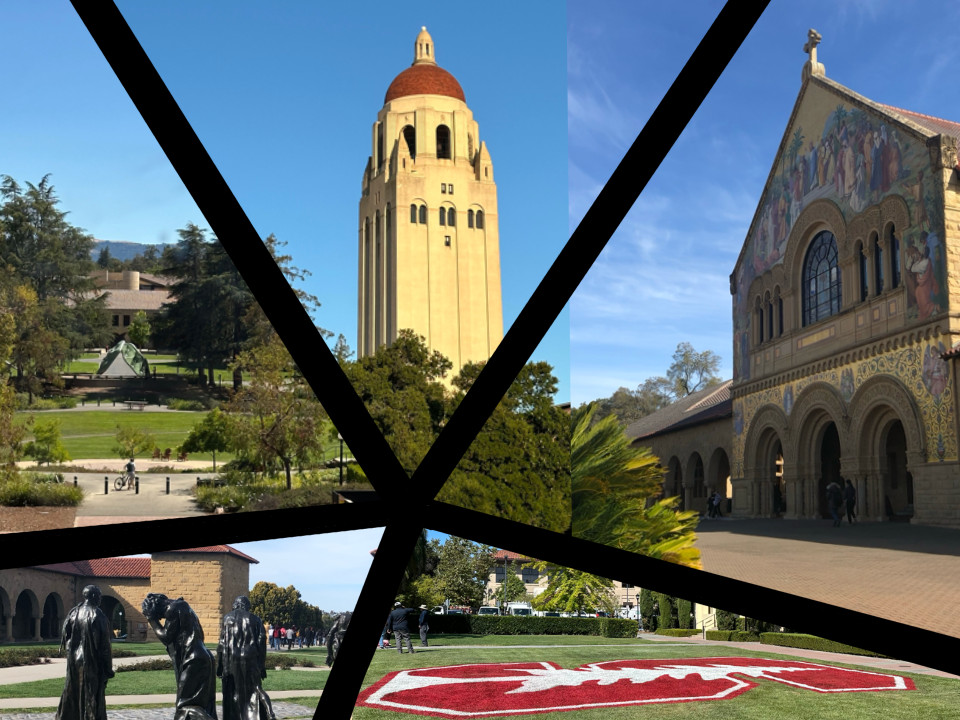
In his column “Ache of Home,” Xu ’29 explores the search for belonging in the context of a lifetime at Stanford.
I always knew that college would be different.
There would be no more shrimp and celery sautéed in a sea green ceramic pot, no Thursday family dinners to accompany it. The wispy wool flooring and once-spacious confines of my individual bedroom would be replaced by two rooms, two roommates and not nearly enough room to set a backpack down. Neither the heater nor air conditioning would turn on when they needed to, but would instead flare up in great fits of anger at the most inopportune times.
Far and away the greatest change, however, has been just how quickly one particular concept has pervaded my life. It is a concept that has hitched its wagons to every industry and every academic discipline, flying its great banners on video advertisements and cautionary course syllabi alike. It is a concept that is still slumbers, dormant in potential yet already reshaping the digital and physical landscapes as we know them in irrevocable ways. It is a concept that makes weary many a historian, and leaves the quantum physicist floating in a world of designed possibility. It has already taken on a bloated reputation brought by the investment of the venture-capital vultures, and has so much promise that its very name circles infinitely between get-rich-quick grifts and the glimmer of a potential technological revolution to come.
I am, of course, talking about artificial intelligence.
AI is the singular dominant cultural phenomenon on this campus. Dining halls are filled with conversations about high demand “Artificial Intelligence and Accounting Information” course or AI in Law talk that so-and-so professor is giving at the law school, aspiring investment bankers and marine biologists speak of “deriving market patterns through machine learning” and “using self-governed models to graph coral reef extinction trends.” The dwindling body of pure, human research that does exist is buried in a flood of emails about AI ethics and AI engineering and the effect of AI on healthcare, or why my new machine learning startup is different from all the others. I myself have not been immune to the change — I came in a political science major, and now spend my time at Green thinking about C++ and Turing machines.
Indeed, one quickly finds that AI isn’t so much a dominant topic of discourse as it is a national religion. Back in November, I was grabbing coffee with a friend when I broached the possibility that the AI craze had gone too far. He let out a little giggle, the sound you make when a toddler blames the missing cookies on the family cat. The religious have always possessed and employed their faith in defense of their gods; Stanford approximates a rough equivalent in defense of artificial intelligence. AI is the default: to succeed at Stanford, one must rise above the capacity for learning, and prove that their skills cannot simply be replicated with any generic large language models.
It is almost never a question, in contrast, whether we should be dealing into the culture of AI at all.
To be clear: ChatGPT, Claude and the host of others do not mark the end of mankind as we know. AI can map climate change and deforestation, automate logistics and aggregate data from thousands of sources, and has shown potential for early cancer detection — oftentimes with far greater accuracy and efficiency than humans ever could. On a deeper level, the accessibility of LLMs has forced many schools, Stanford included, to reckon with its educational and humanist priorities. As University administrations love to emphasize: if the machines are to replace so many of our current skills, then it is more important than ever for us to determine what is unique, what is valuable about being human.
What frustrates me about artificial intelligence is inextricably tied to this last question. There is this sense that the revolution is inevitable, that it is already here, that it will inevitably shape our relationships with the world and for each other for generations to come. We lie complacent as the next wave of ever-more sophisticated LLMs and machine-learning models are developed outside our doorstep, carefully tiptoeing around the possibility that our golden goose is poisoning the well from which we all drink. Stanford professors repurpose midterm papers into exams and presentations, considering and calculating the types of assessments least vulnerable to generative AI; students find ways to sneak AI in nonetheless, and treat their own models as the basis for startups or research projects. The University, despite arguably being the world’s leading academic institution on AI as a whole, has deferred responsibility onto individual instructors.
This past April, I interviewed former Surgeon General Vivek Murthy about social media and the American loneliness epidemic. Among his many recommendations, Murthy suggested physically separating yourself from technology. “Another way of drawing these boundaries is to say, ‘Okay, when I get together with friends, we’re all going to put our devices aside,’” he told me.
Murthy’s language is fundamentally the language of resistance. He does not suggest redefining relationships through social media group chats, or promoting social interaction through online entertainment; instead Murthy asks, Why can’t we stick to the old ways? That approach might just be heretical at Stanford, a place where innovation is king and technology runs through the lifeblood of the school. Stop yelling at the clouds, old man! is what some of you are probably thinking. But it is a valid point to make any time the ways we live begin to change. And artificial intelligence certainly qualifies. Why can’t we go back to having papers instead of tests? Why can’t we spend the extra thirty minutes to write Canvas posts? Why can’t we go back to a world that can function without AI? No matter how much technology has allowed us to accomplish, scientifically or culturally, I find it hard to argue that it has ultimately made us happier or more fulfilled.
“It is very easy to sit at the bar in, say, La Scala in Beverly Hills, or Ernie’s in San Francisco, and to share in the pervasive delusion that California is only five hours from New York by air. The truth is that La Scala and Ernie’s are only five hours from New York by air. California is somewhere else.” This is Joan Didion speaking, from her essay “Notes From a Native Daughter”. I first read these lines as I flew into SFO during Admit Weekend, dutifully copying them down into a personal notebook but never fully comprehending where that “somewhere else” could be. Nine months later, I think I might finally understand.
I always knew that college would be different, but I don’t think I could have expected this. Stanford has been a headlong rush into the future, a chapter echoing with the bellowing of the progress engine. It is a journey amidst a lush and sprawling campus with uncharted ideas lurking at every corner, entire warehouses stacked full of questions about people and AI and the blurry line between. Amidst it all, there is this overwhelming notion that the genie has been set free of its bottle, and that the best way forward is to bow down and nourish its glutton. The first part seems hard to dispute. The second part, I am not so sure about.