
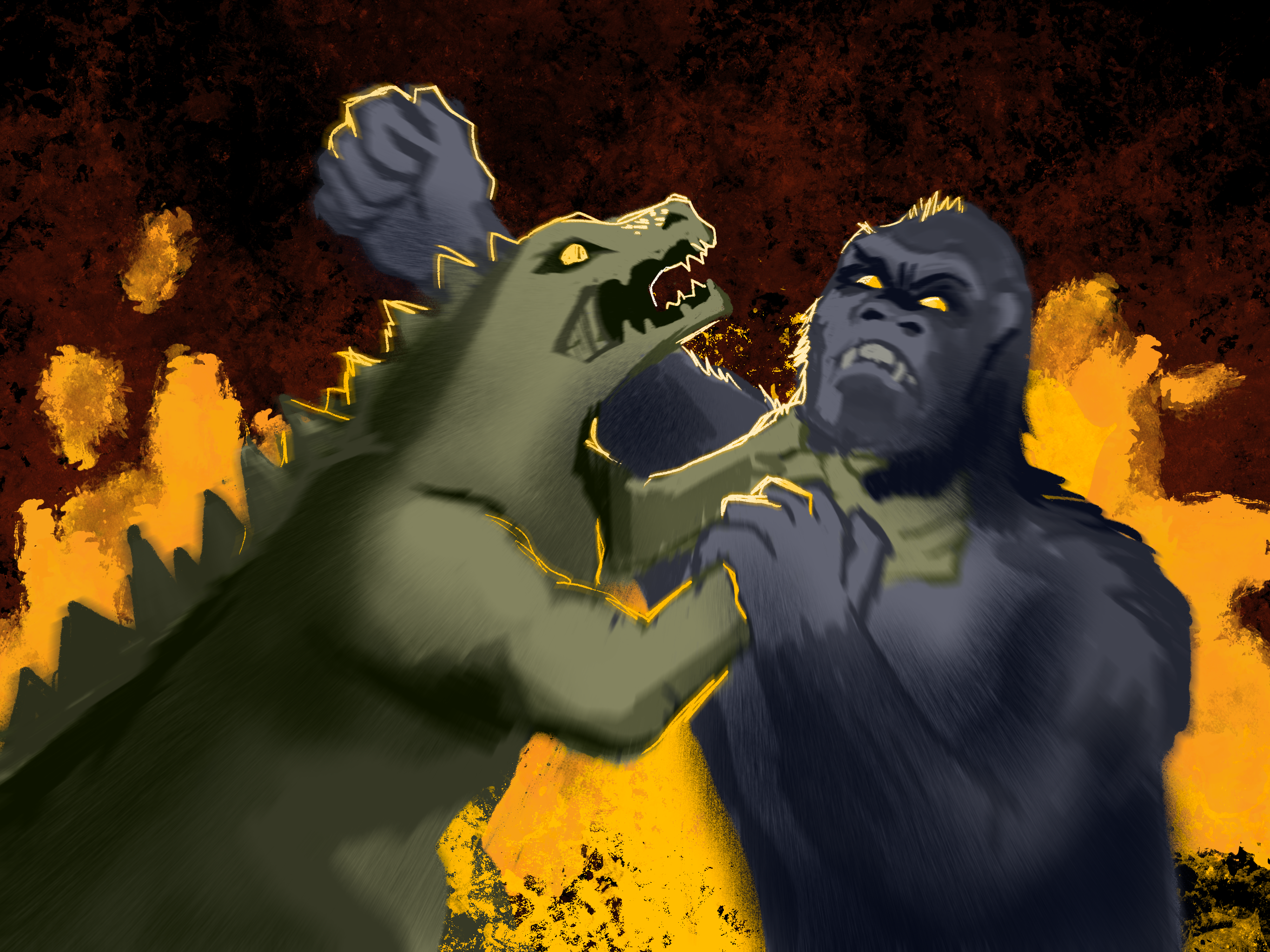
As much as I’ve been trying, I can’t get “Godzilla x Kong: The New Empire” (2024) out of my head.
It really shouldn’t be as memorable as it is. Unlike, say, a Tarantino flick, or something in the vein of an avant-garde European film, Adam Wingard’s “Godzilla x Kong” (2024) is cinema sculpted purely for entertainment. Even then, I never found myself wowed by the special effects (perhaps due to the impeccable quality of my JetBlue in-flight entertainment system) or clinging to my seat during a fight sequence. And yet, watching the movie was probably one of my most dopamine-inducing experiences of 2024.
Typical movie review decorum dictates that you summarize the plot of any movie being reviewed. For “Godzilla x Kong,” it’s hardly even necessary. Without even simplifying all that much, “Godzilla x Kong” is the story of a giant monkey and a radioactive lizard teaming up to fight an evil giant monkey and his mind-controlled, ice-breathing lizard. If this sounds like the type of movie you would watch at 10 instead of 20, you’re getting the point.
Scrolling through this movie’s reviews, it is fascinating to see just how often the word “spectacle” comes up. Critics on Rotten Tomatoes have panned the movie with a 54% critic average: one suggests watching only if interested in the “monster-mashing spectacle… because the movie doesn’t have much else to offer.”
Variety’s Owen Gleiberman, pitting “Godzilla x Kong” against the Oscar-winning “Godzilla Minus One” and its themes of nuclear violence, war and divine Tatari-gami, headlines his review as “A Godzilla Spectacle Minus One Thing: A Reason to Exist.”
The Guardian didn’t use the word “spectacle” explicitly, but Benjamin Lee’s characterization of the movie as a “breezy, forgettable monster sequel” rests largely in the same vein (admittedly, Lee’s criticism centered around the one-dimensionality of its human characters, a recurring pattern in American interpretations of the Monsterverse).
However, Wingardhas never seemed too bothered by the remarks.
“These movies are always about taking things that are relatable and then scaling them up,” he told the Los Angeles Times. “You’re looking for those things [that] would be fun to see on this wildly big scale that we’ve never seen [before].”
Wingard — the godfather of the American Monsterverse, a shared multimedia franchise in which all Godzilla and King Kong movies reside — revealed how a near-fatal incident with a red light-running car gave him new appreciation for his own mortality as a director. Faced with the possibility that he might never make another film, he decided to go all out in spectacle.
Audiences, for their part, seem to side with Wingard. In contrast to that 54% critic Tomatometer, “Godzilla x Kong” stands just shy of a 90% audience Popcornmeter. These reviews reveal a totally different perspective.
“You’ll never make me hate these movies and I don’t care if he starts talking in the next one,” wrote one audience member, who gave the film a five-star review.
“The greatest movie of all time! Undeniably!” another five-starrer wrote.
All of this support ultimately resulted in a $572 million world-wide gross, making “Godzilla x Kong” the 8th highest-grossing movie of 2024, placing its name next to Hollywood hits like “Kung Fu Panda 4” (2024) and “Dune: Part 2” (2024).
“G x K” is an archetypal anomaly, the type of film that sparks Substack articles and YouTube essays about the role of critics in cinema. It doesn’t help that compared to its contemporaries — the aforementioned “Kung Fu Panda” and “Dune,” as well as the A24 staple “Civil War” (2024) — this film was never about telling a story. It is a movie where the events, and more specifically the battles, are guaranteed. Everything else, from the plot to the “uninteresting” human characters, serve to get us there. Gleiberman’s comparisons to superhero movies aren’t quite accurate: Wingard was not drawing from a universe of preexisting material, and his movie stripped away the shallow thematic meaning of Marvel and DC films in favor of an all-out brawlfest.
Yet no matter how little attention it receives from the pundits, or the disproportionately few accolades and nominations it has received relative to its commercial success, “G x K” has stood proud. Its audience-critic disconnect is why the film endures. Wingard’s film doesn’t try to wrap itself up in some neat moral blanket; it doesn’t try to push a moral or historical agenda. You might argue that “Godzilla x Kong,” like “Godzilla Minus One,” has some sort of moral responsibility towards its audience, that it could stand to address similar themes of divinity and violence. And that’s true — but only if you consider the left part of its name.
In 1933, Merian C. Cooper directed and produced the original “King Kong.” It came at the heels of an explorer trip Cooper embarked on, a trip where he produced “natural dramas,” documentary footage of real people and real animals in exotic locations edited together to produce a piece of fiction. In this way, “King Kong” films have always been about entertainment. From the beginning, they hinged upon taking the very real lizards and monkeys of this world and turning them into larger-than-life creatures of enormous power.
As for “Godzilla”? While Wingard acknowledged the value of Godzilla as a metaphor for nuclear destruction, his vision for the character was a tad bit more optimistic. In his same interview with the Times, Wingard said, “The aim for me is to inspire future filmmakers, the kids who are going to watch this and see these monsters as characters. They’re going to understand what’s going on, and they’re going to have their own interfacing of their imagination into it.”
Suddenly, Wingard’s intent as a filmmaker — whether it be enlarging the quotidian or interfacing imagination onto the big screen — doesn’t seem so absurd. “Godzilla x Kong,” then, is not only authentic in its messaging and enjoyment. It is also very much true to its historical and directorial selves.