
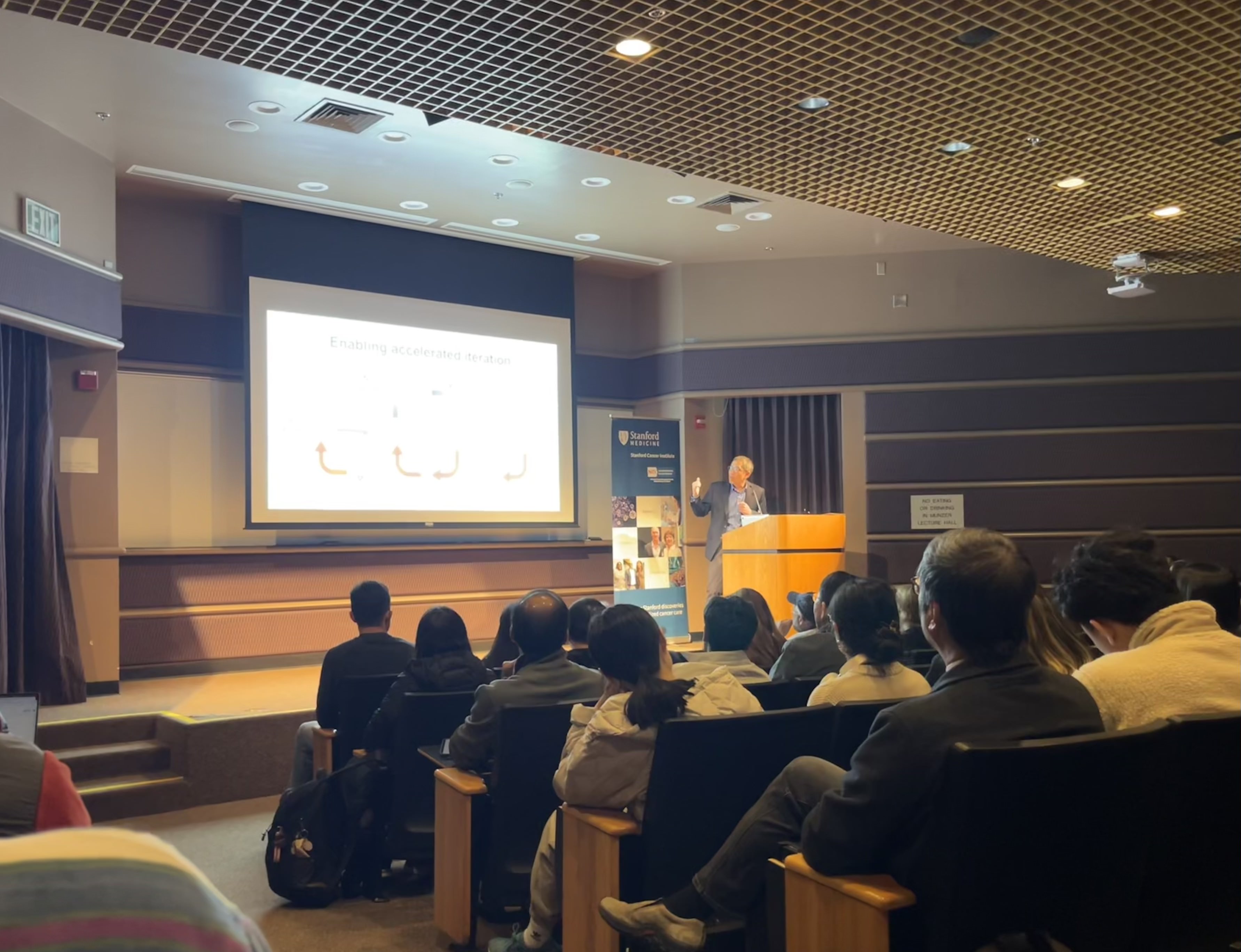
Lawrence Fong M.D. ’92, the scientific director of the Fred Hutch Cancer Center’s Immunotherapy Integrated Research Center (IIRC), discussed his lab’s latest innovations in cancer immunotherapy in a Jan. 13 presentation.
Fong’s presentation was part of the “Breakthroughs in Cancer” lecture series hosted by the Stanford Cancer Institute. The series highlights a different scientific advance each month in the realm of cancer research.
In his lab, Fong researches a variety of immunotherapeutic approaches to cancer treatment, including ways to enhance endogenous immunity — the body’s internal immune response — and redirect immune effectors, which target specific infected cells. Rather than studying the two approaches separately, Fong stressed the importance of investigating the link between them.
“[Enhancing endogenous immunity and redirecting immune effectors] are not mutually exclusive. It’s not like you need to pick one, and that’s what you’re going to do,” Fong said. “We need to think about ways that we can actually combine these modalities together.”
In the presentation, Fong discussed the role of checkpoint inhibitors (CPIs), a form of immunotherapy that blocks checkpoint proteins. Through tests on both CPI-sensitive and CPI-insensitive tumors, Fong concluded that CPIs seem to have a substantial impact on only a minority of patients.
“An antibody targeting one of these immune checkpoints, PD-1, basically has transformed oncology,” Fong said. “[However,] it’s still a minority of patients that derive a benefit with regards to these checkpoint inhibitions… there’s a lot of room for improvement if we can understand what those mechanisms of resistance are.”
In addition to testing the role of checkpoint inhibitors in human patients, Fong has developed mouse models to measure the effectiveness of CPIs by monitoring the level of myeloid cells.
“We inject a syngeneic mouse tumor model line, [then] we treat these mice with a hormonal therapy, which is degarelix,” Fong said. “And you can see that the tumors initially shrink, and then they go on to progress, not unlike castration resistant disease. And in fact, if we look at a single cell level, we can actually identify these SPP1 high myeloid cells [a type of immune cell], in this mouse model.”
In addition to myeloid cells, Fong’s research hones in on T-cells, a form of immune effectors. Fong discussed how sipuleucel-T, a cancer vaccine, results in T-cell exclusion.
“We saw these immune infiltrates, but… they were actually in a region that we call the tumor interface…We could not find those T-cells actually going into the tumors. And so now, this is a phenomenon that we call T‑cell exclusion,” Fong said.
Although the talk was geared toward oncology researchers, the event’s attendees came from all hospital departments. Gursimar Kohli, a life science research professional at Stanford Medicine’s Department of Dermatology, said she found the talk intriguing and comprehensible.
“I thought this talk was very good. I just graduated from undergrad, and I still understood all of it… very well-presented and easy to understand. He gave a good overview of what is going on,” Kohli said.
Kai Zheng, a marketing specialist for Stanford Cancer Institute, said he enjoys the diverse topics presented in the monthly seminars.
“It’s always a really cool opportunity to see researchers come together to collaborate in this way and get to share their research,” Zheng said.
Through constant collaboration and an environment that fosters innovation, Fong seeks to apply his research to make an immediate impact.
“What we’re hoping to accomplish is to be able to take our learnings in the clinic and then basically help guide the next generation but not wait 10 years to do that,” Fong said.