
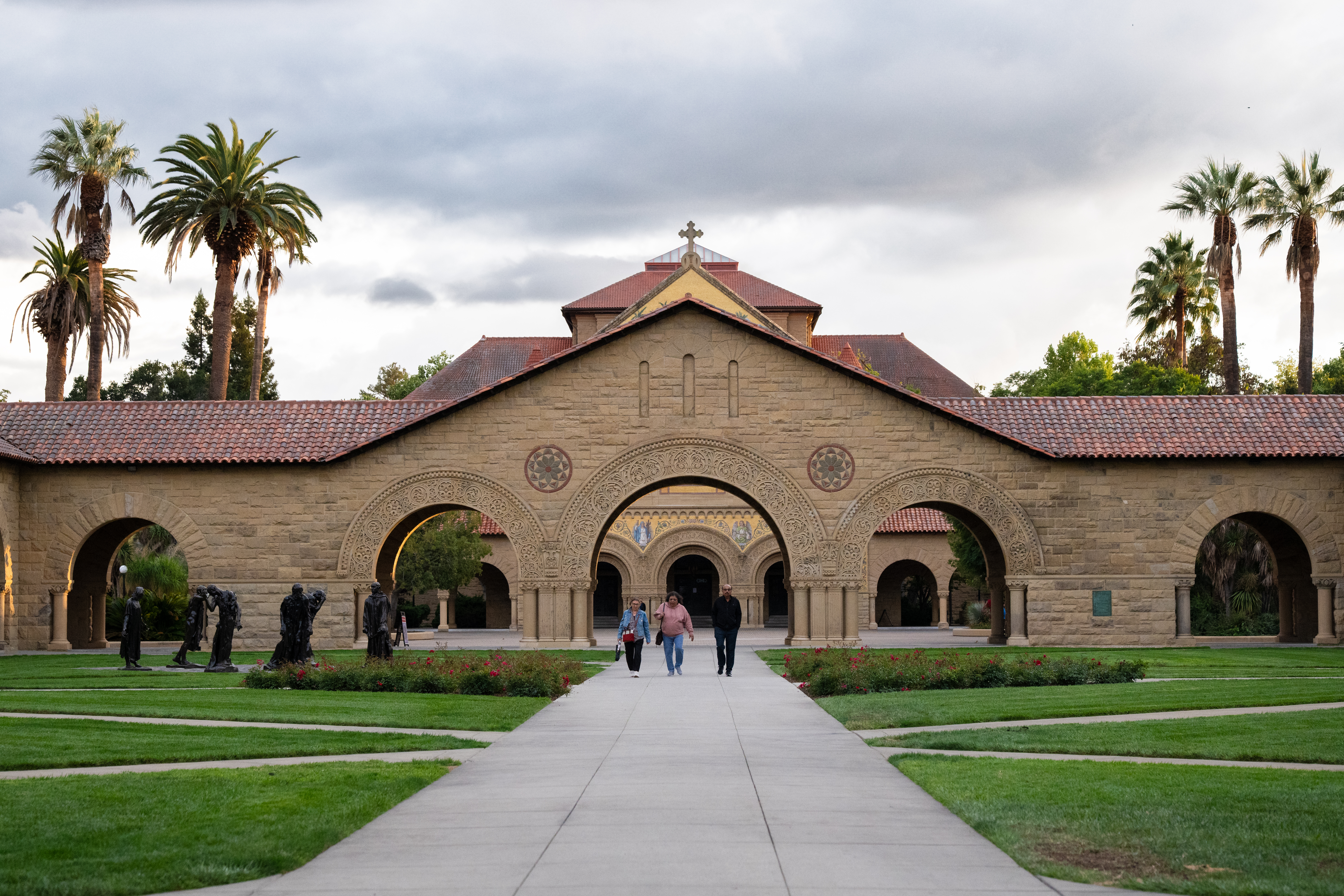
The University shut down the Office of the Vice Provost for Digital Education, also known as Stanford Digital Education (SDE), on Jan. 15 due to budget cuts.
Since 2021, SDE has coordinated efforts to provide online Stanford courses to a wider audience. “By uniting Stanford’s human and technological capabilities in novel ways we seek a more just, equitable and accessible system of education,” the SDE website read. Over its five years, the program reached 2,612 high school students in 103 schools in 22 states and Washington D.C., according to the website.
As a result of the shutdown, the University has indefinitely paused its collaboration with the National Education Opportunity Network (NEON) to offer Stanford courses in Title I high schools.
“The Stanford Digital Education (SDE) initiative was launched with start-up funding from the university and was not able to secure a source of long-term, sustainable funding. Given the budgetary constraints of last year, the university made the decision to focus its ongoing digital education initiatives in established programs with sustainable, long-term funding models,” Director of University Public Relations Charlene Gage wrote to The Daily.
Gage pointed to the Center for Global and Online Education (CGOE) and Stanford Continuing Studies as examples of programs that bring Stanford courses to a worldwide audience using long-term funding models.
NEON coordinated remote courses taught by Stanford professors to high school students in Title I schools, which are public schools that receive federal funds under the Elementary and Secondary Education Act (ESEA) to serve a high percentage of students from low income families.
Professors in the NEON program taught courses with a Stanford student teaching fellow, while a high school teacher supervised from the classroom. At the end of the course, the high school students received a Stanford transcript and grade. These courses received nationwide recognition in the Wall Street Journal and the Los Angeles Times.
NEON has offered to cover the costs of running the Stanford program, according to Leslie Cornfeld, CEO and founder of NEON, which is why she remains optimistic that its courses will resume. The Daily has reached out to the University for comment on this offer.
She believes Stanford is committed to public interest and that there is enthusiasm from the Stanford community about the program.
“Having Stanford in the building, in their school, meeting the professors, meeting the undergraduate teaching fellows showed scholars that [at] Stanford and schools like Stanford they were welcome,” she said.
Drew Endy, a bioengineering professor who taught a NEON course, called the Stanford NEON courses a “gift from heaven” and emphasized their alignment with Stanford’s founding grant, which declares a mission “to promote the public welfare by exercising an influence in behalf of humanity and civilization.”
Endy highlighted that NEON courses made students more familiar with different fields of study, allowing them to explore new academic opportunities.
“How many people should have the option of learning to read and write DNA? I’m going to argue everybody, because that’s how we get a free, flourishing, democratic society,” Endy said.
Parth Sarin ’22 M.S. ’24, a former SDE graduate student fellow, found out on July 2 that the University planned to stop funding the program.
“I’m just really sad that Stanford will no longer benefit from the perspectives that they brought as students in these classes and the reverse, that these courses won’t be shared in the same way with students who used to benefit from them,” they said.
During the past year, Sarin said that anxiety was prominent among SDE participants, who feared the provost and the president would sunset the program amid funding cuts.
“It was kind of like this weird axe hanging over everyone’s heads leading up to the final decision,” Sarin said.
Sarin is skeptical of the University’s decision to cut SDE because the program is “not very expensive to keep around.” They claimed that Stanford has thus far avoided the Trump administration’s recent attacks on elite universities, a trend they attribute to its conservative policies — especially those regarding Diversity, Equity and Inclusion (DEI).
“The University’s decision to cancel a program like NEON can’t be understood in a vacuum of budget,” they said. “I think the University can point to [cancelling SDE] as an example of backing away from its commitments on equity and a program that primarily was offered in Title I schools to low-income black and brown students … I do see this as a reflection of pretty regressive politics.”
It has been difficult thus far for SDE to find new parent organizations within the University to continue its NEON program, according to Sarin. They attributed this to increased institutional pressure and decreased staff presence.
“I think if the University wanted to, it certainly could keep [NEON] around. I think there’s the funding for it, I think there are other programs of the University that could take it up and I think that the faculty members who are offering these courses would be willing to do that,” they said.
Endy said that there is high demand among faculty to participate in NEON courses. He hopes that faculty members will meet with the University president and provost to discuss the possibility of bringing the program back, and believes Stanford alumni and supporters would willingly donate to fund its renewal.
“Money may have been a reason contributing to pausing or stopping what was prototyped. But I don’t think it should be viewed as an excuse for not taking this forward,” he said.
Lindsay Humphrey ’00 M.A. ’02, an English teacher at Birmingham Community Charter High School in Los Angeles, led the implementation of a NEON program in her school. She received the news that SDE was closing due to budget cuts via an email from Vice Provost Matthew Rascoff on July 4. No reason for the cuts was offered, she said.
Sara Schafer, the Advanced Placement (AP) coordinator at Topeka High School, co-taught all NEON courses at the school, including Stanford courses. She was involved in an initiative to expand Stanford’s NEON course offering, and visited campus last fall to discuss the matter with SDE. In July, she learned SDE would close. She was not informed about why the program was ending.
While Humphrey’s high school offers courses from several universities, she said Stanford’s were exceptionally high-quality and impactful. Now, two students from Humphrey’s school who took NEON courses attend Stanford. Humphrey said the Stanford courses generated excitement and long waitlists at the school.
“There was this really strong undercurrent of like, ‘oh my gosh, I could do this. I could be there.’ It was helping them see themselves in a top tier university in a way that they just had not before,” she said.
NEON was able to provide courses from other universities at Topeka High School to fill the gap after a “scramble.” However, Schafer thinks it is important for Stanford to continue its program, as it can help recruit students from the midwest — an area with relatively low application rates to the University.
She emphasized the impact that Structured Liberal Education (SLE) lecturer Greg Watkins’ visit had on students, “because the kids think of the person giving the lectures as like a celebrity.” Students cooked for him upon his visit amid their excitement.
TaSheena Thompson ’26 grew up in Navajo Nation, NM. where there were few resources for students and college was not a major topic of conversation.
“Once the program locked in into my high school, it gave me an opportunity to see what college would be like,” she said. “… [It] opened my eyes and challenged me in a great way to finally really understand what college is like.”
“[It] made me more confident about actually going to college in general, especially because I didn’t have anyone to help me get through that, or help me get to this level of education,” she said. “Being able to take that course here, it made me think that I could succeed anyhow.”
Thompson took four courses with NEON, including one Stanford class on poetry in America. She found out the program was being shut down a few weeks ago and expressed disappointment for future students.
“Especially for the reservation schools and for all those kids that don’t have the opportunity to take courses at that caliber it sucks because we’re taking it away,” she said. “Especially because a lot of younger kids dream about going to Stanford.”
Humphrey says her school’s community is devastated by the loss.
“It’s not possible to fill a gap the size of Stanford,” she said.
A previous version of this article reported that Sarin received the news of SDE’s closing on June 2 instead of July 2 and that Sarin was a teaching fellow rather than a graduate student fellow. The previous version also reported that the founding mission stated “on behalf of humanity and civilization” rather than “in behalf of humanity and civilization.” The Daily regrets these errors.