
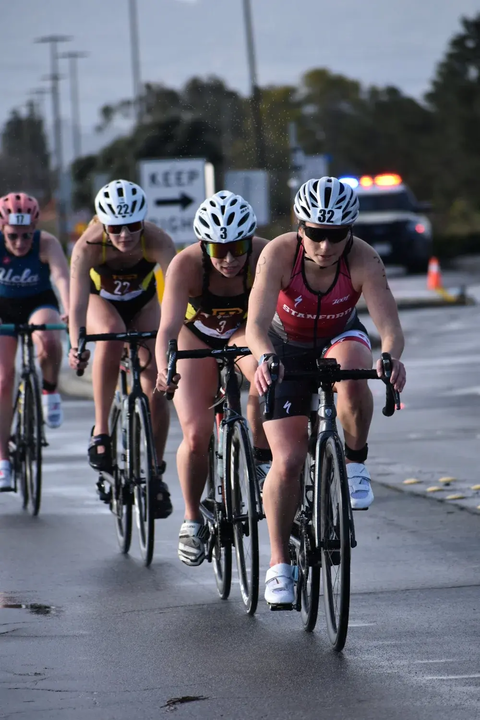
The Stanford University Triathlon Team will host its annual Treeathlon on Feb. 14, welcoming students, staff and members of the public to a new course at Seal Point Park in San Mateo.
The Treeathlon, now in its 23rd year, will consist of a 750-meter open-water swim, a 20-kilometer bike ride and a 5-kilometer run. These distances make the race a sprint triathlon, which is standard for collegiate triathlon events.
According to co-race director Zander D. Opperman ’25 M.A. ’26, the location change has been both difficult and exciting.
“Changing locations has its challenges, from designing a new course to building new partnerships, but we have enjoyed working with San Mateo to make the race a reality,” he said.
Organizers are particularly excited about the new course’s scenery and spectator experience. “The race overlooks the Bay, with the Santa Cruz Mountains and the San Francisco skyline as backdrop,” said Mathis Hayer, co-race director and a second-year Ph.D. candidate in energy science and engineering. “From a small hill, spectators can see almost the entire course at once and cheer on their peers and loved ones throughout the race.”
Treeathlon participants can choose between multiple races: the Classic Sprint, which also has a relay option, and the more competitive Draft-Legal Sprint. In the Draft-Legal race, competitors will not be penalized for drafting during the bike segment. Drafting is a skill that more experienced riders utilize to conserve energy when riding in a tight, competitive pack.
Beyond competition, organizers emphasize the community atmosphere that defines the event. “With athletes and enthusiastic student teams from all over California visiting, it’s quite a spectacle for participants and spectators alike,” Hayer said.
Treeathlon also serves as the Stanford Triathlon Team’s primary fundraiser, supporting travel to national competitions. Each year, the team sends 30 to 40 athletes — and their bikes — to the USA Triathlon Collegiate Club National Championships.
“Treeathlon makes the trip to Nationals affordable for members of the team,” Opperman said. “The revenue from Treeathlon allows our team to uplift anyone who is interested regardless of their financial situation.”
Accessibility is also a central goal of the annual Treeathlon, particularly for first-time triathletes.
“Sometimes triathlon can be intimidating to beginners because of the options for specialized bikes and wetsuits and whatever high-tech fad is in fashion, but the reality is that the sport is accessible even if you have a rusty ‘ol bike, a surf wetsuit and some worn out sneakers,” Opperman said. “Treeathlon has plenty of weekend warriors [who] find satisfaction in participation alone.”
Hayer echoed that sentiment. “It’s also important to remember that you’re only racing yourself. One of the best things about your first triathlon is that you don’t even have a time to beat yet,” he said.
Community volunteers also play a vital role in organizing the Treeathlon. Many volunteers are club triathlon team members, such as Samantha Pyle ’29, who will be volunteering as a lifeguard for the open water swim portion of the race.
“Races are a big day for everyone participating… I’m excited to watch and support everyone who is there on their own journey and help keep everyone safe as a lifeguard,” Pyle said, adding that “it has been so cool to see everyone come together for an event that raises money for our team, contributes to collegiate competition, and brings joy to members of the Bay Area community.”