
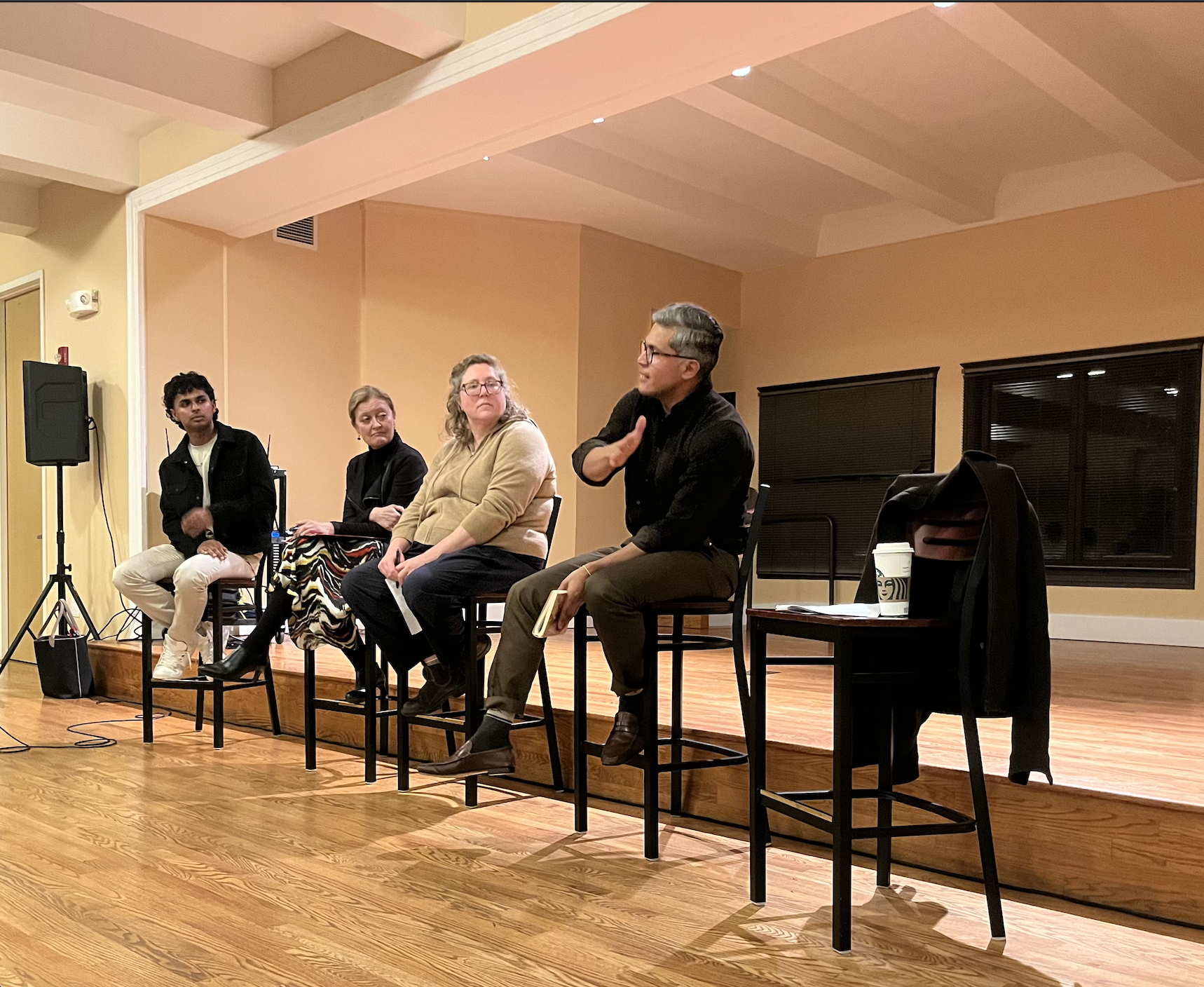
The Associated Students of Stanford (ASSU) hosted a town hall on Wednesday with University administrators, addressing social life, housing and resident assistant (RA) staffing, among other student concerns.
The ASSU’s director of social life and inclusivity, Madhav Prakash ’27, moderated the event. He was joined by Michelle Rasmussen, the vice provost for Student Affairs (VPSA); Cole Shiflett, the associate dean of Residential Education (ResEd); and Samuel Santos, the provost of Inclusion, Community and Integrative Learning. Prakash framed the event as an opportunity for students to “speak directly to power.”
ASSU publicized the event via an email titled “Is the war on fun back?”, emphasizing student concerns that “things have fallen off” and that “none of the frats throw.” The town hall was framed as part of a larger effort to organize “The Revival” and bring social vibrancy to campus. While the email highlighted restoring fun, the town hall itself also covered questions about housing policy, community center funding and graduate student programming.
Ahead of the town hall, Prakash told The Daily he hoped students would engage with the event. “I want people to be angry in that room,” Prakash said. “I would rather students be angry there than angry on Fizz or alone in their rooms.”
At the same time, Prakash emphasized that the event was not intended as an attack on administrators. “Nobody signs up to spend their 40s in a job centered around student engagement because they hate students,” Prakash said. “The people in VPSA care. They are committed, even if they’re constrained by resources and risk assessments.”
During the town hall, attendees expressed concerns regarding fraternity events being shut down and student safety during busy weekends.
“We aspire to create the conditions where you all can design experiences that you want,” Santos said in response. “But we are always going to err on the side of safety.”
Multiple students were dismayed that event restrictions were common last quarter. One student said that dorm parties have “been happening big time” in lieu of fraternity parties. He said that he “felt robbed of his freshman fall” and wanted to ensure “there’s not a similar situation in the spring.”
“We’re all for having successful parties and events, and we wouldn’t put the energy or the money into it, knowing it’s going to be shut down,” Santos said in response. He added that campus events “require a lot of collaboration with students.”
Regarding theme housing and the reapplication process, Vice Provost Michelle Rasmussen explained, “We don’t want to completely eliminate one housing type… we want to have a healthy number of co-ops and Greek life chapters.”
Students also raised questions about the limited availability of row houses. Rasmussen said “the biggest challenge is that we know we have more demand for upperclassmen students to live in this quasi-autonomous manner than we can currently accommodate,” adding “the supply issue is the biggest constraint by far.”
In response to a question about prioritizing self-ops over theme houses, Rasmussen said that the University wants to ensure students have a variety of housing options. “Speaking on behalf of URGC (Undergraduate Residences Governance Council), we’re very aware of maintaining that mix [of housing types] and not skewing too much to one another,” Rasmussen said.
Administrators also received questions regarding RA staffing.
“The numbers of RAs are being finalized for next year.” Shiflett said. According to Shiflett, there are currently 10 vacancies and about 470 RAs. Next year, ResEd will hire between 430 and 440 RAs, she said.
Questions were also raised regarding potential cuts to community center resources. However, according to Santos, “No one is being fired. Our community centers remain open to all students regardless of identity.”
Pualii Zidek ’27 said that while turnout for the event was smaller than she expected, she appreciated the event’s aim of addressing student concerns.
“I’m glad VPSA decided to solicit student opinion in a town hall,” Zidek said. “But I think it could’ve been promoted more to get a more diverse perspective of the student body population.”
“It was a little disappointing that some of the answers were essentially ‘I don’t know’ or ‘I don’t know what to do about that,’” Zidek said.
Even with uncertainty from those in attendance, administrators insisted on their willingness to work with students to improve campus life.
“Our top priority across all of this is collaborating closely with students to create and support the conditions for a vibrant social life,” Santos wrote to The Daily.
“In conversations with students, I’ve heard a strong desire for Stanford to feel joyful, lively, and connected — especially during spring quarter,” Santos wrote. “We share that desire and are working to support it.”