
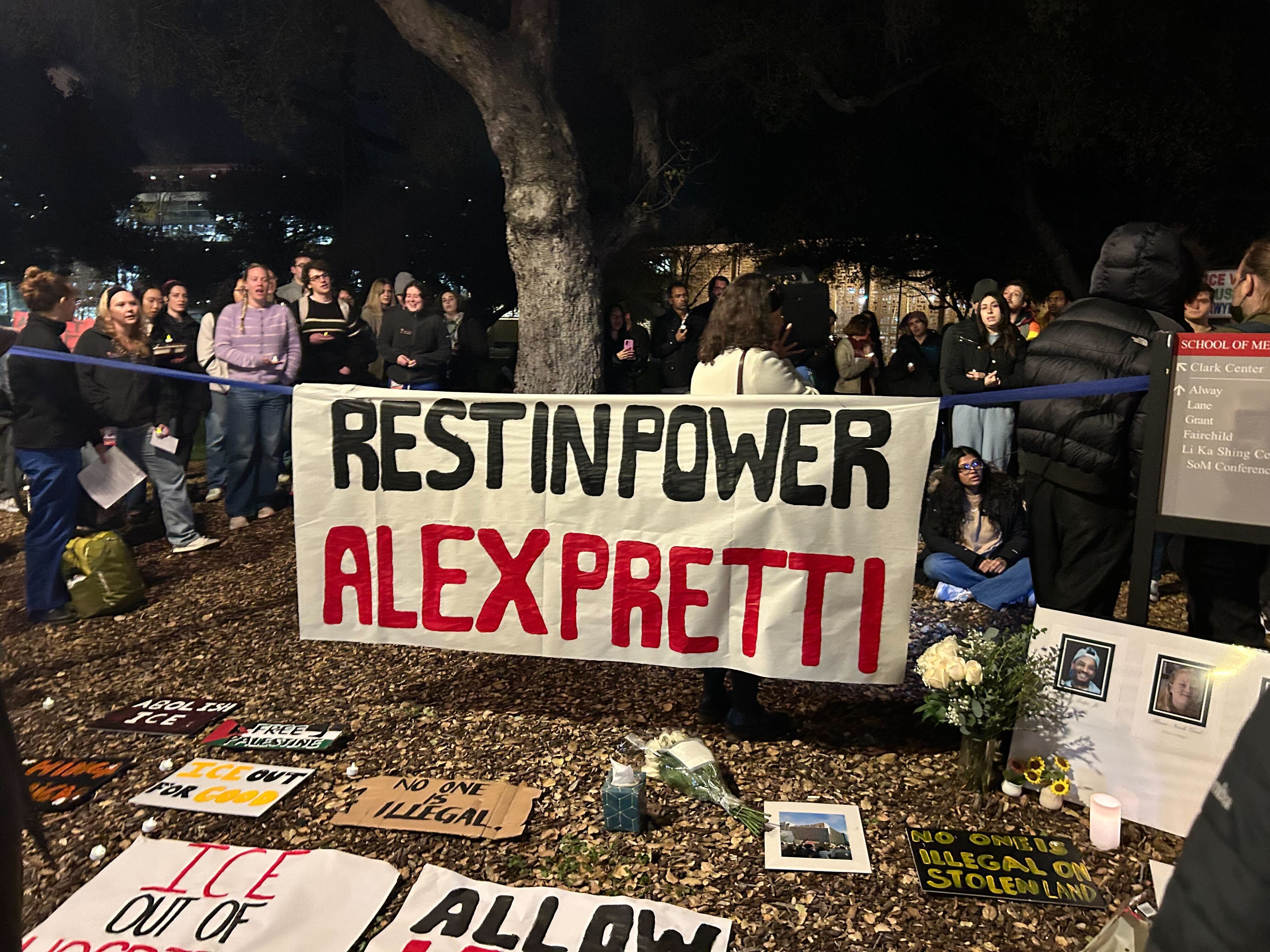
Healthcare workers gathered to honor Alex Pretti and others killed by Immigration and Customs Enforcement (ICE) in a candlelight vigil on Monday evening outside of Stanford Medical Center. The event, hosted by Healthcare Workers for Justice in Palestine and advertised by Stanford Students for Justice in Palestine (SJP), drew over 100 people to grieve and protest Stanford Medicine’s ICE policy.
On Jan. 24, intensive care nurse Alex Pretti was killed by a U.S. Border Patrol Agent in Minneapolis, sparking widespread protests across the U.S. His death came less than three weeks after ICE shot and killed Renée Good, another U.S. citizen in the same city.
“We are here because [Pretti] was a colleague,” said organizer Jewel Sheehan, a Stanford Medicine clinical assistant professor. “He was executed delivering aid to someone who was being attacked by the state. And that is something that we are all trained to do.”
Several vigil attendees gave speeches about the recent ICE crackdown and ways to take action, including calling the Rapid Response hotline to report immigration enforcement activity. Some people held candles in memory of Pretti and other ICE victims, while others carried signs reading “ICE OUT” and “NO ONE IS ILLEGAL.” They also sang songs including “This Little Light of Mine.” Many cried.
According to Sheehan, there were two main reasons for the vigil. The first was the shooting of fellow healthcare worker Pretti by federal agents in Minneapolis, which she described as a “state execution.”
Sheehan said that Pretti’s death struck a chord in her and other healthcare workers because he shared their commitment to helping others – a commitment she said was on display in his final moments.
“If I saw someone pushed to the ground, I would rush to them and ask, are you okay?” said Sheehan, tearing up. “And those were Alex Pretti’s last words.”
Kate Finn, a Stanford Medicine nurse, echoed this thought. “Alex Pretti was a nurse, and I’m a nurse as well. We see, basically, executions in the street every day, and all of them hurt. This one especially hit a little close to home,” she said.
“He was just doing what nurses do,” she continued. “He spent his life caring for people, and was doing the same in his final moments.”
The vigil aimed not only to remember Pretti and others killed by ICE, but also to advocate for changes to Stanford Medicine’s ICE policy, according to the organizers.
Sheehan said that Stanford Medicine previously had a patient in ICE custody and handled the situation “really poorly.” She claimed that ICE agents roamed the halls and interfered with patient care. As a result, she said, the patient’s family protested outside of the hospital.
In light of these events, Sheehan called Stanford Medicine’s ICE policy “woefully inadequate.”
“Stanford’s current policy is essentially: call security, call administration, and then comply with whatever ICE asks you to do,” she said. “It does nothing to protect our patient rights … It does nothing to protect our staff. It does nothing to protect patient’s families.”
The Daily has reached out to Stanford Medicine for comment.
The organizers sought to push for changes given the policy’s limitations. According to Sheehan, Healthcare Workers for Justice in Palestine is working with health policy lawyers and other hospital systems in the area to craft a stronger policy to present to the hospital administration. They are currently holding talks with the Committee for Recognition of Nursing Achievement in hopes of gaining their support.
“I really am hopeful that people will take our concerns about the inadequacy of the ICE policy here at Stanford back to their union leadership, their unit leadership, their department leadership, and really push for adoption of a [new] policy,” said Sheehan about the vigil attendees.
Healthcare Workers for Justice in Palestine started to protest ICE because they saw a connection between the conflict in Gaza, which they describe as a genocide, and the actions of federal agents in the U.S.
Organizer Wendy Feng, a psychiatrist and former Stanford faculty member, said that the technology the Israeli military has used to target Palestinians is the same technology that ICE is using to track undocumented immigrants and activists.
She added that she sees a pattern — in which those in power abuse others and blame that abuse on the victim — across events in Gaza and events in the U.S., citing the Trump administration’s labeling of Pretti and Good as domestic terrorists.
During the vigil, Finn left flowers and a note calling Pretti a “true hero” beside his photograph. “It was just nice to hear other people’s anger and grief and sorrow about everything that’s happening,” she said about the event.
Feng said she was grateful for the strong turnout, despite such short notice. “We’re seeing the power of people being peacefully together, valuing humanity, and that’s so encouraging,” she said.