
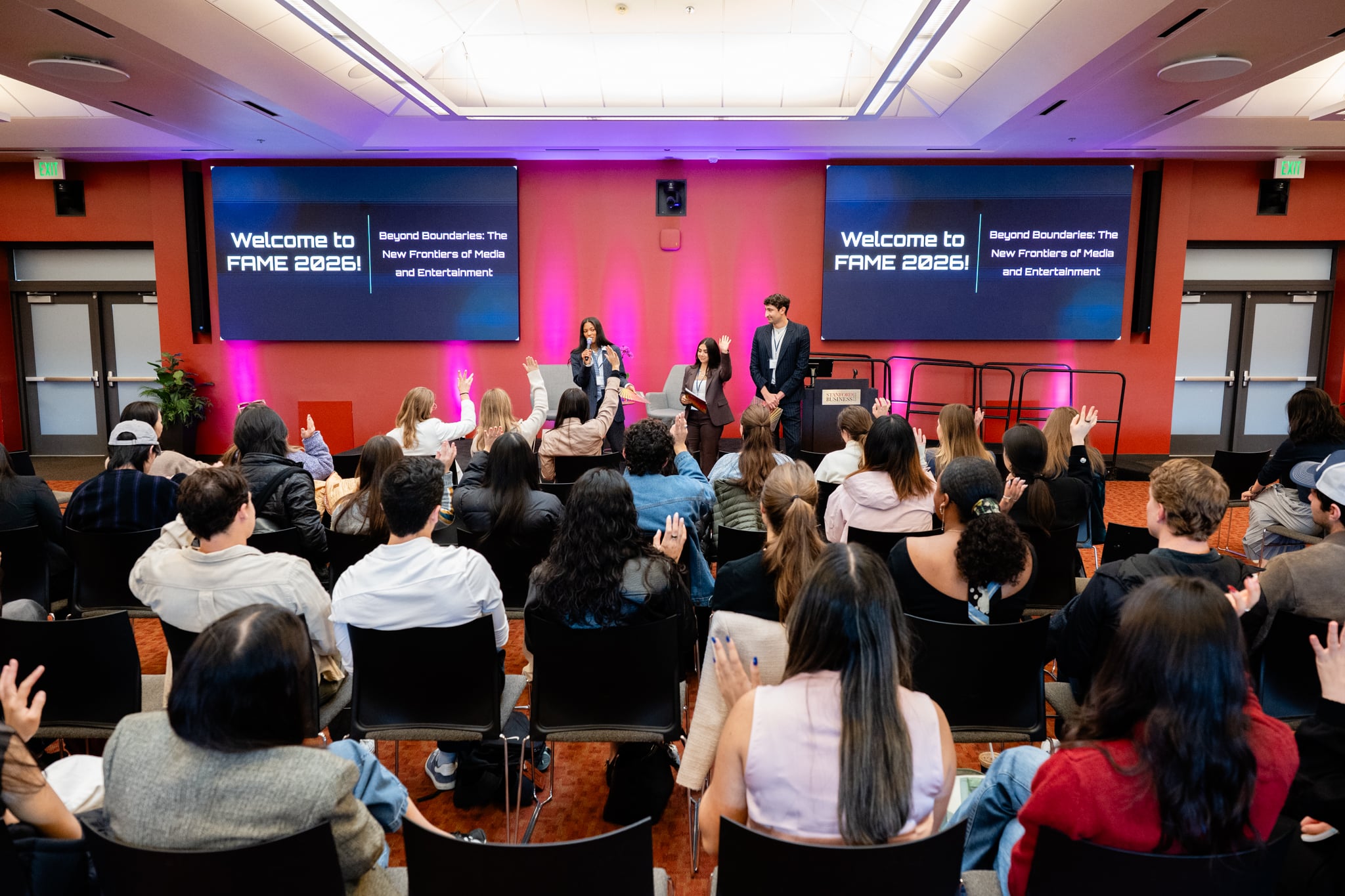
The Stanford Graduate School of Business’ Arts, Media, and Entertainment Club hosted its annual Future of Arts, Media, and Entertainment (FAME) Conference on Jan. 28 at the Oberndorf Event Center. The event brought together industry leaders from film, music and technology to discuss how creativity and commerce are evolving in a rapidly changing entertainment landscape.
Titled “Beyond Boundaries: The New Frontiers of Media & Entertainment,” the conference featured executives from Warner Bros., YouTube, TikTok, Spotify, Live Nation, Netflix and emerging artificial intelligence (AI) companies. Panels throughout the morning explored how digital platforms, AI and shifting consumer behavior are reshaping how stories are told, marketed and monetized.
The opening keynote was delivered by Ted Lim MBA ’12, Chief Business Officer of Warner Bros. Motion Pictures. Lim reflected on his unconventional path into entertainment, beginning as a management consultant before using business school as a pivot into media. The Stanford graduate reflected upon his long-standing love for audio-visual storytelling, shaped by his time at Disney during its acquisition of Lucasfilm.
Lim emphasized that creativity and business strategy are not in opposition, noting that traditional industry practices are often resurfacing in new forms. He described how fundamentals like audience targeting, financial discipline and strategic marketing remain central, even in a digital-first world.
A panel on the creator economy featured Chris Schremp, the managing director of YouTube content partnerships; Benjamin Thomas, the global head of strategy for publishing at TikTok; and Joanne Lee MBA ’09, the senior vice president and general manager of Creator Labs at WME.
Panelists drew a distinction between AI-generated and AI-assisted content, agreeing that AI should function as a tool that enhances — rather than replaces — human creativity. Attendee Keith Zhang echoed this sentiment.
“It’s up to the human to do the curation,” Zhang said. “You need a sharp eye and a creative mind to produce something great.”
While the creator economy panel focused on digital platforms, a subsequent discussion grappled about how technology has democratized the music industry.
Sam Duboff MBA ’15 — Spotify for Artists’ global head of marketing and policy and a former FAME Conference organizer — noted that artists can now produce and distribute music from nearly anywhere at a fraction of the cost once required. He cited Spotify’s playlist stitching system as an example of how platforms have leveled the playing field.
Still, challenges remain. Duboff was joined by Michael Chua of Live Nation and Ticketmaster, who emphasized that the industry increasingly relies on touring and fan monetization. Meanwhile, YouTube Music’s global product activation lead Scott Maier highlighted the growing importance of live performances in an artist’s career and warned that companies often delay conversations around artist compensation.
Later panels returned to the fundamentals of storytelling and leadership, featuring veteran film executive Donna Smith; Erick Peyton, CEO of Unanimous Media; and Tamar Nisbett MBA ’20, former Netflix content strategist now working at Character.AI.
Smith emphasized that while technology may transform production, the core of filmmaking – the storyline – remains unchanged.
Nisbett echoed Smith on the unpredictability of creative success, noting that a franchise like “Stranger Things” was not engineered to be a global megahit.
Peyton shared his non-linear journey into entertainment, tracing his path from junior college to leading a multimedia studio co-founded with NBA star Stephen Curry. He stressed the importance of collaboration and perseverance in creative careers, a message that resonated strongly with attendees.
Attendee Carlos-Alfonso Garza, an incoming MBA student, found Peyton’s story particularly inspiring. The panel reinforced Garza’s confidence in pursuing a non-traditional path in the media industry.
“Hearing about [Peyton’s] journey made me feel like everything is going to work out,” Garza said. “It was a reminder not to underestimate the people you work with.”
For some attendees, the conference offered insight into how entertainment and technology intersect at Stanford. Alex Zhi, Smith’s mentee who traveled from Los Angeles to attend the FAME Conference, said he was interested in understanding how students approach that intersection.
“I wanted to see how Stanford bridges entertainment and technology,” Zhi said. “Hearing student perspectives here was a big part of why I came.”
The conference concluded with a closing keynote from Lucy Guo, co-founder of Scale AI and one of the youngest self-made female billionaires. Guo reflected on her nonlinear career path, from hackathon winner to startup founder, and urged students to take risks early.
Across panels at FAME, speakers returned to a shared conclusion: while technology continues to reshape entertainment, success still depends on human creativity, collaboration and the ability to navigate uncertainty.
This article has been updated to adhere to the Chatham House Rule that the conference enforced.