
The use of artificial intelligence (AI) in schoolwork has become as ubiquitous as using Google. Many professors now include a statement on generative AI (GenAI) usage or over-reliance in their syllabi for courses. But a larger question remains: How are students actually using AI?
The Daily surveyed 50 undergraduate students about the models they frequented, how they utilized it and how they felt about AI more broadly.
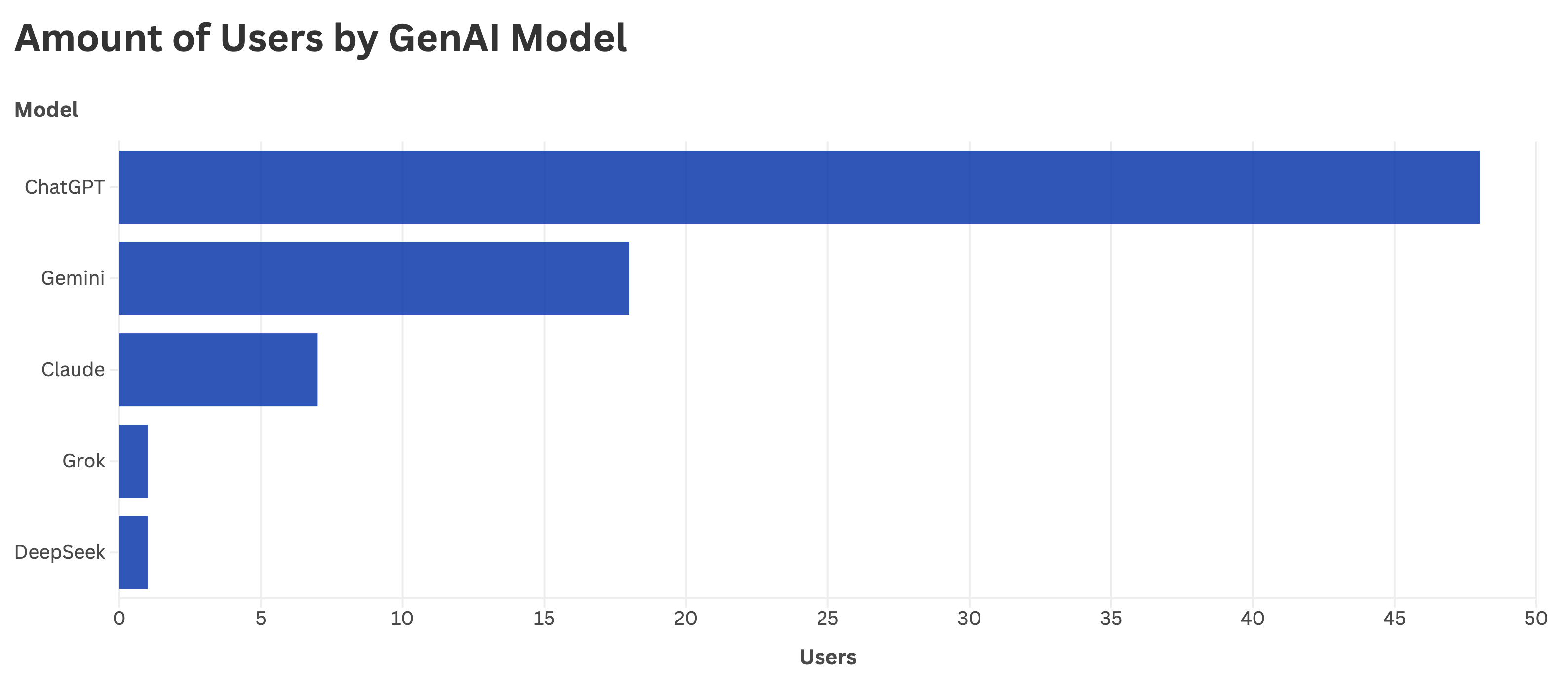
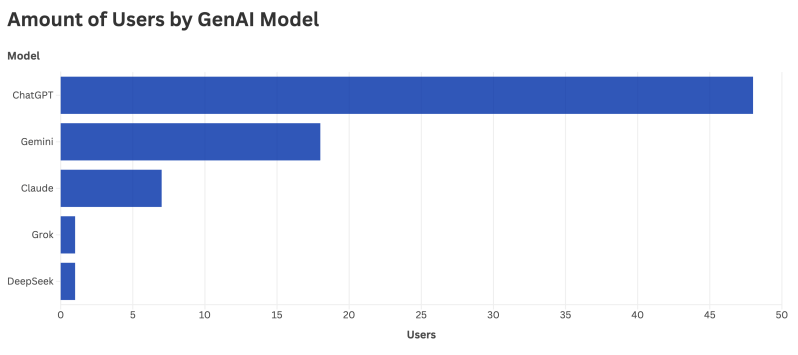
Of the surveyed students, 48 replied that they regularly use OpenAI’s ChatGPT. Less than half of all respondents reported regularly visiting Google’s Gemini, the second-most used model. Next came Anthropic’s Claude with seven users, and finally, X’s Grok and the open-source DeepSeek, both having received only one response each.
The survey also asked students whether their model choice changed depending on the task they used it for.
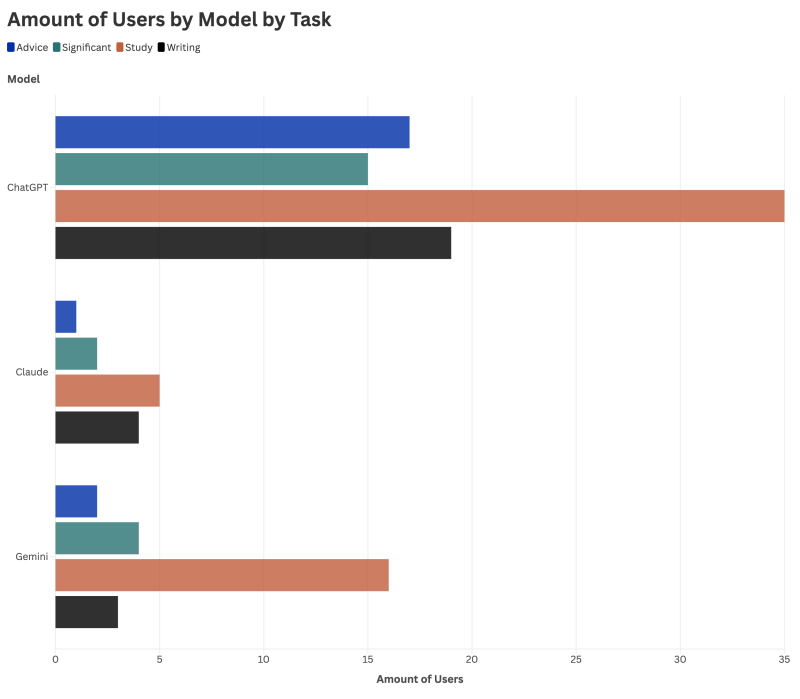
Overall, studying was the most common use case for respondents who frequent ChatGPT, Gemini and Claude, the three-most used models. 100% of ChatGPT users said they frequently used the platform for studying, compared to 88% for Gemini users and 71% for Claude users. However, differences emerge when the task categorizations for each model are broken down further.
Of the 48 ChatGPT users, 19 said they primarily use it for writing, 17 use it for advice and 15 said they use it for “significant work.”
In contrast, using Gemini to study is significantly more frequent than using it for other tasks, considering that less than a fourth of surveyed students reported using Gemini for any other purposes.
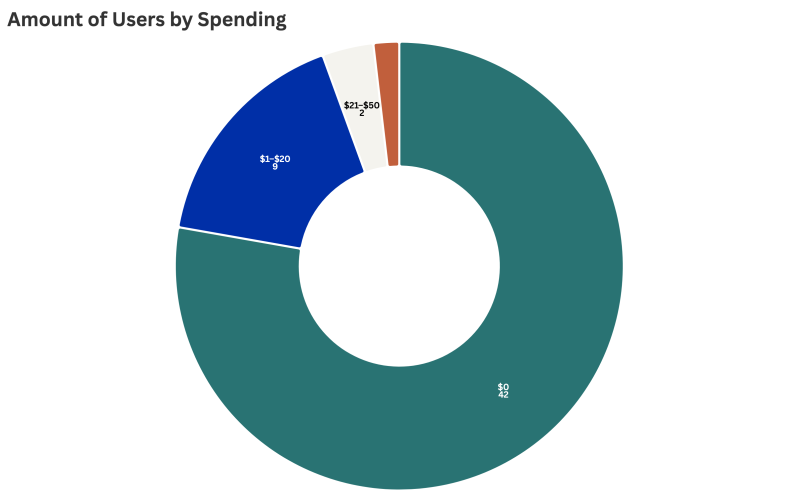
Most of these GenAI programs offer various tiers of subscriptions. Basic services are typically free, and premium options range in cost per month. Over 75% of students are using these programs for free. 18% spend up to $20 a month, and 6% spend over that amount monthly.
The survey also asked students how many hours per week they use AI and how many hours they believe they save by using AI.
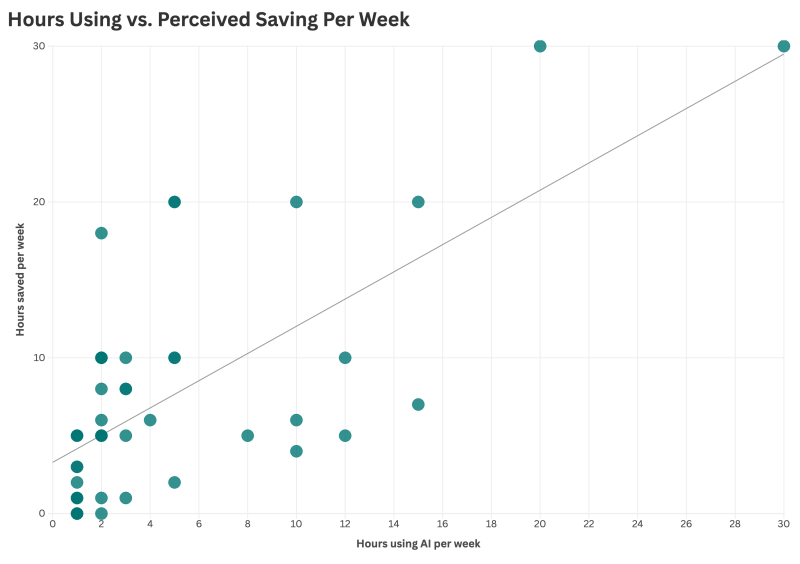
The data reveals a positive correlation and a slope of 0.9, though with a strong scatter. In fact, more students’ data fell under the trend line than above it, revealing a significant variance within the results. More data would be needed to make broad strokes about AI’s time value.
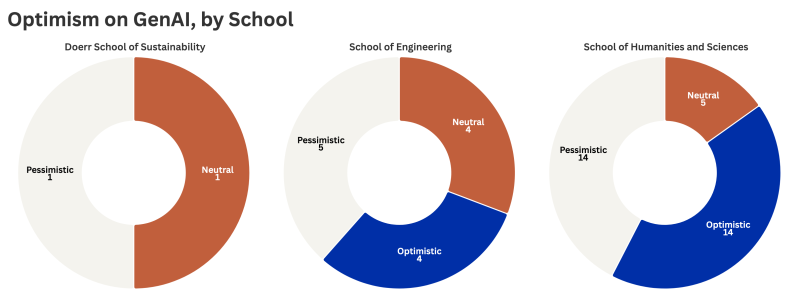
The survey then asked about students’ broad optimism on these models on a scale of one to 10, one being pessimistic and 10 being optimistic. Further conditioning of students’ school affiliation — the School of Humanities and Science, the School of Engineering and the Doerr School of Sustainability — found that degrees of optimism remain consistent through each school.
Relatedly, respondents were also polled on what their primary concerns with GenAI were, taking into account their school affiliations again. Across all schools, accuracy was the primary concern.
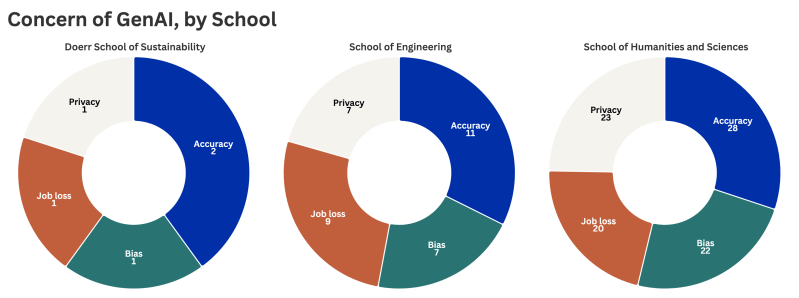
For engineering students, job loss was the second most common concern of GenAI, in contrast to students from the School of Humanities and Sciences, where privacy and bias of AI was a more frequent problem than job loss.
It’s important to acknowledge the limitations of this study. 50 students is ultimately a small proportion of Stanford’s undergraduate population, and, even with a random representative sample, not enough to generalize all claims about GenAI usage and perception. Notwithstanding, this data reveals emerging and evolving trends in how students use AI.