
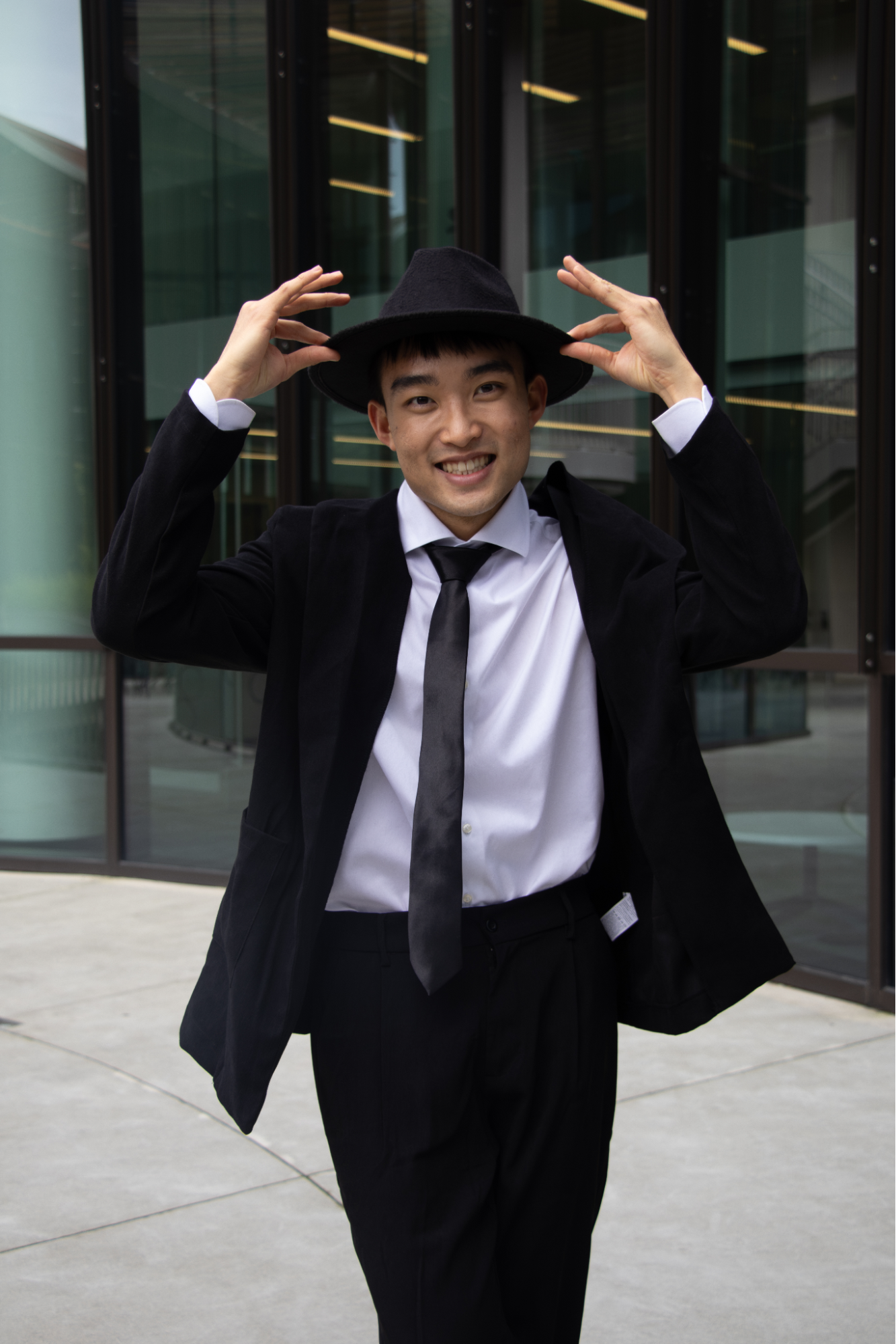
In “Stanford Creates,” columnist Emily Chen ’29 highlights student endeavors in the arts and how they come to life at Stanford.
Bringing his dynamic and versatile moves everywhere from parties to the big stage, Eddie Chen ’28 is one of Stanford’s premier dancers. As a 2024 U.S. Presidential Scholar in the Arts — an elite award given to 20 high school seniors across the country each year — Chen is driven by his passion and love for hip-hop dance at the highest caliber.
Having stepped into a dance studio for the first time at seven years old, Chen took his first hip-hop class a few months into his dance journey and was instantly hooked. Creative movement came to him naturally.
In elementary school, “Whenever any song came on in [class], I would just be dancing in my seat,” Chen said. “I think I’m very fortunate to have found such a big passion [for] something early on.”
Chen attended an arts-focused high school in Southern California and was greatly influenced by his environment as he grew as an artist.
“Being involved and being surrounded by other people that were also really passionate about the arts helped … empower me as a person,” he said.
In high school, Chen also competed in the award-winning dance team Gravy Babies, presented a TED talk about the power of self-expression through freestyle dance and gave back to his community by teaching extensive youth dance workshops in California and Taiwan through his nonprofit Dancing Moves the Heart.
“Passion begets passion,” he said. “I think that passion is one of the greatest engines towards growth [and] where you want to be in life.”
Chen was particularly drawn to hip-hop because of its free and self-expressive nature, which offers a contrast to more institutionalized and technical dance forms such as ballet. According to The Kennedy Center, hip-hop emerged from the Bronx in New York City in the early 1970s. Birthed by innovative DJs and dancers looking to show off at parties, it created a culture of community and competition — symbolic of a whole generation of creatives.
“Art forms that are associated with hip-hop have always started from marginalized communities wanting to express themselves,” Chen said.
While he has extensive experience learning and executing choreography, Chen is equally as enthusiastic — if not more — about the art of freestyling. He believes the biggest task of freestyling is storytelling.
Chen describes what goes through his mind while freestyling: “How can you structure your freedom in a way that can also be digestible to the audience?” he said.
Through understanding and wielding the vocabulary of movement at his disposal, Chen weaves new stories through movement, often tied to the music he dances to.
“Maybe I want to hit just the bass first… then the lyrics… now this is the climax. I’m gonna go crazy, all out, do bigger movements,” he said. “Maybe I start slower [or use] more heavy textures, like varying different levels of dynamism, and that creates a very flowy rollercoaster of emotions of a storyline that the audience can follow.”
His enthusiasm for dance is infectious among his peers.
“[Chen] is always telling me about a new show he has, or idea, or songs that he wants to dance to,” said Chen’s high school classmate and fellow Alliance dancer Yujen Lin ’27. “No matter where I go with him, he is always dancing.”
At Stanford, Chen studies Energy Science and Engineering while participating in student-led dance groups Alliance and Free Flow.
He was also an organizer for Stanford Climate Week this past October. While the initiative was primarily focused on STEM-related innovation, research and commercialization, Chen was compelled to end the event with a celebration of the arts. He co-directed the interdisciplinary show, “When the World Breathes Again,” with musicians Sean Tan ’27 and Howard Qin ’24 M.S. ’26. Through the show, Chen led a group of artists in a dynamic celebration of the natural world.
In Chen’s eyes, art is “such an important complement” to Stanford’s STEM-heavy culture.
“[STEM is] like the cold numbers, right? If you don’t marry that with the warmth of humanity and your soul’s expression through art, you can’t really illustrate and narrate that to the greater public, to the greater society,” he said.
Mia Clark ’27, Alliance director and fellow freestyle dance enthusiast, told The Daily that Chen is “not afraid to go after what he wants.”
“His energy is just that contagious — it naturally pulls others along and inspires them to do the same for themselves,” Clark said.
Chen also makes an effort to explore his artistry in the greater Bay Area. Last year, through the arts organization ArtIS, he created an interdisciplinary show in collaboration with students from the San Francisco Conservatory of Music.
“That was a great opportunity for me to really explore the art scene in [San Francisco] and engage my passion outside of Stanford,” he said.
While balancing artistic and academic lives are challenging, Chen strives to pursue both.
“I’m really interested in energy and climate issues. But if I get too immersed in that realm for weeks on end, I will go crazy,” he said. “If I can fit a quota of 10 to 14 hours a week of just dancing, then that would be enough for me.”
Chen’s goal is to keep his long-standing artistic passion: “Dance has always [been] and will forever be like my first love, right?”
A previous version of this article incorrectly stated the name of Chen’s nonprofit as Two Step Together instead of Dancing Moves the Heart. That portion of the article has since been updated. The Daily regrets this error.