
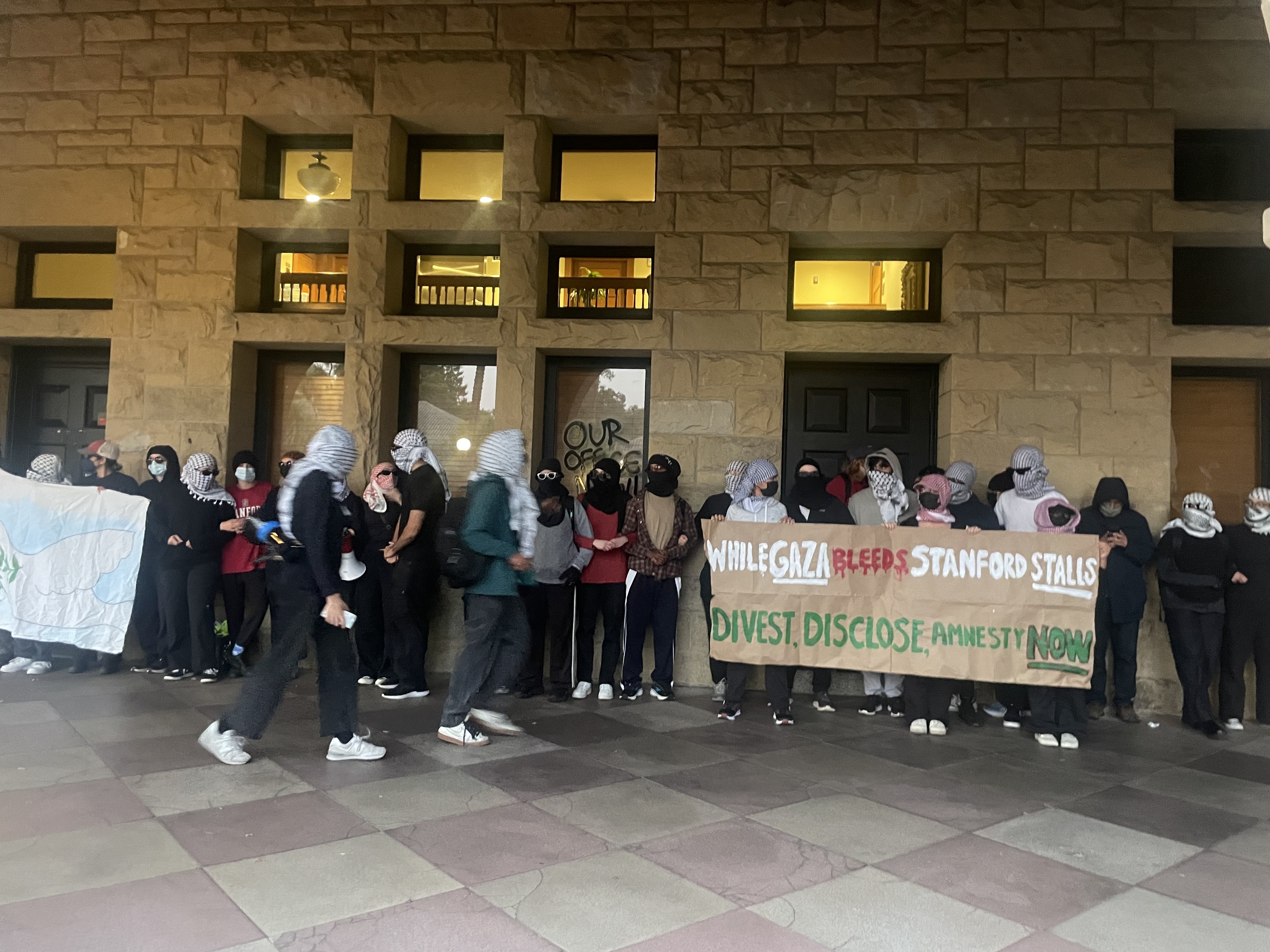
A Santa Clara County judge declared a mistrial Friday in the vandalism and trespassing case against five Stanford pro-Palestine protesters who barricaded themselves inside the University president’s office in June 2024.
After four weeks of trial and about a week of jury deliberations, the 12 jurors were split 9-3 on the count of conspiracy to trespass and 8-4 on the count of vandalism. The deadlock that followed the trial’s closing statements caused Judge Hanley Chew to declare a mistrial.
“It appears that this jury is hopelessly deadlocked, and I will declare a mistrial on counts one and two of the indictment,” Chew said to the courtroom. The jurors said more time to deliberate would not help solve the impasse.
During closing statements, the prosecution argued that the five defendants are guilty on both counts — conspiracy to trespass and vandalism — reaffirming its stance that the protesters had committed crimes. The prosecution deemed protesters’ intent to call for Stanford’s divestment from ties to Israel irrelevant to the case at hand.
Meanwhile, the defense’s closing argument held that the government attempted to delegitimize the protesters’ dissent, making it the jury’s responsibility to affirm the validity of their dissent.
“The message of this trial hasn’t really been whether dissent is American and vandalism is a crime. The message has been that their dissent is not valid, and because it’s not valid, then the government gets to take it,” defense attorney Avi Singh said. “The government doesn’t get to decide what’s American and what’s un-American. The government doesn’t get to decide what’s dissent and what’s not dissent.”
The five defendants could face up to three years in prison and a required payment of $300,000 in restitution if convicted.
Santa Clara County District Attorney Jeff Rosen said the prosecution will seek to retry the case once the court reconvenes on Feb. 25 in Santa Clara County Superior Court.
“This case is about a group of people who destroyed someone else’s property and caused hundreds of thousands of dollars in damage,” Rosen said. “That is against the law and that is why we will retry the case.”
In his closing statement, prosecution attorney Rob Baker showed video footage of the protesters breaking into Building 10. Baker said they broke the windows, disabled security cameras, spray painted the building and splattered fake blood on items in Building 10. He also referenced messages over Signal which revealed the defendants communicating their plan for breaking through the window and planting the plywood used to cover an office window.
“All this case is about is showing that the defendants committed these crimes,” Baker said.
Initially, eleven protesters were indicted, but three pleaded guilty to misdemeanors and another three accepted alternative paths to avoid felony convictions.
Over 3,000 people nationwide were arrested at protests and encampments in the spring of 2024, but most faced misdemeanor charges or saw their charges dropped.
“The jury will recognize that the felony charge is completely outrageous. Nationwide, this is the only case that has gone to this level,” Stanford Students for Justice in Palestine (SJP) member Amanda Campos ’26 said ahead of Friday’s outcome.
The prosecution reaffirmed that the case was a purely factual dispute, rather than a political issue.
“This case does not mean you support genocide. You are here to decide a factual decision, did these defendants conspire to occupy Stanford building 10, and did they commit vandalism? That’s the only reason you’re here,” Baker said.