
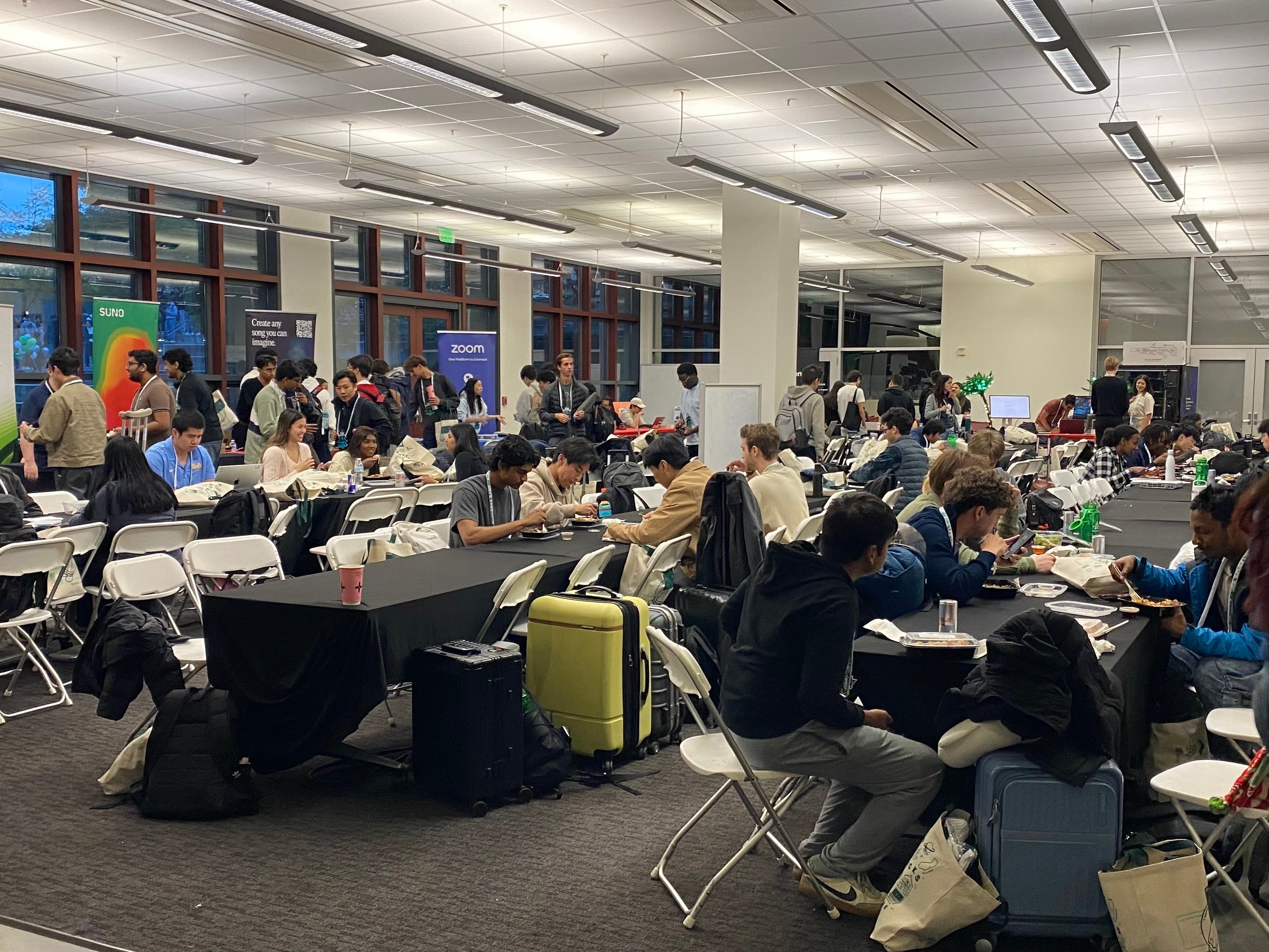
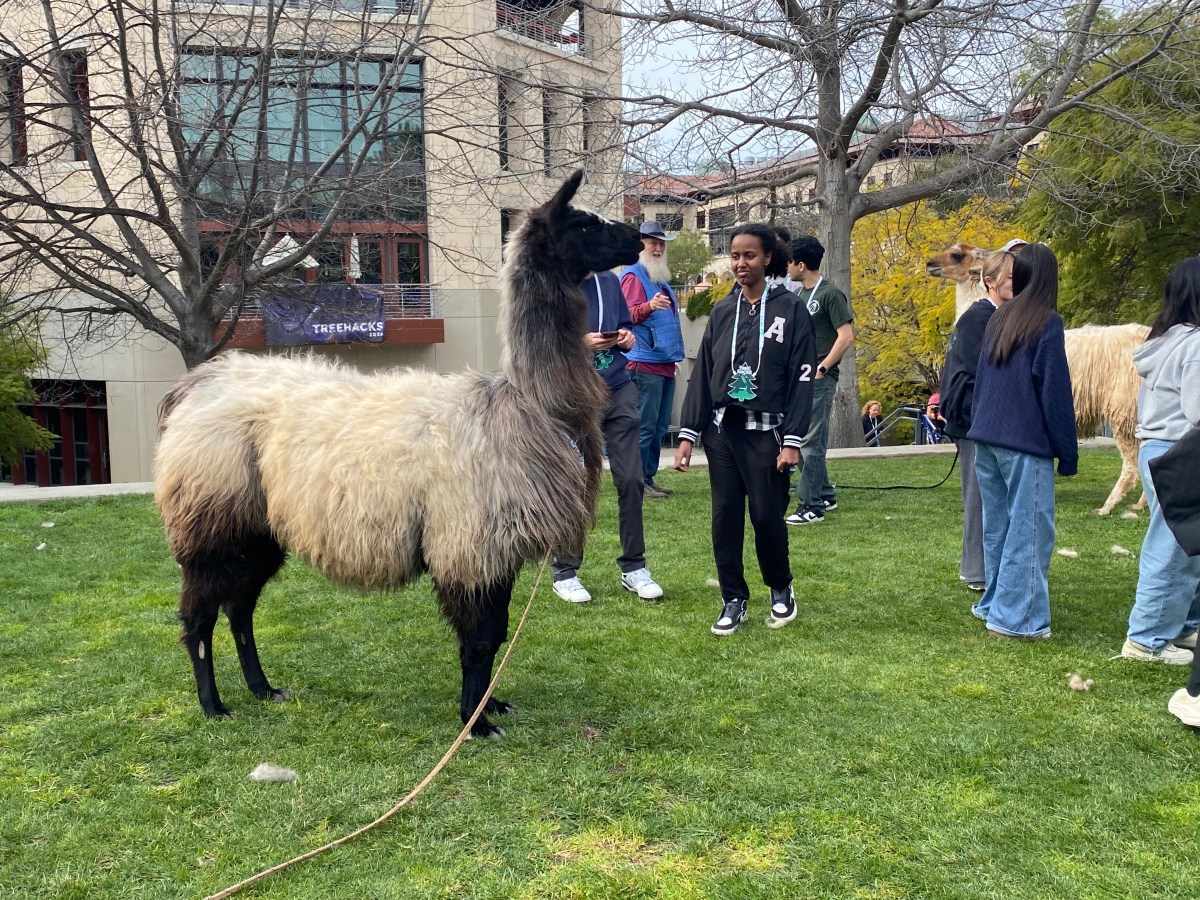
At 2 p.m. on Saturday, the basement of the Jen-Hsun Huang Engineering Center was humming with activity. Hackers bent over computer screens of code at long tables littered with empty energy drink cans, wires and spare parts. At times, an authoritative undergraduate circulated with a megaphone, announcing that participants could pet llamas outside or attend a fireside chat with Google representatives. Meanwhile, companies from OpenAI to Logitech tabled at the perimeter of the space, answering questions from tech industry hopefuls.
From 9:30 p.m. on Friday to 9:30 a.m. on Sunday, over 1,000 students from around the world participated in TreeHacks, now the world’s largest collegiate hackathon. Hackers competed for over $500,000 in prizes awarded across 14 categories.
Sponsors gave out dozens of prizes awarding the groups who most innovatively used their companies’ technology. The TreeHacks team offered awards including “most creative,” “best hardware hack,” “most impactful” and “most technically complex.”
The grand prize was awarded to Shepherd, a motorized smart cane for the visually impaired created by Tony Wang ’27, Arjun Oberoi ’26, Shane Mion ’26 and Anthony Chukhlov ’27. The cane can detect obstacles and steer its user using computer vision.
The competition is open-ended — according to TreeHacks technology director Thijs Simonian ’28, organizers hope to support the development of creative projects that “have an impact on the world.”
“I feel like a lot of the ingenuity and change in the world happens when people are able to just work on random ideas they are excited about personally, and this is a way we’re able to do that,” Simonian said. “We put all these people into a room and give them 36 hours to do literally anything.”
In pursuit of this impactful ingenuity, each team of up to four students created a project judged on three criteria: creativity, technological complexity and social impact.
The competition began long before the event launched on Friday, though — of over 15,000 applicants, only about 1,000 were selected to participate. According to Simonian, the TreeHacks team spent several months reading each application, looking for an “excitement to go out and build stuff.”
“We care a lot about how many personal projects you’ve explored and built in your own free time,” Simonian said. “If we see you built a computer from scratch or… make all these cool model rockets in your free time, that’s super exciting because we know in that short 36-hour time frame you can build really incredible things.”
Anika Somaya, a junior studying math and computer science at Columbia, and her group translated a shared interest in music to a project built on top of Suno API, an AI music generation software. The group’s project aimed to make the technology “much more flexible with what creators can do,” Somaya said.
Other groups created products applicable to a range of AI products. Emily Cheng ’29 worked with her group to create HackOverflow — a question and answer forum for AI agents modeled after Stack Overflow. The project won fetch.ai’s “One Agent Workflow” prize for successfully setting multiple agents in communication with one another. Cheng said the project will allow AI to access answers to common problems immediately, reducing redundancies and making the agents more efficient.
Hackers came from a range of backgrounds and experience levels. TreeHacks was Cheng’s first hackathon, while Somaya said she had already competed in several. Komal Vij ’27 said she attended hackathons in the Bay Area, including CalHacks and competitions at AGI House, prior to this year’s TreeHacks.
According to Vij, whose project “ZoneZero” won the Stanford Ecopreneurship Prize, TreeHacks is unique because of the networking opportunities afforded to participants. “One of the biggest advantages of coming to hackathons like this is to meet some of the sponsors and learn about what they’re building,” she said. “Every year there are super cool sponsors, and they always have new tools that you can use and build with.”
TreeHacks’ sponsors include companies such as Zoom, NVIDIA, Google, OpenAI, Y Combinator, Anthropic and Perplexity. Companies demonstrated new technologies by tabling throughout the weekend, allowing students to sample their products.
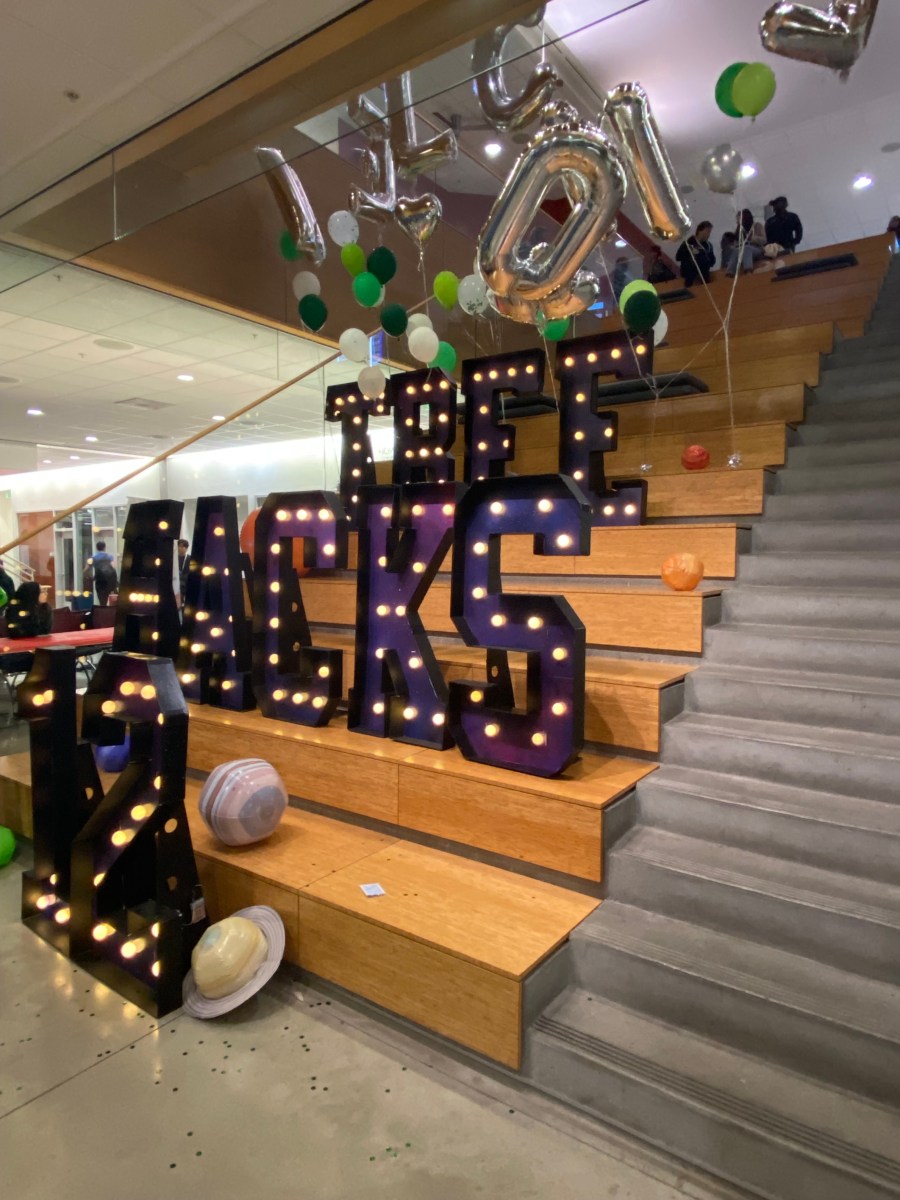
Scouting sponsors and soliciting applications for the hackathon began over the summer, Simonian said, when a core team of six organizers began to coordinate the event. After hiring summer fellows, the team also began to design the website, reach out to vendors and photographers, book venues and confirm other logistical details. During fall quarter, the team worked on “builds,” such as a large light-up countdown timer in the center of the event space, a photobooth and a brain-controlled car, which Simonian said “bring a little extra flair” to the event.
While months of planning went into the hackathon, the process to book OpenAI CEO Sam Altman as this year’s TreeHacks keynote speaker began “on a whim,” according to Simonian. Ameya Jadhav ’26, the chief financial officer of TreeHacks 2025, initially sent Altman a direct message on the company’s Slack workspace while working as a summer intern at OpenAI. Jadhav’s spontaneity paid off, and Altman confirmed his availability to speak at the event a few months later.
Simonian, logistics director Rachel Fernandez ’28 and sponsorships director Hannah Gao ’28 interviewed Altman at Friday night’s opening ceremony. Simonian said that Altman was “willing to take hard questions.”
“We went through our questions quickly [before the talk] and [Altman] basically told us, ‘don’t listen to my comms team. Ask me whatever you want,’” Simonian said.
The keynote kicked off a weekend of nearly non-stop programming. Participants and organizers alike typically sleep just a few hours each night, attending talks, coordinating activities and coding until the early morning. Simonian said running the event is worth the exhaustion.
“Our overall goal is to just give people the opportunity to build and make the world a better place through their random ideas,” Simonian said. “There’s literally no reason not to do the craziest thing you can.”