
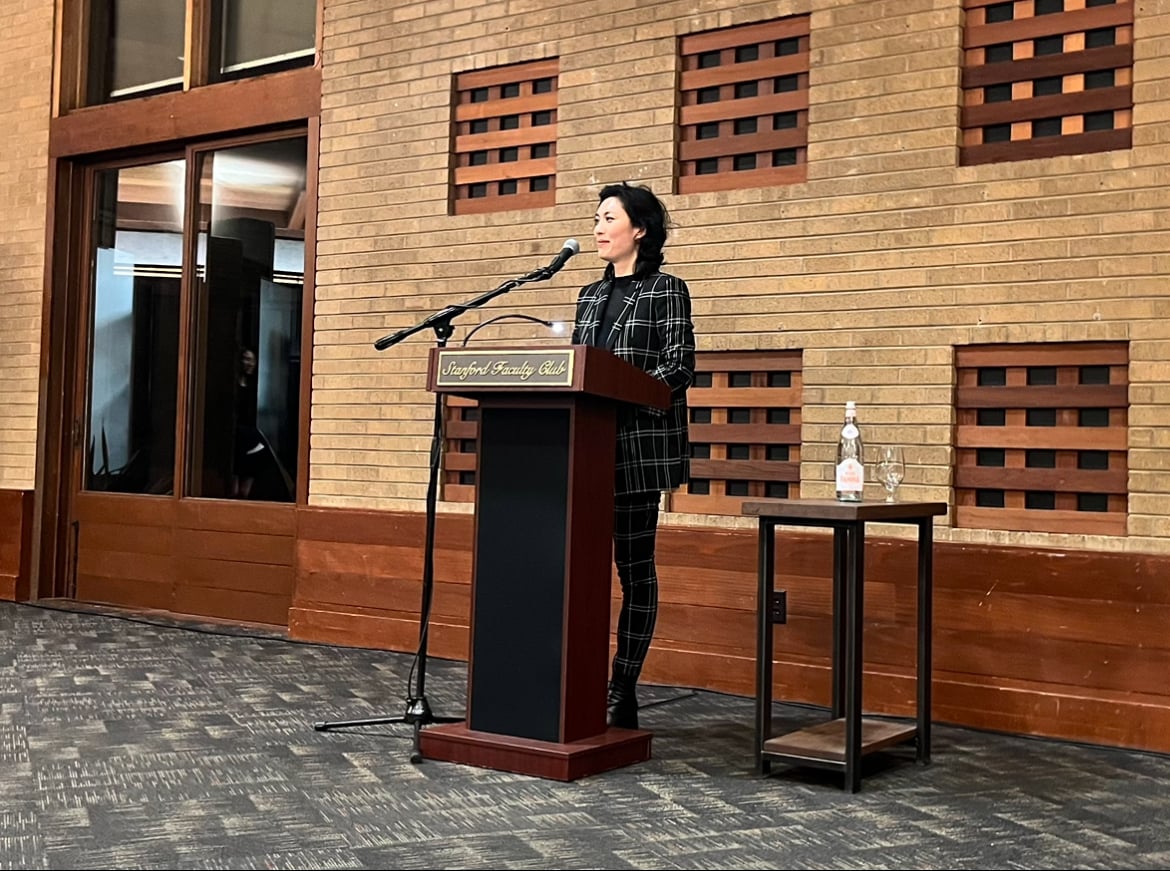
More than 100 people filled the Cedar Room at the Stanford Faculty Club Wednesday evening for a reading by C Pam Zhang, award-winning author and the 2026 Stein Visiting Writer. The Creative Writing Program invites the Stein Visiting Writer each year to teach an undergraduate writing seminar of their design.
The five rows of chairs filled up more than 30 minutes before Zhang even made an appearance. Those who could not find a seat stood at tall cocktail tables in the back in anticipation of the evening’s reading.
Karen Russell, fiction writer and the newest addition to the Stanford English faculty, introduced C Pam Zhang, summarizing the premises of Zhang’s two novels, “How Much of These Hills is Gold” and “Land of Milk and Honey.”
In “Land of Milk and Honey,” Zhang’s “keen attentiveness to beauty, to the body, to passion, to human connection make [the novel] feel enormously hopeful,” Russell said.
Russell went on to highlight some of Zhang’s various accolades: the 2021 Academy of Arts and Letters Rosenthal Award, the 2021 Asian/Pacific Award for Literature, fellowships from MacDowell and the New York Public Library’s Cullman Center, among others. Russell noted that “this is an abridged version” of Zhang’s awards, eliciting scattered chuckles from the audience at the ironic lengthiness of the list.
Zhang took center stage, crediting Russell for being one of the former’s writing heroes. The Stein Visiting Writer joked that she wasn’t nervous about delivering her reading until after Russell introduced her: “Now I am because I don’t know how to possibly live up to that description.”
Zhang prefaced her reading by thanking students for their emotional openness, bravery and vulnerability when sharing their writing in her undergraduate writing seminar, ENGLISH 190V: “Reading for Writers: STRANGE ENCOUNTERS.” She then revealed that during this reading, she would be sharing a new piece — a rare occurrence for her.
In her reading, Zhang shared an excerpt narrated by a granddaughter telling the stories of her parents and grandparents. Using the granddaughter’s dislike for her own name as a springboard, Zhang explored the origin and importance of names. She painted the image of the narrator’s grandfather, who prioritized naming his newborn son over holding him, and gave up on searching for a dictionary only when “the birthing fluids had frozen into a red, purple mass.”
Zhang then teleported her audience members to a labor camp, bringing to life the struggles and fateful interactions that the narrator’s grandmother encountered, from drawing warmth from a rock on which she lay to remaining calm while being dragged around by soldiers.
Zhang built tension in her descriptions of how the narrator’s grandmother was manhandled by the soldiers, “as if she were one of the clever jointed dolls newly popular in the city she came from,” she said. The writer also meditated on the power of laughter in changing the mood of an entire room — even in a labor camp.
The Stein Visiting Writer then transitioned to the Q&A portion of the event.
She first encouraged an audience member to treat their writing “like a little baby alien” when asked for writing advice.
“[Your writing is] a creature that you just don’t understand yet,” Zhang said. “But it has its own vast intelligence, and you’re just trying to get out of this way and help it grow.”
When a student asked Zhang about how to “hold a whole novel in your head,” Zhang began by analyzing the premise of the question itself.
“First of all, you can’t hold the entire novel in your head,” Zhang said. “With each of my drafts, I try to find myself a North Star.” In an early draft, Zhang might just focus on the relationship between two characters.
“If I try to hold everything else in my head, I’m going to fail at that first task,” she continued. “A lot of this is just being at peace with the idea that everything takes a really long time and that no things are perfect.”
Knight Family Professor of Creative Writing and poet Aracelis Girmay asked Zhang about how the novelist deals with the dread that might arise when working on a piece that is more forced than enjoyable.
“Actually, I really love throwing pages away,” Zhang said. “I think it’s more of a psychological trick, where I would say that things that go in the trash were not useless. They were just something I had to get through.”
Girmay reflected on the novelist’s recommendation to embrace the unknown in writing and push back on predictability.
“When she talked about that dreadful feeling of knowing what would happen next… I was really thinking about how folks determine or come up with the conditions that help them have curiosity in their own writing,” Girmay said.
The night ended with Zhang reflecting on how her writing has impacted her personal growth: “Every book you write not only surprises you, but changes you,” she said.