
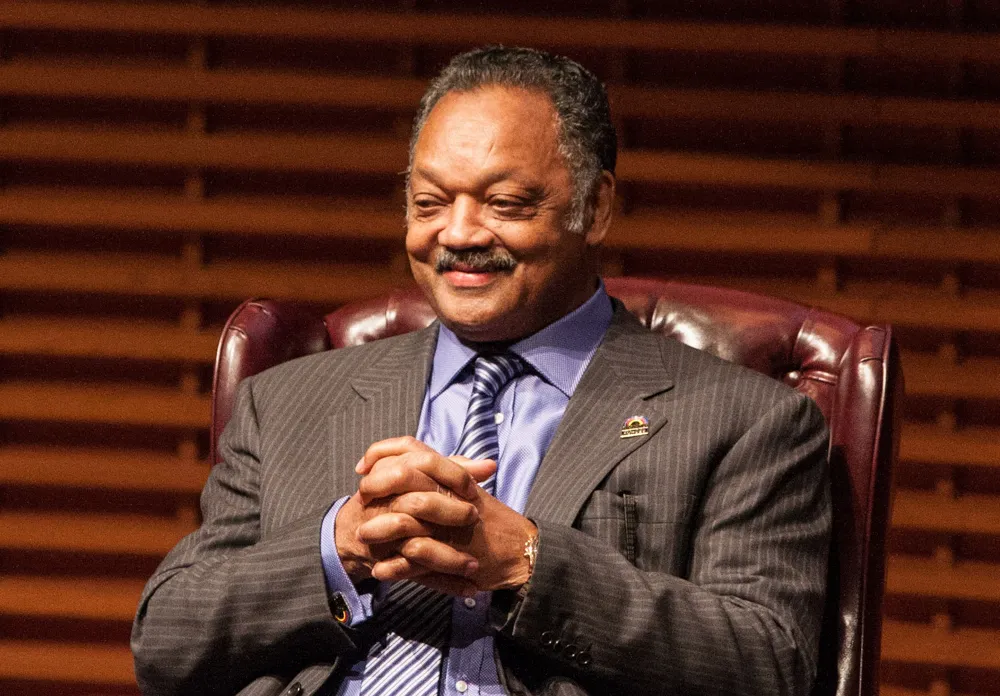
Rev. Jesse Jackson died on Feb. 17 at the age of 84. He leaves behind a formidable legacy as a civil rights activist who shaped the national conversation, including on Stanford’s campus.
“The importance of Jesse Jackson was … [his] desire to make sure that the [civil rights] movement didn’t stop with King’s assassination, but rather broadened,” said Clayborne Carson, Martin Luther King, Jr. Centennial Professor Emeritus at Stanford. Jackson, he added, was a “gregarious” man “concerned with internationalizing the movement.”
Jackson is remembered for his persistent activism, including participating in a campus demonstration led by Stanford students against the core curriculum requirement of “Western Culture.” The demonstration on Jan. 15, 1987 advocated for a more inclusive and diverse set of required texts.
“There was never a demonstration [Jackson] didn’t want to go to. He loved that stuff,” Jon Reider ’67 Ph.D. ’83 said, giving a first-hand account of the infamous protest, which received attention from national publications.
A historical inaccuracy was born for Jackson following the demonstration, as he was wrongly credited with chanting the phrase “Hey, hey, ho, ho, Western civ has got to go.” The quotation has since proliferated widely in various news outlets.
Reider has attempted to correct this false narrative in numerous publications. He maintains that the reality of Jackson’s presence at the protest differed from the popular account.
Recalling Jackson’s response to the student protestors, Reider said that “[students] started chanting [the phrase] as he was speaking, and that’s where he demurred … [stating] ‘No, no, we don’t want to get rid of Western culture. Now, there’s a lot of things we like. We just want to expand it, take the modern word and make it more inclusive.’”
Over his life, Jackson worked to carry on King’s legacy after his assassination. Jackson’s presidential campaigns in 1984 and 1988 also reflected those aspirations.
“[Jackson] was a very powerful, magnetic, attractive, strong figure,” said Bill Chace, former Associate Dean of Humanities and Sciences at Stanford and President of Emory University, who recalled Jackson visiting the university. “He was riding very high and was a prominent figure. So I respected his coming to the [Emory] campus and was glad he was there.”
Carson spent time with Jackson at the 1995 African and African American summit meeting in Senegal, alongside other Black leaders like Rev. Al Sharpton and Rev. Leon Sullivan.
“I could name probably a dozen other people who were part of that effort to link the African American struggle with the African struggle,” Carson said. “That, to me, was their most important contribution, the most lasting one, because I think a lot of those ties still exist.”
Jackson made additional trips to the Stanford campus outside of the demonstration, including visits connected to his presidential campaigns.
“What King was saying at the end [of his life] is that…we need to become more global and link our struggle to struggles that are going on elsewhere,” Carson said. “There were those like Jesse Jackson who strongly believed that, and Stanford was one of the places where that was strong.”