
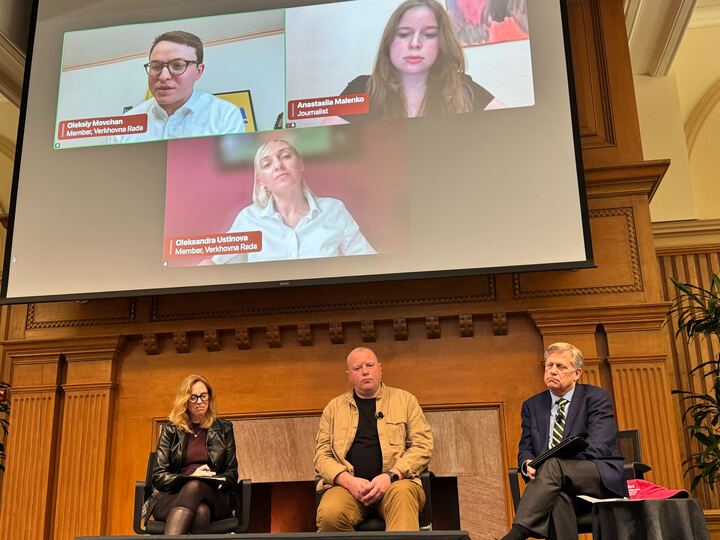
To mark the fourth year since Russia’s full-scale invasion, Ukrainian leaders convened at a Stanford panel, raising alarms over the war’s rising human cost and implications for the global democratic order.
The Center on Democracy, Development and the Rule of Law (CDDRL) hosted its annual panel at the Bechtel Conference Center Tuesday. This year’s discussion brought together high-profile Ukrainian leaders to preside over the matters that persist years later. CCDRL has hosted a similar event every year on the date of Russia’s full-scale invasion.
“This is an event we hoped not to be holding this year,” said panel moderator, CDDRL director and political science professor Kathryn Stoner during her opening remarks. “It is unthinkable that we are at this fourth anniversary […] Most analysts and military experts abroad, and especially Vladimir Putin, thought that Ukrainian military forces would collapse in days.”
Michael McFaul, ’86 M.A. ’86 — a Senior Fellow at the Freeman Spogli Institute (FSI), political science professor and the former U.S. ambassador to Russia — co-moderated the talk.
Joining the conversation were journalist Anastasiia Malenko ’23, who has extensively covered the war, members of the Ukrainian parliament Oleksii Movchan and Oleksandra Ustinova and former Ukrainian ambassador to Canada and member of the Ukrainian Ministry of Defense Andriy Shevchenko. Andriy joined in-person, while the other panelists were present virtually from Ukraine.
All four highlighted Ukraine’s resilience despite targeted strikes on civilian lives. Malenko noted how citizens continue to fight for their country’s freedom, despite infrastructural damage that has exposed families to prolonged blackouts, leaving them without heating in freezing winter conditions.
“We can live with cold, without electricity,” Movchan said, “but we will not give up our freedom, democracy, nation and our country.” Panelists agreed that loss of liberty is the most permanent threat to Ukraine.
Shevchenko remarked that while Ukrainians “despised” their bureaucracy, political figures, including President Volodymyr Zelenskyy, provided the stability to keep the country running during the critical first weeks.
Panelists also strongly rejected “land-for-peace” proposals, which would have Ukraine cede territories to Russia in exchange for security promises. Ustinova said that previous concessions under the guarantee of peace did not stop Putin’s 2022 invasion. “We gave up land to him before, and now he wants more,” she said.
Ceding territory, she added, also means the relocation of thousands of people or placing them under different rule.
Territorial concessions would only make future invasions easier as Russian frontlines move closer to major cities, according to Movchan. “There is no optimism about this kind of exchange,” he said.
The discussion also touched on the global gravity of the conflict. “[There are] only two options: either we finally put Russia to its knees […], or we must prepare seriously for a full-scale, third world war,” Shevchenko said.
While a balance between Russia and Ukraine could have been achieved before the war and during earlier stages, it has become more apparent to Shevchenko that “the Russians are not going to stop.”
McFaul asked the panelists about actions the U.S. government and citizens should take to support Ukraine in its struggle. “I’m embarrassed about how little our government is doing in this fight. I think this fight is in our national interests,” he said.
Ustinova urged Americans to send letters to congressmembers or publicly protest. “It’s very easy to come out and protest if this is about your rights, your freedoms, but not somebody else’s.”
Nora Sulots, CDDRL communications manager, said the event closely reflects the Center’s mission.
“Ukraine is grappling with [..] how democratic institutions function under extreme pressure, how governments sustain legitimacy and economic stability during war, and how international partnerships shape political and economic trajectories,” she wrote to The Daily.
Attendee Robert Liu ’28, who also attended last year’s event, echoed McFaul regarding the war’s duration. Liu wrote that while unfortunate, “we must gather again” to recognize another year of war. He expressed disappointment in “the Trump Administration’s treatment of Ukraine as a bargaining chip rather than a crucial ally in the fight for democracy and sovereignty around the world.”
While the moderators acknowledged the war shows no signs of stopping, they hope the future holds fewer somber anniversaries.
“I hope that next year we can celebrate a victory and we can celebrate the end of this war, so we don’t have to talk about how to sustain it, but how to rebuild.” Stoner said.