
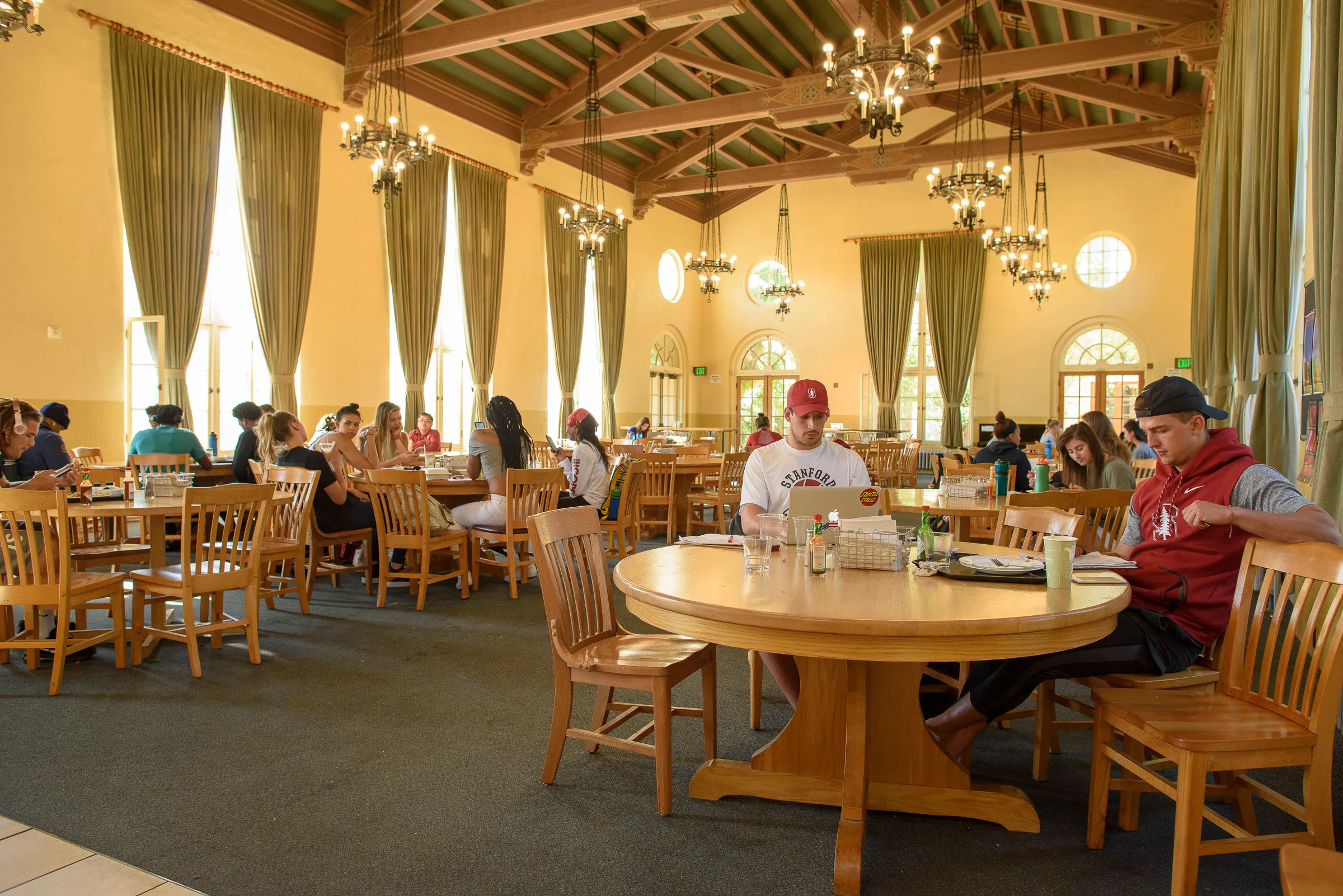
Seven undergraduates are fighting waste at Stanford with “Tree Bites,” an app that alerts students when food is left over at events across campus.
The app, which was released on the App Store in January, allows event organizers to post pictures of leftover food alongside details such as amount, distance and perishability. Nearby users on campus are then notified and given directions to pick up the leftovers.
The project began in October, when Amy Key ’29, Sanmay Sarada ’29, Selma Ahmed ’29 and William Peng ’29 were challenged to create a project tackling food waste as part of a three week startup challenge organized by Affiliated Stanford Entrepreneurial Students (ASES).
Another three students, Aarush Garg ’29, Maia Lopin ’29 and Cash Tieman ’29, helped develop the app through Stanford Social Entrepreneurial Students’ Association (SENSA).
Key said her team quickly noticed that thousands of pounds of food are thrown away weekly at Stanford’s dining halls, when students overfill their plates and scrape off the excess. However, the group decided it would be challenging to alter students’ dining habits through an app alone.
Instead, the team shifted their focus to leftover food at club and department events. They were inspired by the Stanford Buffet Response Team, a group chat where people send photos of leftover food at campus events.
Another online group lets residential assistants communicate when they have surplus food from dorm events. “And so I saw that and was like, ‘why don’t we find or create some sort of centralized app?’” Key said.
Sarada added that he personally wanted to target food waste at events because “if I could find a way to not eat dining hall food every day, it would just be a lifesaver.”
The team then developed the app itself. According to Sarada, who had never worked with Swift before Tree Bites, about 90% of the coding was done through AI. However, the app required significant attention to ensure the user interface would operate seamlessly.
“I remember pulling like, two all nighters just really trying to push this out and figure out what was going on with the app,” Sarada said. The app often broke due to mistakes made by AI and had to be debugged frequently.
Now that the app’s development is finished, the team is focused on finding event organizers to post leftover food and general users to populate the app. Currently, the Tree Bites Instagram has nearly 1,000 followers and a post advertising the app on Fizz received over 2.2k upvotes.
Additionally, the team is looking to partner with academic departments and centers such as the First-Generation and/or Low Income Student Success Center (FLISSC) to encourage staff to use Tree Bites regularly.
Sarada hopes that integrating Tree Bites with existing campus departments will help the app get off its feet. “If you downloaded [the app], it would become a no-brainer to use it,” he told The Daily.
However, distinct attitudes towards food waste may pose a challenge in Tree Bites’ adoption. When trying to convince a friend to download Tree Bites at a fraternity event, Sarada said, “he was like, ‘honestly, if we have leftover food, I could care less. I would just throw it away.’”
At a later event hosted by Business Association of Stanford Entrepreneurial Students (BASES), Sarada noticed 15 pizzas were ordered to serve only 25 participants, and several boxes were thrown away unopened.
But Sarada notes that much of the Stanford community still seems enthusiastic about reducing food waste, recounting an instance where he passed by a middle-aged man manually passing out leftovers at Coffee House. “It really got me thinking that people don’t care as much, but departments do,” Sarada says.
“I think notifying undergrads will be good,” said Ana San Jose Gonzalez ’26, a residential assistant at the dorm where Sarada currently lives. “Undergrads are somehow always hungry.”
In the future, Tree Bites is looking to continue expanding their services. One idea is to show app users the locations of community fridges, where any student can leave or take fresh food, across campus. Another is to replicate the app across other college campuses.
But now, the team is working to get the app on as many students’ phones as possible. They emphasize that they want their project to make a tangible, lasting impact on the way Stanford handles food.
Key says the journey so far has been both fun and fulfilling. “Even throughout high school, I was very focused on the idea of social impact and how I can achieve social impact through tech,” she says. “So I think this definitely aligns with my core values.”