
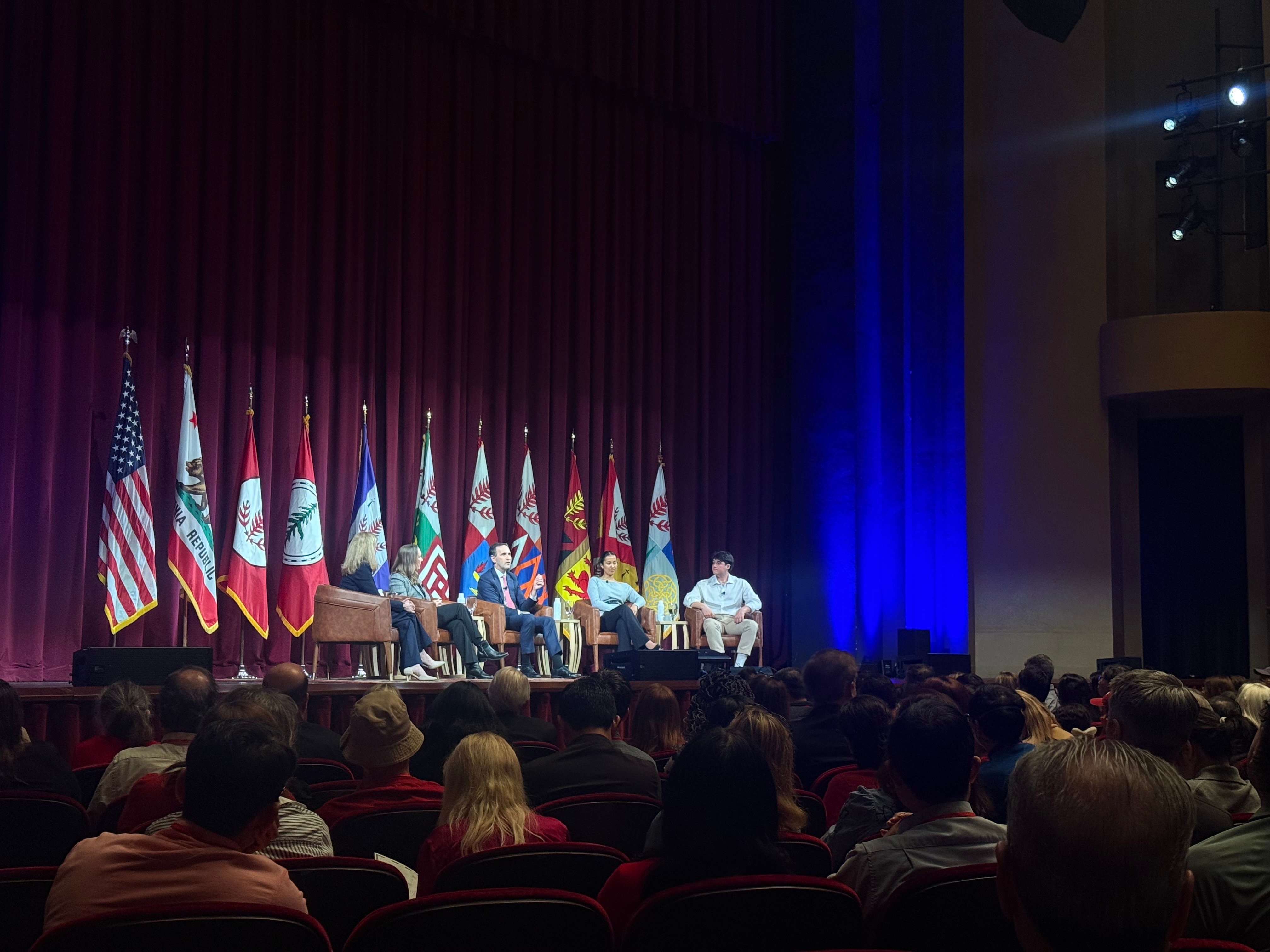
University president Jonathan Levin ’94, provost Jenny Martinez and Vice Provost for Student Affairs Michele Rasmussen opened Family Weekend by emphasizing Stanford’s aims of intellectual growth and vibrant student life in a panel discussion with Associated Students of Stanford University (ASSU) president Ava Brown ’26 and vice president Will Berriman ’26 M.S. ’26.
The panel also fielded questions about free speech, highlighting the success of the COLLEGE program and recent political challenges for higher education. President Levin mentioned a recent trip to Washington to protect federal funding for science agencies. During the panel, he also reaffirmed his commitment to supporting international students.
“I think Stanford has a very unique and distinctive culture,” Levin said, opening the event.
At the beginning of the discussion that followed, panelists reiterated the importance of campus free speech. Provost Martinez acknowledged that free speech has been “top of mind” for her and Levin since starting their roles, calling it an “issue for universities and for the country.”
Martinez highlighted the COLLEGE program, now in its fourth year, as a place where “people come in with the expectation that they’re going to be talking about controversial issues and then by the end of it, they’re more comfortable sharing those views.”
In response to Brown’s question about her vision for student life on campus, Rasmussen highlighted the importance of optimizing students’ conditions for success.
“Everything we do in Student Affairs is governed by this ‘north star’ of supporting the academic mission of Stanford,” Rasmussen said. “We think about things like residential life, and making sure that we’re creating very nurturing and caring communities for students to live in for all four years they’re with us.”
In line with the panel’s discussion of academic integrity and intellectual freedom, Martinez noted Stanford’s unique expertise in the field of AI. “Stanford is one of the key places to resolve questions [of AI use] because we really have the expertise on campus,” she said. Martinez also highlighted Vice Provost of Undergraduate Education professor Jay Hamilton’s AI in Education initiative, which looks at AI’s impact on college and K-12 education.
Brown expressed concerns that “[her] friends and peers” who are starting to enter the workforce are doing so at a time when “AI is going to impact the future of work.”
In response, Levin addressed the crowd of parents, saying, “I think all of your children will get jobs when they leave Stanford.” Met with laughter, Levin discussed using “technology in a facile way to get ahead.” Levin promoted the use of AI in conjunction with human skills like “being able to think on your own two feet, to relate to other people, to talk to them… [and] to empathize.”
Berriman reflected on his appreciation for the Stanford community, citing it as a reason for his decision to pursue a co-terminal master’s degree. Stanford has done an excellent job of “[nurturing] their students, not just towards their professional endeavors, but also in their life on campus,” Berriman said.
Following the panelists’ conversation on student life, audience questions turned to topics such as national politics and campus security.
An audience member asked the panel about current White House policies, like a policy on international students, and funding changes — particularly to the endowment tax — that have impacted the University. “This has been an incredibly tumultuous year for all of higher education,” Levin said in response. As one of the leading research universities in the world, according to Levin, Stanford relies hugely on “federal research funding to support the faculty.”
Levin said that during a Tuesday trip to Washington, D.C., he thanked senators for their efforts to pass bipartisan legislation maintaining funding for “all the science agencies at levels that were flat or even a bit up from last year.” Addressing recent challenges to international students’ visas, Levin said Stanford is “a magnet for talented people from everywhere.”
Levin added that the University has joined peer institutions in filing amicus briefs in response to federal efforts to tie funding to cultural or governance changes on campuses. While uncertainty remains, he emphasized that congressional support for scientific research has thus far been bipartisan. “We’re very committed to trying to make sure that that continues and has broad bipartisan support in the future,” he said, noting that international students remain central to the University’s academic mission.
Another parent raised concerns about balancing an “open dynamic campus” with a “rising need for security.” In response, Levin pointed to the Department of Public Safety (SUDPS) and a series of recent safety simulations and reviews conducted by University leadership. The administration, he said, had also commissioned an external review of campus security practices in light of incidents at other universities. “We will do everything we can to keep your children safe and make sure that they can focus their experience here,” Levin said.
An audience member asked what resources exist to ensure students are “thriving” over four years on campus. Rasmussen described Stanford’s “network of care,” which includes medical, counseling and psychiatric services, as well as a newer well-being coaching program focused on early intervention.
In recent years, she said, the University has reduced wait times for counseling appointments and expanded capacity. “Before something becomes a big problem, we encourage our students to work on an issue that might feel like it’s holding them back,” Rasmussen said.