
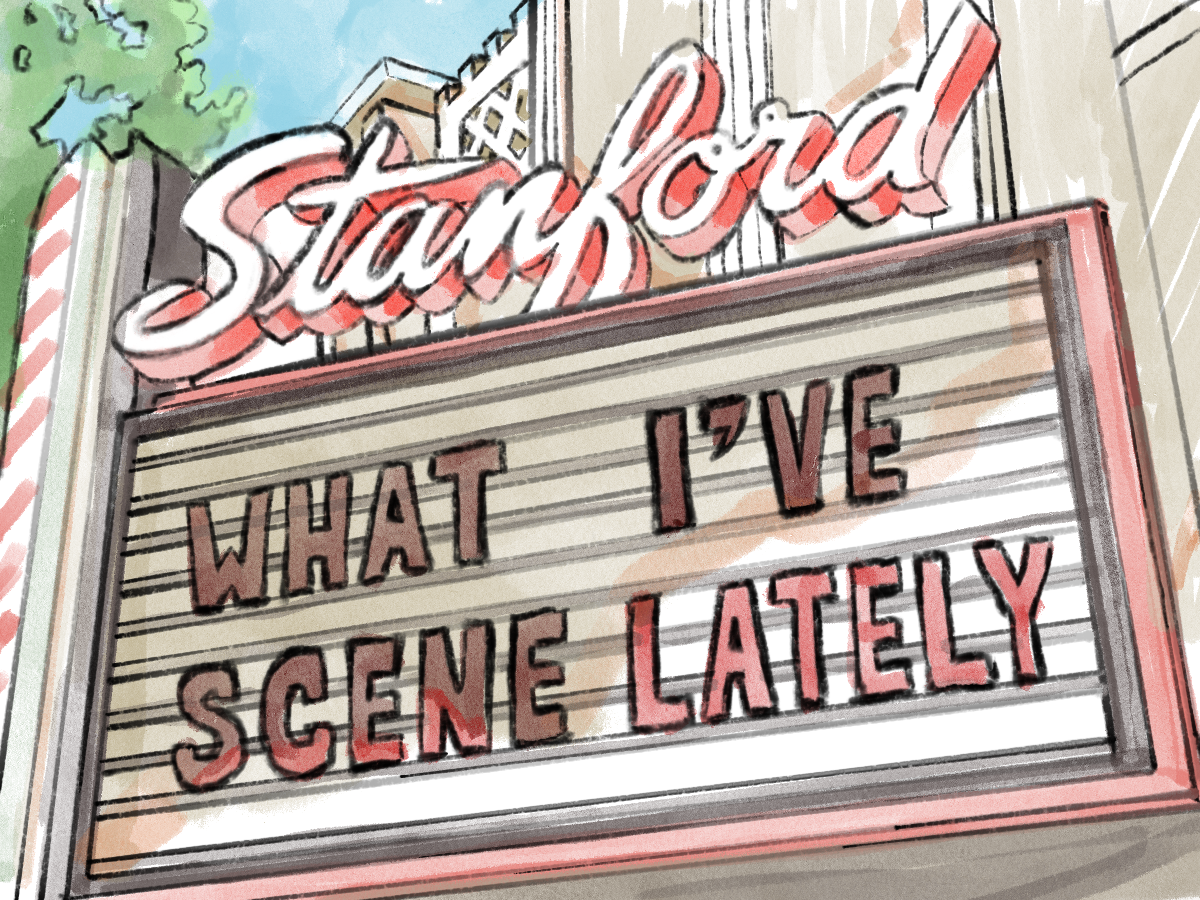
In her column “What I’ve Scene Lately,” Chloe Loquet delivers witty, opinion-forward reviews of the latest in film and television.
Editor’s Note: This article is a review and includes subjective thoughts, opinions and critiques.
This review contains spoilers.
Let’s set the scene. I’ve just sat down with my best friend at the Palo Alto Landmark Theater, popcorn in hand and ready to watch Emerald Fennell’s “Wuthering Heights” (2026). I’m expecting a heart-melting romantic epic just in time for Valentine’s. What we get isn’t a sweet adaptation of Emily Brontë’s Victorian love story, but two hours of bodice-ripping, raw egg-oozing and sweaty back shots (props to Jacob Elordi’s back double).
Like past incarnations, “Wuthering Heights” tells the story of Catherine Earnshaw (Margot Robbie) and Heathcliff (Jacob Elordi), whose relationship evolves from a childhood bond into passionate, dangerous love. Their connection faces class barriers, and later greater tension after Cathy marries the wealthy Edgar Linton (Shazad Latif), leading to a tumultuous reunion and shared destruction.
Fennell — a three-time Oscar nominee — is best known for writing and directing “Saltburn” (2023), which amassed a cult following and criticism for its intentionally grotesque explicitness. One might say her latest work is a Saltburn-ification of a story that has been cinematically reinterpreted by nearly every generation. As a young movie lover, I’m not entirely sure that what Rolling Stone Magazine is calling “the horniest literary adaptation ever made” is the retelling we were asking for.
Right off the bat, suggestive wailing plays over a black screen. Darkness shifts into color, revealing not the steamy scene we anticipated, but a public hanging amidst a grimy, late-18th-century backdrop. Reacting to an involuntary bodily function rather than the extreme violence, the crowd erupts into frenzied laughter.
This opening sequence, decorated by the gritty, avant-garde electro-pop sound of Charli XCX’s “House,” sets the tone for the rest of the film. Juxtaposing life and death, pain and pleasure, Fennell makes it clear this is not a polite Victorian period drama, but a raw Gothic romance capturing the danger of the time. Her sensory-rich blend of unabashed comedic edge and fever dream aesthetic sings throughout, establishing a refreshing artistic perspective.
In a stunning celebration of craft, “Wuthering Heights” develops a modern-Gothic style that is simultaneously intensely dark and captivatingly whimsical. Cinematographer Linus Sandgren and production designer Suzie Davies deserve their flowers for the transcendent world they conjured: Sandgren’s ethereal, sweeping visuals transport viewers to otherworldly moors, while Davies’s curation of Cathy’s bedroom — with its sweating walls wrapped in blush, vein-streaked material — creates an intimate, dreamlike “skin room” reflecting the protagonist’s complex essence.
As a creative director, Fennell delivers a world unlike any other; as a storyteller, however, she seems to fall a bit short.
Going in expecting a wholly faithful interpretation of the book will only result in disappointment. Plot-wise, there are some key shifts that might rattle Green Library’s resident bookworms. In Fennell’s fantasy, Cathy is older (though not much more mature), and Heathcliff (described as ambiguously “dark-skinned” in the book) is whitewashed. These casting decisions have received backlash, with critics opining they corrupt core aspects of both characters’ identities.
Fennell has defended her decisions, claiming Robbie perfectly captured Cathy’s soul regardless of age, and that Elordi was her muse in wanting to create this film as he was exactly the man she envisioned when she first read the novel as a teenager. While I agree the casting came at the expense of original details and sometimes distracted from the narrative, I appreciate Fennell’s commitment to a distinct vision and her zeitgeist-attunement in selecting a pairing that would be sensationalized and pull in viewers.
Further edits include the abbreviation of both cast and storyline. Unlike the book, the film does not explore the lives of the second generation of the Earnshaw and Linton families. By focusing solely on Cathy and Heathcliff’s fatal attraction, Fennell’s interpretation drowns out all other plot points to reframe the story as a chaotic Romeo-and-Juliet-esque romance. I opt to view this choice not as an oversimplification of the source material, but a dissection of the volatile, all-consuming love that captivated Fennell as a 14-year-old reader trying to understand herself and the world around her. It’s not the cheapening of a classic but a re-imagination through the eyes of who Fennell was when she first encountered Brontë’s work.
With its emotionally distant characters, celebration of cruelty, melodramatic tone and overreliance on shock factor, “Wuthering Heights,” is far from perfect. But it did what few period romances can do nowadays: it filled theaters. True movie magic is showing major studios and the world that a female filmmaker, her gutsy vision and Elordi shielding Robbie’s eyes from the rain — not Michael Bay or a Marvel franchise — can fill seats.
Did I love it? No. Did I enjoy being transported to a world where I could forget about impending midterms and get lost in the messy ride? Absolutely. This film may not be a cinematic masterpiece but for two hours and 16 minutes, “Wuthering Heights” had an entire room of people — Stanford students, middle-aged couples and teenage girls alike — hysterically laughing, gasping and sobbing together.