
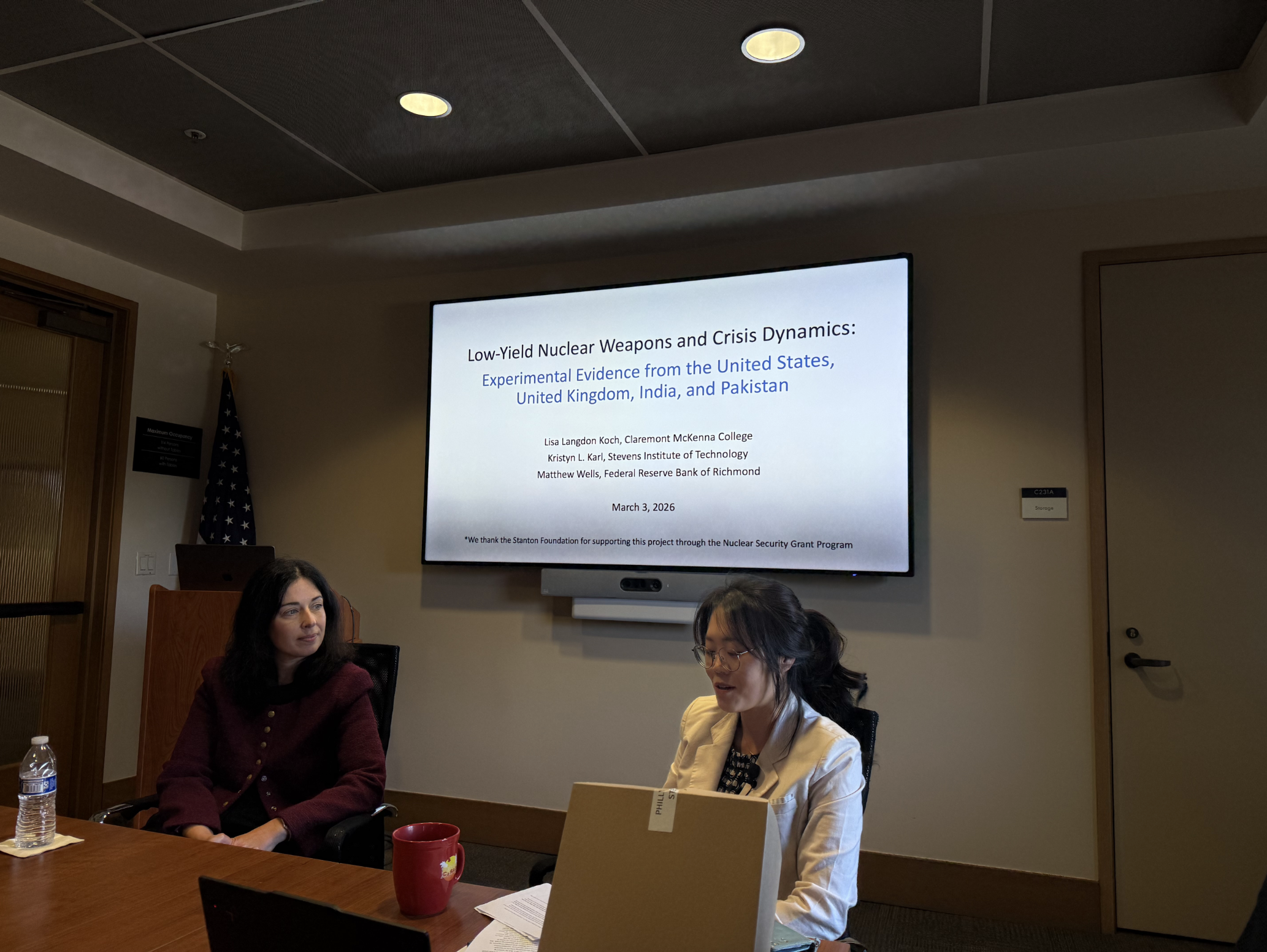
Lisa Koch, an associate professor of government at Claremont McKenna University, emphasized the importance of framing to shape public perceptions of conventional and tactical or “low-yield” nuclear weapons in a crisis dynamics talk with the Center for International Security and Cooperation (CISAC) Tuesday.
Koch presented a research survey she conducted in 2023 to investigate the perception difference between conventional and low-yield nuclear weapons. The survey included hypothetical scenarios of strikes between India and Pakistan and between the U.S., U.K. and Russia, in relation to a North Atlantic Treaty Organization (NATO) airbase in the Baltics. Respondents were asked to choose between conventional strike and low-yield nuclear strike usage, based on information provided about military and civilian casualties.
Low-yield nuclear weapons are “nuclear weapons that have an explosive yield of 10kg or less,” Koch said. “Perception is what matters in a crisis.” She explained that nations like the United States, India, Pakistan and potentially China prefer describing such weapons as “low-yield” or “lower-yield” instead of “nuclear” to shape perception.
“U.S. officials introduced the term ‘firebreak,’” Koch said, a strategy that aims to “contain conflicts to conventional weapons use and prevent escalation to nuclear weapons use.”
The “threat of unacceptably costly punishment and the credibility of that threat” shapes the question of whether or not nuclear weapons are a stabilizing force, Koch said, citing Schelling and Jervis, two prominent nuclear weapons scholars.
CISAC fellow Sulyige Park asked whether responses might differ in a “first use” scenario rather than a retaliatory one. Koch said she would “hesitate to speculate” without further study, noting that her research was motivated by debates over tit-for-tat responses.
Koch’s research also analyzed crisis dynamics between India and Pakistan, including the Pulwama and Balakot crisis that occurred between Feb. 14 and March 1 in 2019, marking the first time a nuclear-armed state used airpower to attack a nuclear-armed enemy’s sovereign territory.
Her research also addressed the Pahalgam attacks that occurred in May of 2025, which Koch described as an “escalating series of strikes with each state’s sovereign territory,” featuring veiled nuclear threats on both sides.
“One lesson that Pakistan took away from the 2019 crisis…was that their strategy of full-spectrum deterrence was working,” Koch said. Full-spectrum deterrence is the practice of “investing in a diverse array of nuclear weapons, with serious attention to increasing the low-yield nuclear arsenal.” According to Koch, this strategy allowed Pakistan to convince India that its nuclear deterrent is credible.
Emily Tallo, a CISAC postdoctoral scholar, asked about the specific framing of the India–Pakistan scenario and whether respondents demonstrated knowledge of official nuclear doctrines. “What was the information given to the Indian and Pakistanis about the setting for these strikes to occur?” she asked.
Koch explained that while only a small number of Indian respondents explicitly referenced the country’s “no first use” doctrine, many articulated restraint in principle. Koch also noted that some respondents in Pakistan appeared more likely to assume India had already crossed the nuclear threshold, revealing differing baseline expectations.
Kevin Bustamante, a CISAC fellow, questioned why survey respondents in the U.S. and U.K. appeared more restrained than those in South Asia. Koch said contextual stakes likely mattered. An attack on Latvia, even as a NATO member, might not register as a “vital interest” for American or British respondents, she said, whereas India–Pakistan crises are perceived as direct, existential confrontations. She added that Western publics might also assume that strong conventional capabilities reduce the need for nuclear escalation.
Given the region’s dense geography and public discourse, postdoctoral fellow Sitara Noor raised concerns over whether South Asian respondents meaningfully distinguished between “tactical” and “strategic” nuclear weapons. “There is no such thing as tactical,” Noor said, arguing that in the India–Pakistan context, “any nuclear use would be strategic in nature because of the border, the closeness of the border, and the population on the borders, on the both sides.”
Koch acknowledged that many participants lacked technical familiarity, with a notable portion expressing confusion. Still, she said open-ended responses suggested that a substantial number understood qualitative differences between lower- and higher-yield weapons — even if they did not use doctrinal terminology.
Throughout the discussion, Koch returned to a central theme: in nuclear crises, “belief and perception” shaped by elite framing, historical experience and geographic context may be as consequential as material capabilities.