
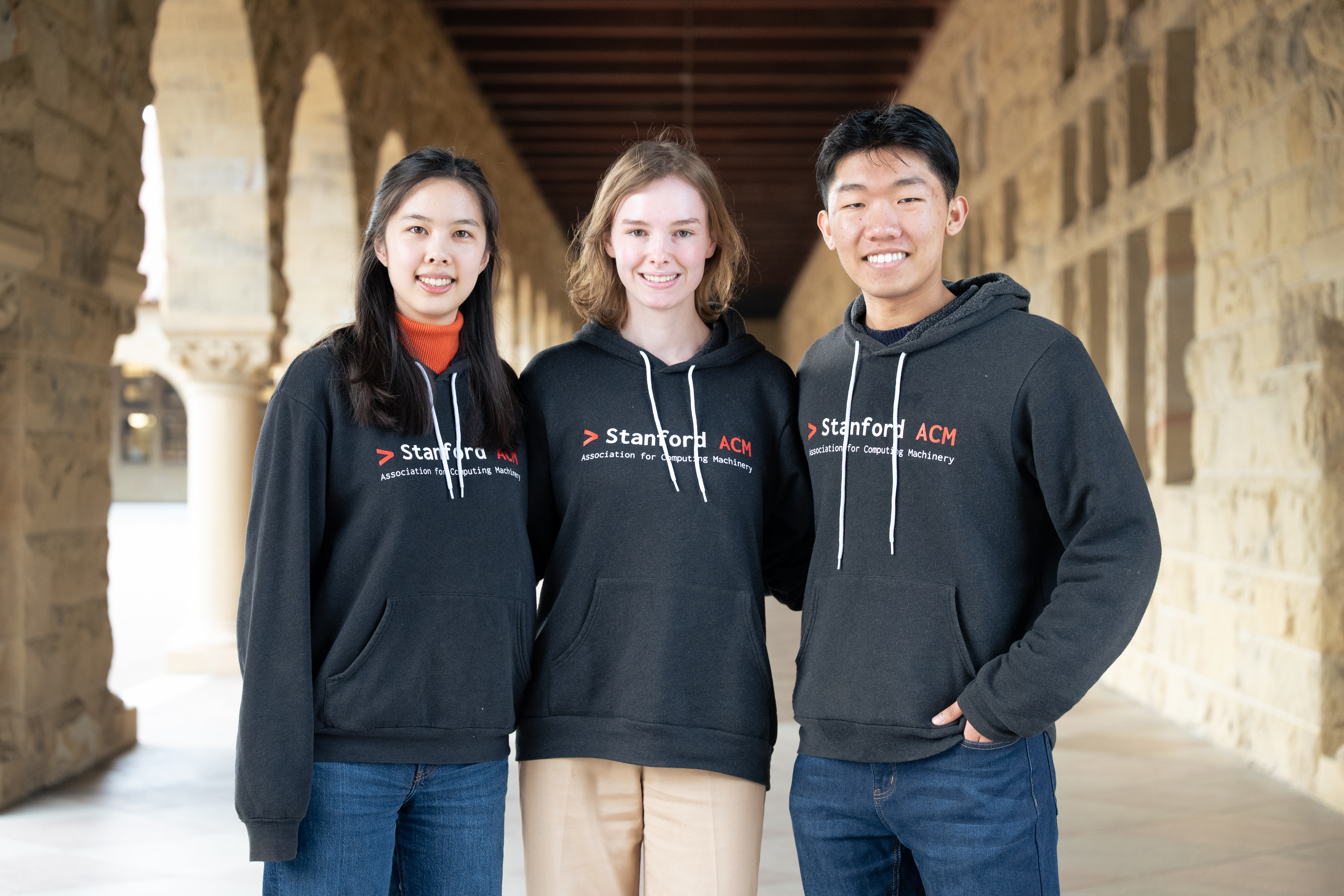
College students have always had a ready answer to the question: “What are you doing after graduation?” At Stanford, whose mission statement promises “academic excellence across the broadest array of disciplines,” those responses have remained as varied as ever. Lately, though, they’ve come with a qualifier:“…if it’s not replaced by AI.”
For Annie Lee ’27, Suze van Adrichem ’27 and Tony Wang ’27, the co-presidents of Stanford’s Association for Computer Machinery (ACM) club, AI is not an existential threat; rather, it is an invaluable tool that can be used to advance the field of computer science. Through ACM, Lee, van Adrichem and Wang aim to support the club’s more than 500 members as they navigate this rapidly evolving landscape.
The trio belongs to a generation of students who have never known computer science in the absence of modern AI systems. Van Adrichem, who studies computer systems and is pursuing a master’s degree in AI, says she and other students poised to enter the field have learned to incorporate AI as an asset to their work.
“What I find really interesting is that a lot of people talk about how it’s a lot more difficult to find a job in computer science now because of AI,” van Adrichem said. “I only started doing computer science two years ago, though, so it’s always been difficult.”
Van Adrichem said that as a software engineering intern last summer, she utilized workflows that integrate AI to aid efficiency.
“A new skill [in my internship last summer] became trying to describe a problem to a language model and being able to review their code as opposed to just writing perfect Python all the time,” van Adrichem said.
However, fundamental coding skills remain a priority at Stanford, said Lee, who studies computer science and math. “In academic environments like Stanford, there’s a strong emphasis on the need to be able to reason independently,” she said.
According to Lee, a mindset shift is required to transition between Stanford’s methods-based curriculum and workplace settings that value the use of AI as an effective tool.
“Schools want to train you to reason and think,” said Wang, a computer science major, who echoed Lee’s sentiment. “You come to school so you can stretch your brain. At a company, it’s not really to learn, but it’s to maximize the amount of things you can produce. In that case, I’ve noticed that companies are very pro-AI, like ‘please integrate AI into your workflows.’”
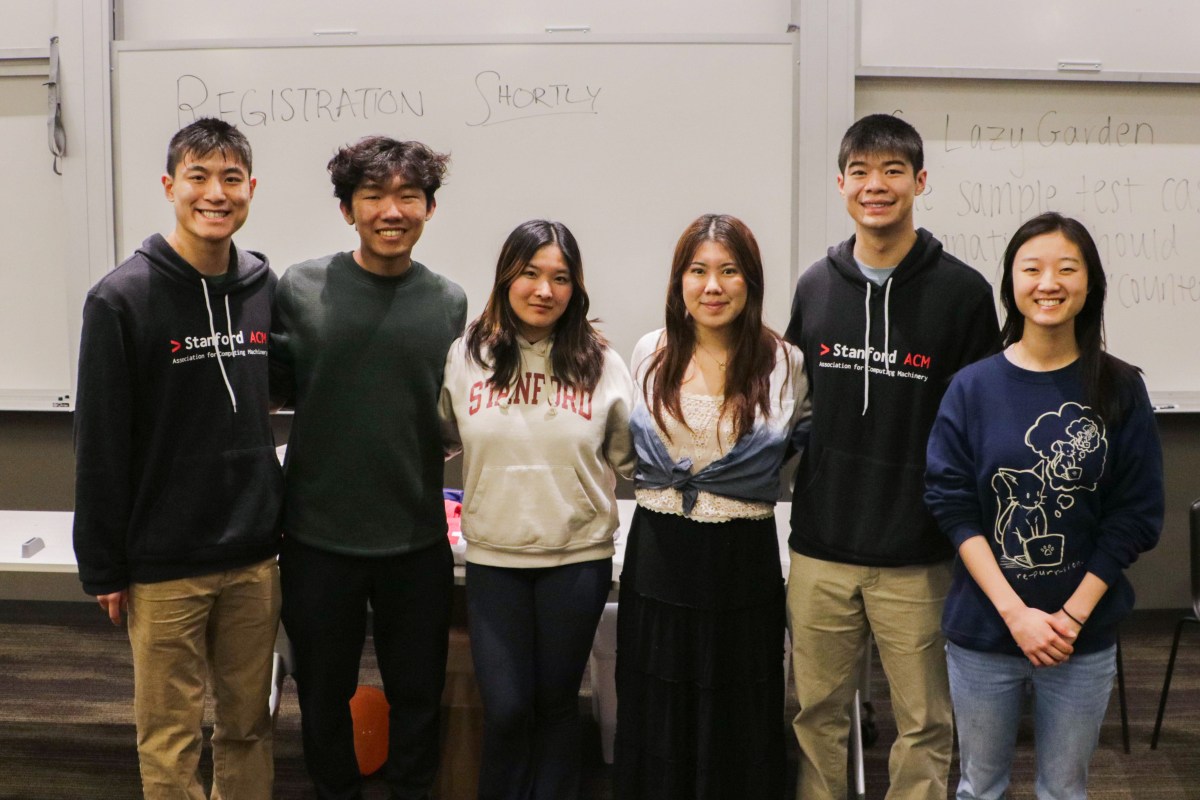
As co-presidents of Stanford ACM, Lee, van Adrichem and Wang foster community and coordinate professional opportunities to help students navigate both the computer science curriculum at Stanford and the professional opportunities available to them. Typically, ACM is led by two co-presidents, but the club’s growth necessitated an additional set of hands, van Adrichem wrote in an email to The Daily. The trio was elected to serve by popular vote.
ACM consists of several branches, such as MLab (a machine learning program), DevLab (a web development program) and Quant Gym (a quantitative trading training). The goal of these programs, Lee said, is to foster a collaborative environment where students can learn from their peers. As co-presidents, Lee, Wang and van Adrichem oversee all of the club’s branches, coordinating events, finance and logistics.
According to Wang, ACM aims to provide opportunities for students interested in a variety of computer science-related topics and activities. For example, the club hosts poker tournaments and web development camps, and includes a quant division for members interested in finance.
“We have lots of different initiatives around this theme of providing community for Stanford students interested in computer science,” Wang said.
ACM’s guest speaker engagements and company sponsorships help students familiarize themselves with the world of professional coding and computer engineering, said Wang. Notable speaker engagements last year included visits from representatives of Watershed, a sustainability software company, and Ramp, a financial technology company.
The aim of these initiatives, per Wang, is to show students that a degree in computer science has diverse applications in the professional world despite potential fears about AI replacing software engineering and coding jobs.
Lee, van Adrichem and Wang all plan to enter the field of computer science as AI researchers.
“Since [AI] is so transformative, doing work into interpretability or alignment, making sure that we have guardrails and it’s safe and unbiased, would be really cool,” said Wang, who sees himself “doing some kind of research or working at some startup that helps with making sure AI doesn’t end up evil in the future.”
Van Adrichem said that for her, change on the horizon regarding the nature of software engineering roles has turned her attention to research.
“Software engineering as a field is kind of changing a lot,” said van Adrichem. “I’m not entirely sure whether software engineering is something I want to do, because it might be something completely different in five or 10 years. I don’t think it’ll disappear, but I think it will be like a different type of job.”
Van Adrichem says that for her, research combines the excitement of finding solutions to complex technical problems with the intellectual stimulation of pondering broader topics.
“I do think that research is still just secretly software engineering,” said van Adrichem. “It is still a lot of engineering, but maybe the difference is that you’re more aligned towards finding an answer to something, as opposed to making a product work.”
According to Lee, the ability to make a tangible impact – which she believes is possible in research roles – factors heavily into her career decisions.
“I feel like company wise, I just really want to end up at a place where I align with the overall mission,” said Lee. “If I’m going to work every day, I feel like I want to do something that feels meaningful, like I am having this impact on this particular group of people for this particular industry.”