
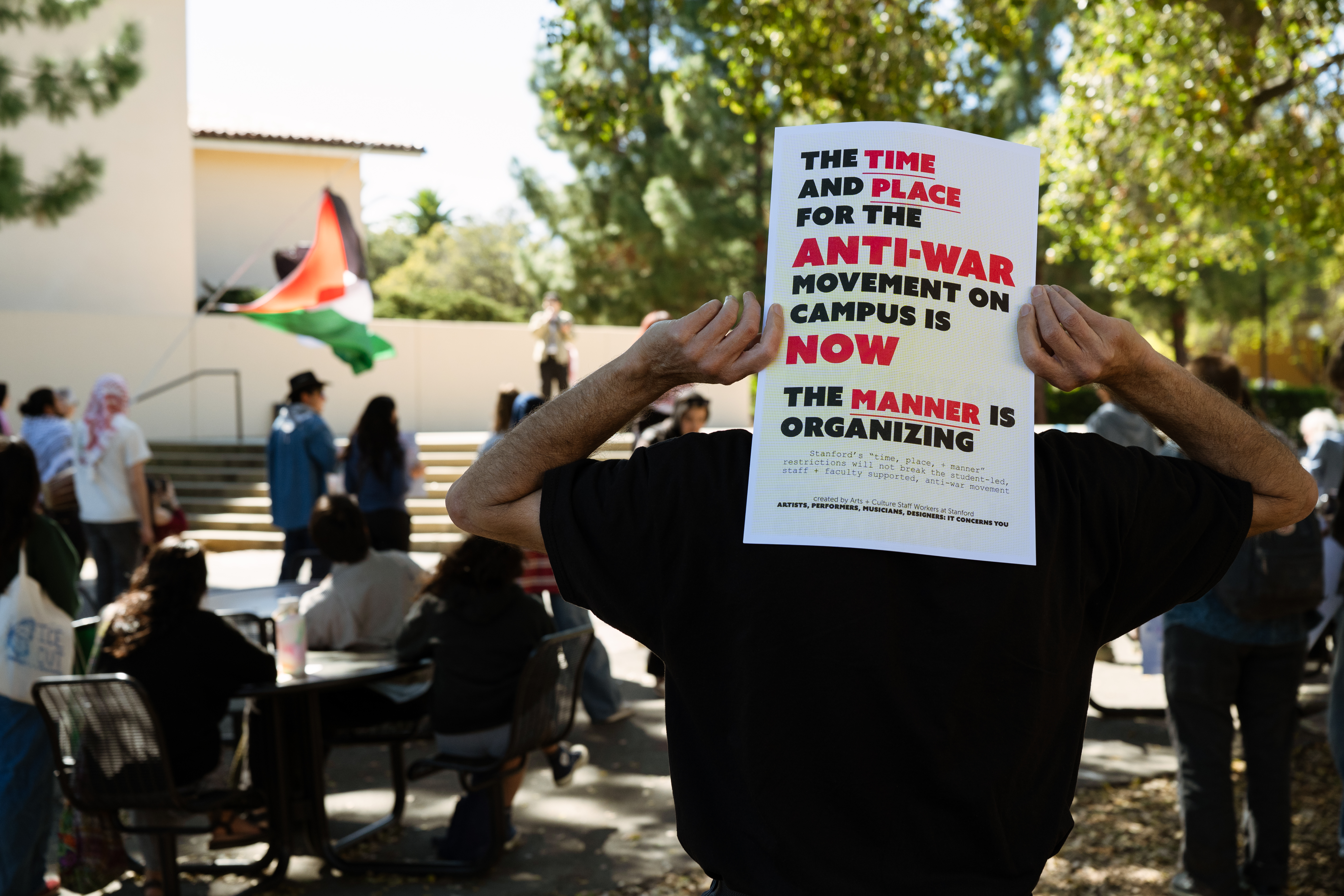
Several dozen Stanford students rallied at White Plaza to protest the U.S. war against Iran at a Thursday event hosted by Stanford Justice in Palestine (SJP), Stanford Jewish Voice for Peace (JVP), Stanford Pilipino American Student Union and Stanford Asian American Action Committee.
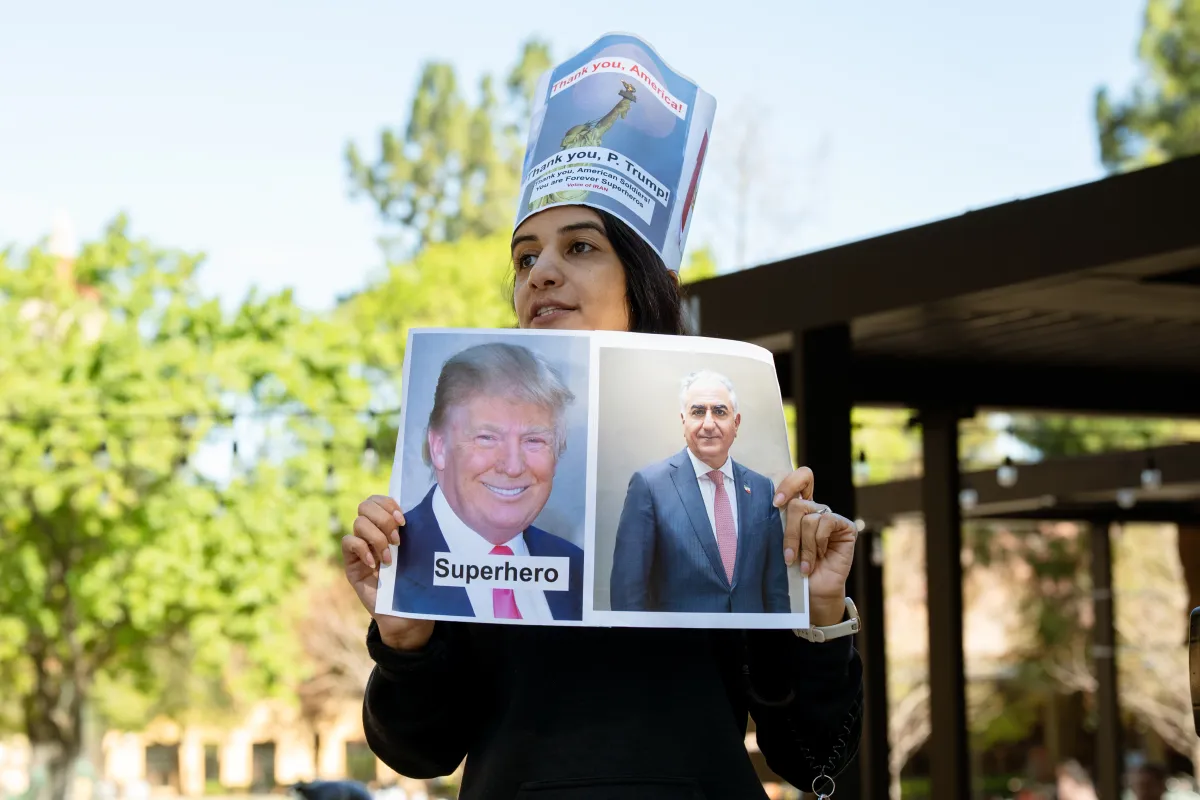
For nearly one hour, students delivered passionate speeches through a megaphone speaker, leading chants of “No War in Iran” and “Free, Free Palestine.” Some protestors brandished Iranian flags in support of the anti-war sentiment. The demonstration was met with several counterprotestors, who displayed a variety of slogans and signage supporting the intervention and thanking U.S. President Donald Trump and Israeli Prime Minister Benjamin Netanyahu for facilitating regime change.
The protest came as a response to the ongoing Iran War, which began with the killing of Supreme Leader Ali Khamenei and several high-ranking military officials by U.S. and Israeli airstrikes on Feb. 28. The two nations have since launched intensive bombing campaigns against Iran, which have killed more than 1,332 people, including an Iranian school located next to a military base.
The U.S. has offered several justifications for the conflict, which include attempting to prevent Iran from developing a nuclear weapon. President Donald Trump has hinted at U.S. goals of regime change and called for Iran’s “unconditional surrender.”
In response, Iran launched missile and drone attacks against Israel, Saudi Arabia, the United Arab Emirates and other U.S. allies in the region. Iranian attacks have killed seven U.S. service members, including four during a strike on a Kuwaiti port. On Saturday, Iran named Mojtaba Khamenei, the late Khamenei’s son, as the country’s new supreme leader.
“Our main focus here today is to stand against the war, to stand against U.S. intervention and stand against U.S. imperialism,” said SJP member Iman Deriche ’27, one of the organizers of the event. Deriche criticized the U.S. for backing “Zionist imperialism” and drew connections between the conflict in Iran and the Trump administration’s Immigration and Customs Enforcement (ICE) crackdown in Minnesota.
“Not only are you killing people abroad, you’re also killing people here in the U.S… there’s multiple wars,” Deriche, whose family is from Minneapolis, told The Daily.
Before the White Plaza protest, organizers had attended anti-war rallies in San Jose and Palo Alto, said Roberto Ibarra ’28, an organizer and former copywriter for The Daily. “We knew we needed to make a presence here [on campus] in order to start the antiwar movement,” he saidIbarra also noted plans for future rallies due to what he described as “extensive expansion we’re seeing by imperialism in the Middle East.”
Counterprotestors carried cardboard cutouts with the words “Thank You President Trump!” and “Free Iran!” stapled to them. Others carried photos of Trump, Netanyahu and Reza Pahlavi, the exiled son of Iran’s last shah. Throughout the demonstration, counterprotestors chanted “Free Iran!” Organizers asked several counterprotestors to leave.
“The people who always bear the brunt of war are the people of that nation. The innocent civilians, generally. It’s never, never, never just military targets that are killed,” said German Gonzalez ’26, another organizer. Gonzalez blamed much of the current situation on the past actions of the federal government, such as the 1953 Iranian coup d’état supported by the CIA’s Operation Ajax.
Gonzalez called for reduced U.S. intervention in Iran. “As the United States, we have to take responsibility for our actions in Iran. We’re not going to have peace in Iran by continuing to bomb it,” said Gonzalez.
“If you ask the people [if] they want the U.S. to intervene and bomb and destroy their homes, destroy their land and continue to starve them through economic sanctions, a majority of people are going to say no,” Deriche said.
In an interview with The Daily, Persian Student Association (PSA) president Mobina Riazi B.A. ’25, M.A ’26 offered a different perspective on the war, emphasizing the regime’s human rights abuses and noting its role in facilitating conflict across the Middle East.
“I’ve also heard the argument, ‘Should the U.S. intervene with every bad regime?’ And to that I say, the Iranian regime is not comparable,” Riazi said. “It is the number one sponsor of terror around the world and against its own citizens. It is an occupied force in Iran.”
PSA has not released any official statements regarding the war.
Riazi also acknowledged the split between perspectives. “I think that there’s a bit of a schism happening, wherein the no war movement is overshadowing this other call to action,” Riazi said, referencing the nation’s domestic human rights violations and authoritarian rule under the regime. However, Riazi denied that Iranian students were actively disagreeing with the anti-war protests.
“More so, there’s concern and frustration that so much attention is being given to [the no-war movement] — attention that is then mislabeling and mischaracterizing the regime and overshadowing a humanitarian call that’s been going on for so long,” she said.
A photo caption initially misstated that Reza Pahlavi was the Prime Minister of Iran. The Daily regrets this error.