
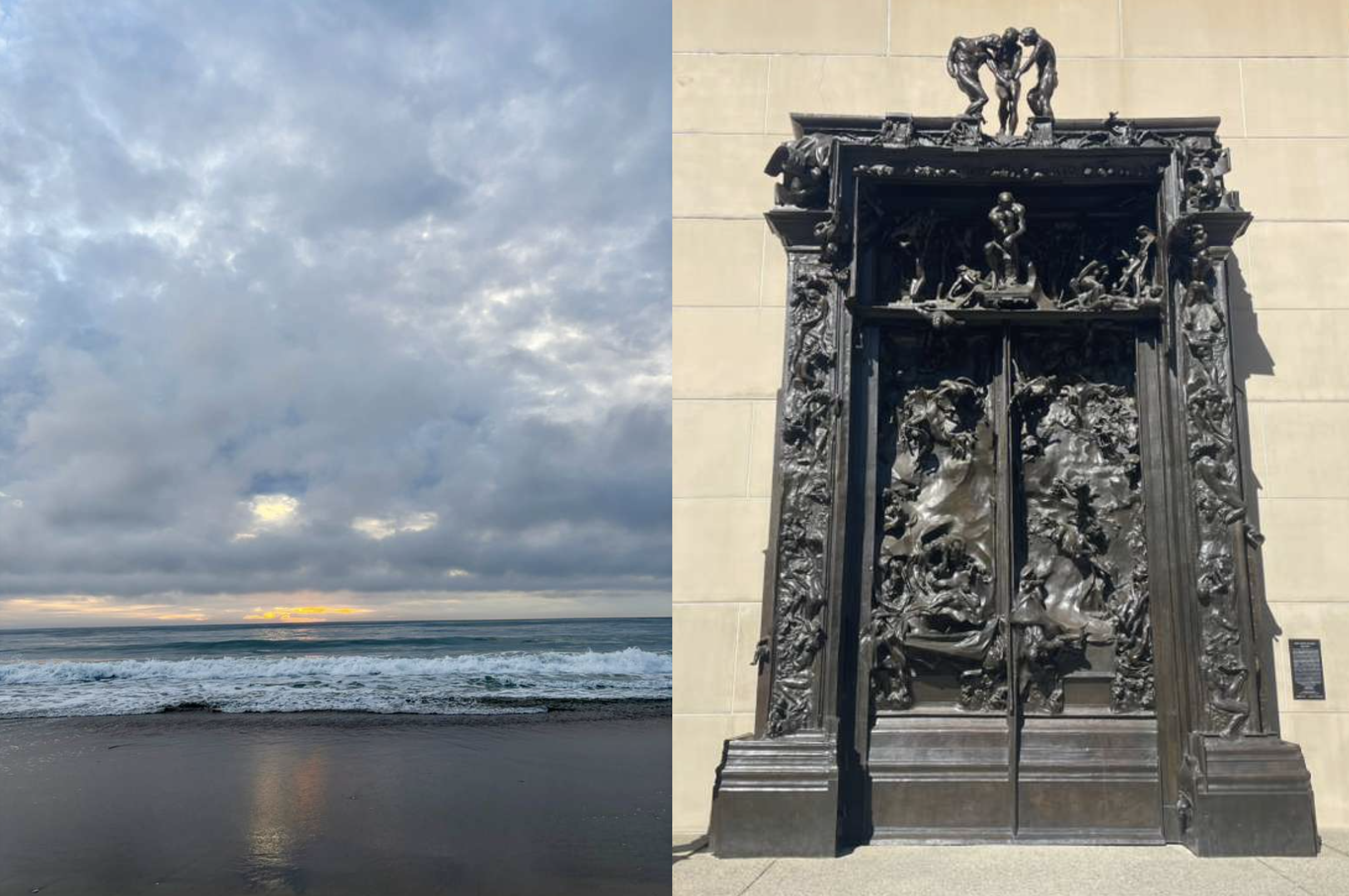
On the last day of February, I went to Half Moon Bay with a dear friend to catch the sunset on a cloudy evening. The sun was hiding behind a myriad of clouds, with its orange light beams trying to escape beneath the mist. We walked down to the sand, and I took off my flip flops to touch the wet sand with the soles of my feet. I felt cold, but I liked the sensation of it. Looking around, I saw an old couple hugging each other while staring into the ocean, and two women flying a kite. For a second, I wanted to approach them and ask if I could fly it for a bit.
I felt very simple, on the beach. My phone was dying so I wasn’t using it. It felt nice to experience something so basic — basic in a sense that going to the beach and feeling the sand and looking at the ocean was a normal and probably a long-lived human experience — without a connection to the outside world. I felt carefree. I liked the feeling so much that I hoped to carry it with me once we left.
We started talking about how one’s perspective to the events around them affects their whole life. “I think the key to happiness is to be nonchalant and not care too much,” I said.
I feel this so heavily in grandiose places like the ocean, where you actually feel so small compared to the permanence around you. Most unnecessary anxieties happen only inside my head, I have come to realize. Sometimes, I find myself stressing over how I am perceived by others; but in reality, being human is a very individual experience to the extent that people don’t even think that much, positively or negatively, about others that are not in their close circle. Even if such thoughts existed, they have no real impact, like a transparent bubble floating around which will decay over time. The truth is, you really can’t change other people, certain situations or the past, so it’s refreshing to accept this and have a stoic perspective on life.
Coming to Half Moon Bay made me remember the time we camped there with my old friend group. The whole time, I was so anxious and angsty about being there with them instead of doing school work. Overlooking the same ocean, I wished I had reacted completely differently back then; I wish the memory was different.
Maybe it’s easy to say this now, when I am at the end of my academic journey. And maybe it’s good that I know this, that some people and events are temporary, and really, life is temporary, and being 23 and young and without any wrinkles is temporary, and I should just be content about experiencing the now before it goes missing. As these thoughts passed by in my mind, I felt melancholic under the cloudy sky.
—
A couple days later, I stood by the Gates of Hell at the Rodin Sculpture Garden by Cantor with another friend. Though I liked how real, human-like and expressive Rodin’s sculptures were, I never truly paid attention to the Gates of Hell before.
We read the description by it. My friend repeated the last lines to me: “You don’t outgrow the gates, you grow into them.”
“What do you think the writer means by it?” I asked.
“Perhaps it means every time you look at it, as time goes by, you see something different; your interpretations change over time,” said my friend.
We made short remarks on the relationship between the Gates of Hell and Dante’s Inferno, but we didn’t know more. Nevertheless, it was perhaps even more interesting to look at the Gates with a lens that was foreign to its meaning.
We looked closely at the faces of the many figures on the Gates of Hell, seeing expressions of pain, struggle and horror. Some figures prevented each other from falling down, like a woman holding up to a man who is falling backwards. This was a common occurrence across the gates, with men and women holding onto objects, onto each other, in tense postures, to not fall down. It was as if there was a strong gravitational force pulling them down.
There were certain couples that were kissing each other. Perhaps when the world is ending, you cling onto love. My friend pointed out the skulls at the top of the gates, symbolizing death. We looked closely, and realised that some figures were more complete than others.
I asked my friend, do you think the figures know each other? They seem to be in small groups, but are they aware of each other? It didn’t seem like it.
The Gates of Hell seemed to be reflective of real life: wasn’t life a communal struggle too? The only person who didn’t seem to be affected by this pain was the Thinker, sitting at the top center, overlooking this chaos. Was the Thinker even a human, if he was not affected by this? Perhaps it was a god-like figure. He contrasted with the intense chaos and pain around him; he was stoic in the truest sense. Perhaps he had accepted that this chaos cannot be fought against and decided to preserve his peace and dignity.
As we left the Gates of Hell and started walking to CoDa, I thought to myself that perhaps the key to life is to be like the Thinker: absorb what is happening, but not be so reactive to events that are out of your control. Perhaps this is the only way to live a peaceful life. The Thinker’s stoicism is what I hoped for a couple days ago at Half Moon Bay as I reflected on life. I left the Gates of Hell hoping to be stoic like the Thinker as I go into the unknown future.