
Stanford community members have responded to the ongoing Iran war with a mixture of shock, dismay and, for some — including members of the Iranian diaspora — measured celebration.
The conflict, which began on Feb. 28 with U.S. and Israeli airstrikes on Iran and the killing of Iranian Supreme Leader Ali Khamenei, has seen more than 1,300 Iranian civilians killed and at least 12 more civilians from other Gulf states. According to the Pentagon, seven U.S. service members have died, with 140 more injured.
Leadership and staff members of the Iranian Studies program wrote in a March 3 statement that they were “yet again deeply troubled as we watch the unfolding events in Iran.” Stanford, they wrote, “has been home to many Iranian students and scholars…We share their grief and anxiety about the safety of their family, friends, and fellow Iranians who are caught in the merciless nightmare of an unwanted war.”
Mobina Riazi ’25 MA ’26, president of the Persian Students Association (PSA), told The Daily that, “The killing of Khamenei is celebrated. It’s something we all hoped to live and see.” Riazi said that the regime’s political stance diverged from that held by many Iranians.
“How do we bring attention to the fact that Iranian people are against this regime?…[This is] a war being waged by the government, against its own people,” she said.
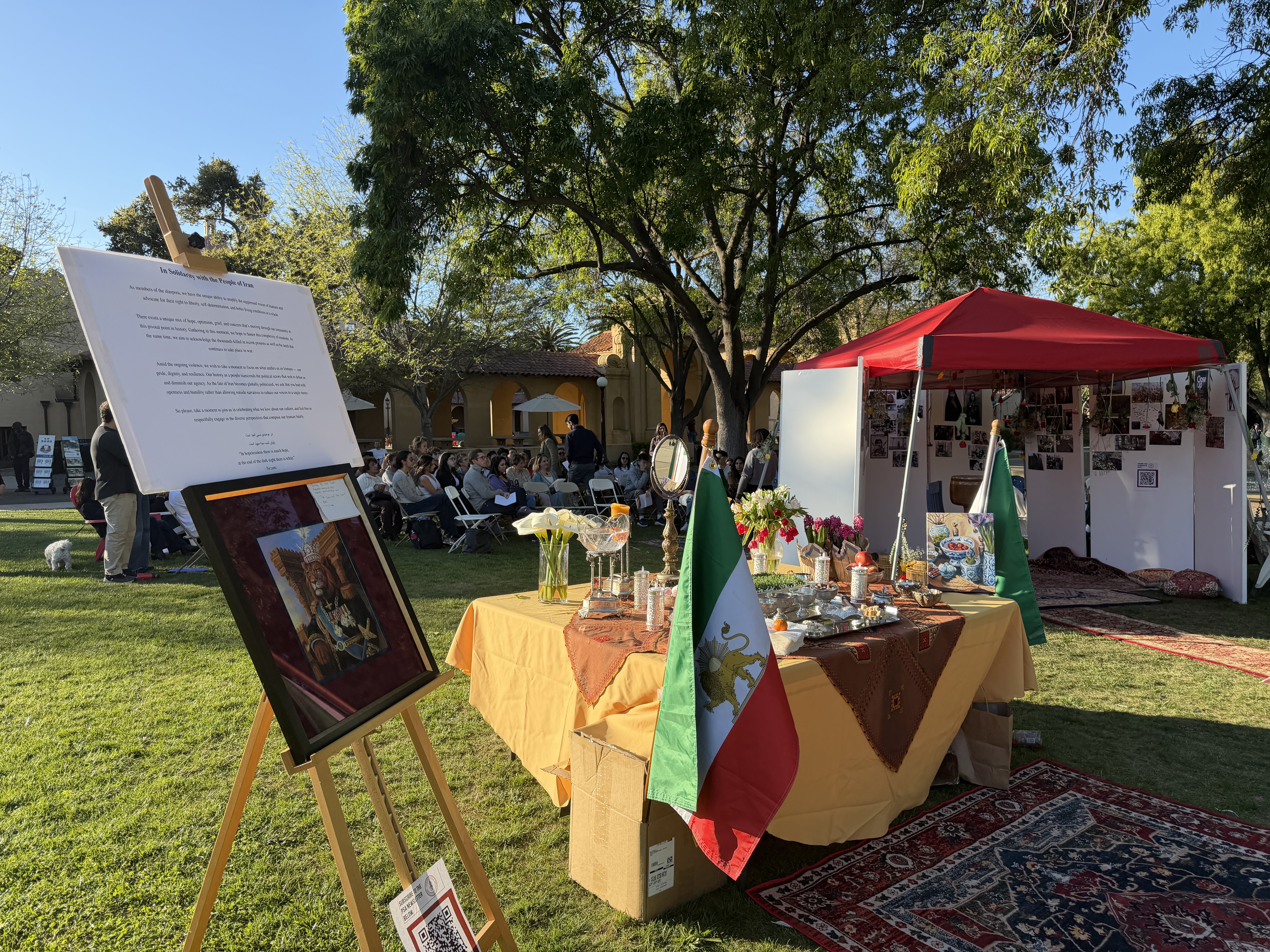
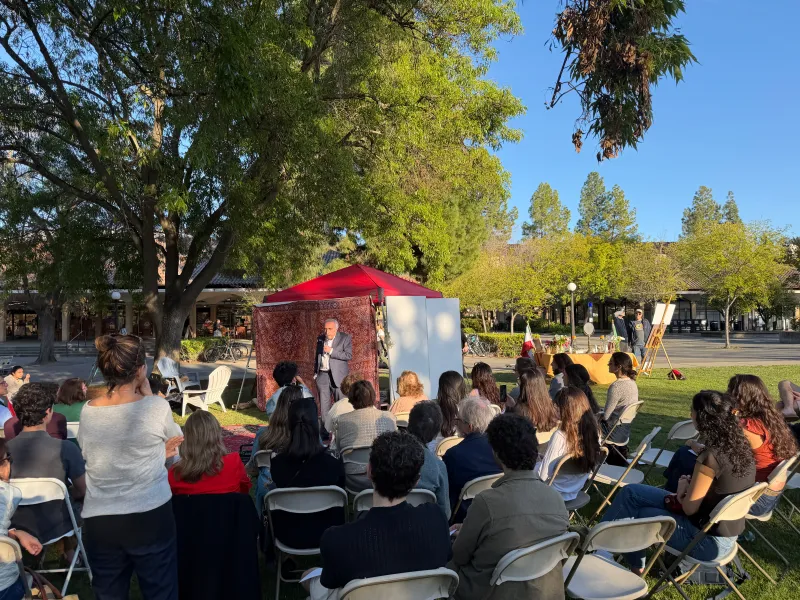
Last Thursday, PSA hosted an event in White Plaza titled “The Iran They Died For.” Featuring a public art installation and several cultural artworks, speakers addressed a small crowd. Some focused on Iran’s culture and history, while others more directly addressed Iranian resistance or the conflict.
“As members of the Diaspora, we have the unique ability to amplify the suppressed voices of Iranians and advocate for their right to liberty, self-determination, and better living conditions as a whole,” read a sign displayed alongside the artwork.
The event also featured a talk by Director of Iranian Studies and Freeman Spogli Institute (FSI) fellow Abbas Milani, an exile from Iran since 1986. “I think the Iranian regime has decided it cannot win this war, and have decided to try and end the war by creating chaos,” he told the crowd, referencing Iran’s actions last week. Since then, Iran named Mojtaba Khamenei, the late Supreme Leader’s son, as its new Supreme Leader. On Tuesday, Iranian Foreign Minister Abbas Araghchi described negotiations with the United States as “off the table.”
Milani, a co-director of the Iran Democracy Project at the Hoover Institution, also described Iran’s response to the U.S.-Israel strikes — which has included missile and drone strikes against Saudi Arabia, Kuwait, Bahrain and the United Arab Emirates — as a strategic blunder.
“[Iran] immediately went to their endgame by attacking [neighbors], rather than to a gradual process,” Milani said at the event. “The United Arab Emirates, as of [Thursday] morning, had received more missiles and drones than Israel had.” The late Supreme Leader Khamenei had long endorsed the destruction of Israel and the United States.
Mona Tajali, a lecturer in the feminist, gender, and sexuality department, also spoke at the event. Tajali stressed the work of the Iranian feminist movement and the broader importance of civil society in Iran.
“At the same time as women were protesting for their bodily autonomy and for their basic citizenship rights, [they] did not see a lot of support from some of the [men],” Tajali noted, referencing women’s rights advocacy since the 1979 revolution. “Iran does benefit from having a very, very strong civil society movement, whether it’s the student movement, the women’s movement or the labor [movement],” she added.
Speaking to The Daily on Thursday, Milani highlighted that Iranians “came out in the streets…celebrating and dancing when the news [of Khamenei’s death] was announced.”
“The next day, the regime decided to bring out its people, to show that there [was] a mourning, and then they have announced a week of mourning,” he added, referencing state-organized gatherings to grieve Khamenei.
Milani described what he saw as a split between everyday Iranians and the regime. Acknowledging a lack of available data and the need to rely on anecdotal sources, Milani said, “Iranians have a very, very favorable view of the U.S.”
According to Milani, hostility has not always defined U.S.-Iran relations, as Iranians once saw the U.S. as a “potential ally” against then-dominant forces of British and Russian colonialism.
Milani pinpointed a number of “critical” points in history that have since shaped U.S.-Iran relations, including the Second World War, the 1953 Iranian coup, the 1979 Iranian Revolution and hostage crisis and the Iran-Iraq war.
Some members of the community have spoken out against the ongoing Iran war. Last Thursday, Stanford Justice in Palestine (SJP), Stanford Jewish Voice for Peace (JVP), Stanford Asian American Action Committee (SAAAC) and Stanford Pilipino American Student Union (PASU) hosted an anti-war protest at White Plaza.
“We have to come out here, and we have to make our voices heard… As students, we don’t believe that our educational institution should be funding and building bombs,” said German Gonzalez ’26, one of the organizers.
Correction: A previous version of this article attributed Tajali’s statements to another speaker. The Daily regrets this error.