
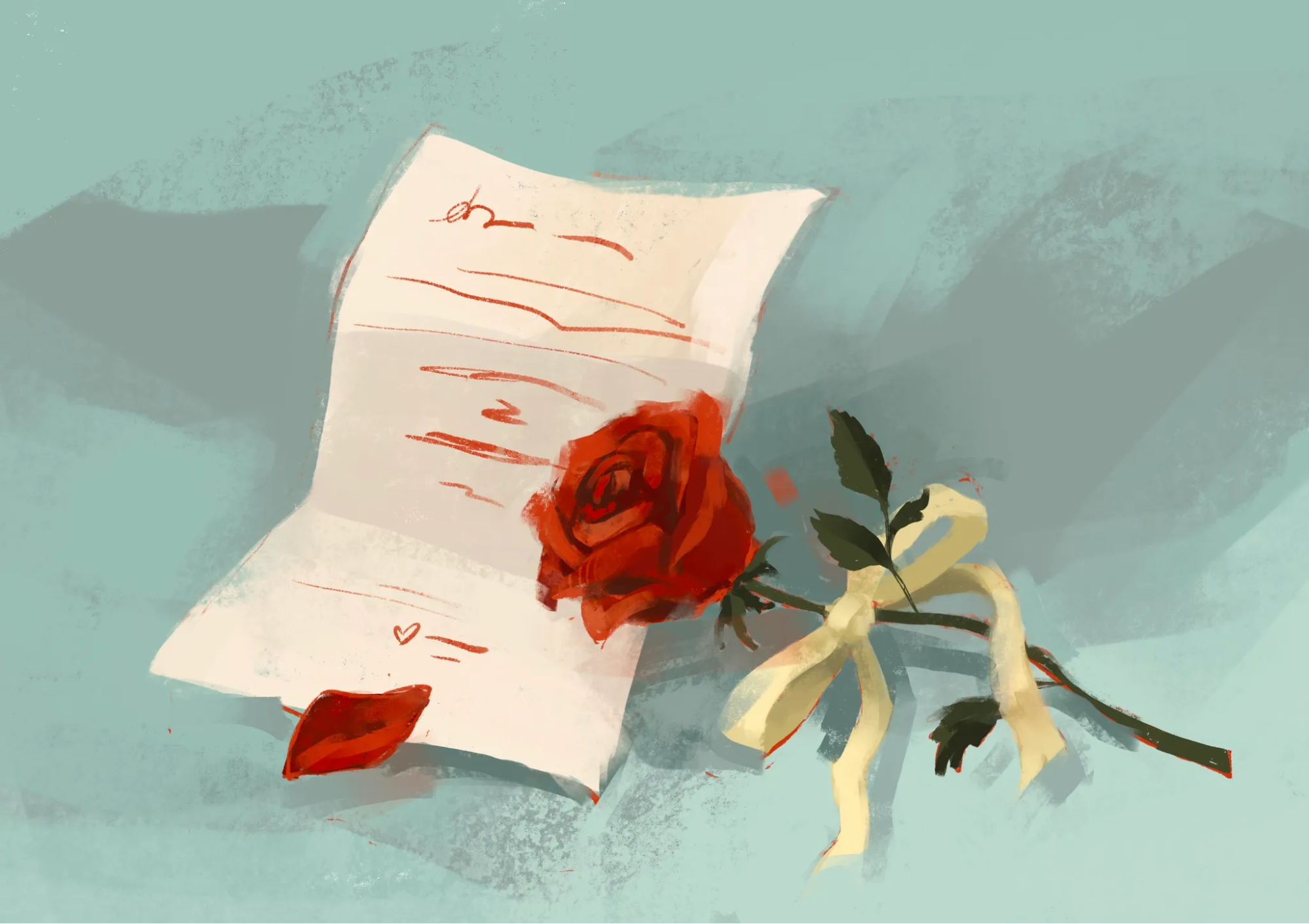
In “Californian Revelations,” Azzam Shafi ’28 explores universal themes in poetry from different cultures.
Editor’s Note: This article is a review and includes subjective thoughts, opinions and critiques.
Love is perhaps the most pervasive subject in all of poetry. But why? It can’t simply be because love is universal. Grief, hunger and even boredom are just as universal. Rather, love’s enduring popularity lies in its unique malleability and depth. By invoking a romance, even a fictitious one, a poet instantly gains access to the full spectrum of human emotion, from melancholy and heartbreak to longing and ecstasy. In this way, the lover is transformed into a powerful literary device, one capable of carrying a poem to great distances.
One of the masters of this form is the Andalusian poet Ibn Arabi. In his works, Arabi’s use of love and romance is nuanced, for it is neither completely fictitious nor metaphorical. During his travels in search of spiritual knowledge, the poet became acquainted with a woman named Nizam. Overcome by her beauty upon first sight, Ibn Arabi was assured that she was God coming in corporeal form to teach him the divine mysteries he was seeking.
Ibn Arabi fainted — which he admitted, in “The Meccan Illuminations,” made for an awkward first impression — during which he had a dream where Nizam guided him through heaven and the universe. He would later write 10 volumes of extraordinary poetry about Nizam and what she represented to him. Delivering beautifully dense verse, Ibn Arabi wrote an accompanying text to explain his poems.
For example, in poem II in “The Interpreter of Desires”:
“When she kills with her glances, her speech restores to life, as tho’ she, in giving life thereby, were Christ. Wild is she, none can make her his friend; she has gotten in her solitary chamber a mausoleum for remembrance. / She has baffled everyone who is learned in our religion, every student of the Psalms of David, every Jewish doctor, and every Christian priest. / When my soul reached the throat, I besought her Beauty and Grace to grant me relief, and she yielded.”
Ibn Arabi explains that Nizam, representing divinity, cannot be understood through orthodox dogma but through love alone. Her solitary chamber, he clarifies, is actually the human heart. He also describes her as unadorned because this divine wisdom took the bare form of human beauty, stripped of other attributes.
Jalaluddin Rumi, a contemporary of Ibn Arabi and a more well-known poet of the same school of Sufi esotericism, is also a fine example of this. Rumi frequently uses the beloved to anchor his poems. To a casual reader, his verses seem like typical flirtation. In fact, his works are too often misrepresented as such. Rather, he treats romance as a starting point of longing that eventually leads back to the divine. For Rumi, the physical is a mere reflection of more metaphysical, universal truths. “The beloved is all in all, the lover only veils Him; The beloved is all that lives, the lover is a dead thing,” he writes in “The Mathnawi.”
The same trend exists in the Western tradition. Even before the age of Romanticism, which brought a blossoming of this kind of layered verse, Italian poet Dante Alighieri was guided through paradise by Beatrice, a lover of his who had died and represented divine grace. “The Commedia” was heavily inspired by the likes of the aforementioned Middle Eastern esoteric thinkers, which explains the eerie similarity between Dante and, say, Ibn Arabi.
“I am Beatrice, who makes you go; / I come from a place where I desire to return; / Love moved me, which makes me speak.”
By the 19th century, the use of love as an allegorical device also developed to suit the needs of an increasingly secular and nationalistic world. The personification of nations, such as Britain as Britannia or France as Marianne, lent itself well to allegorical use. English poet William Wordsworth famously characterized the Isle of Britain as “Lucy,” who tragically died, perhaps as a commentary on the destructive pollution of industrialization.
“A violet by a mossy stone / Half hidden from the eye! / Fair as a star, when only one / Is shining in the sky.”
Similarly, German writer Johann Wolfgang von Goethe’s “Roman Elegies,” written during a trip to Italy, includes numerous real and fictitious romantic and sexual scenes that symbolize Italy and its culture as the writer saw it: exotic and indulgent.
“If my darling is stealing the day’s hours from me, / She gives me hours of night in compensation. / We’re not always kissing: we often talk sense: / When she’s asleep, I lie there filled with thought.”
It is fascinating how these poets, living on opposite ends of the world and in different eras, all found love to be an everlasting pillar upon which they could build their contributions to art.
Here on Stanford campus, where love is a precious commodity with hundreds of students awaiting their Date Drop matches each week, the underlying current is the same. Their quest for love is more than a search for companionship. It is the same longing for wholeness that has moved poets for thousands of years. Love remains a search for a larger meaning.