
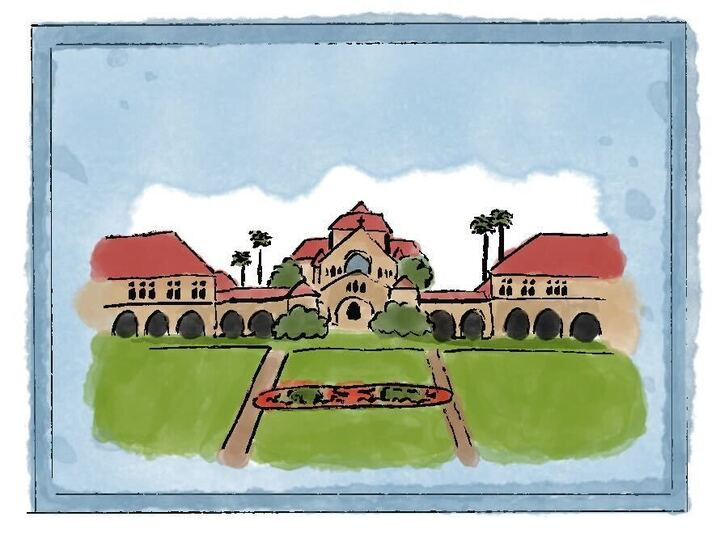
I officially have less than 100 days left until college graduation. All the coterm application deadlines have passed, so there’s no turning back and deciding to stay an extra year, and even if there was, I know my time has come. I’ve been hyperaware of how fast senior year is moving – I started this column just to write about it – but there’s an ever-present pang in my chest as the days dwindle from 99 to 98 and so on. I find myself reluctant to sleep if it means the end of another day, eager to wake up early so as not to waste another moment.
When I was filling out the Stanford senior survey as part of the application to graduate, I faced an onslaught of questions about my college experience.
Would I recommend Stanford to a high school student similar to myself? Yes! I would say I’ve had a good time.
Do I feel prepared to join the workforce? Sort of! Not really, but that’s likely more my fault than anyone else’s.
Have I changed since coming to college?
Sometimes I feel like no time has passed, and then I meet a current freshman and realize that it really has been four years, and I am not the same person I was when I was 17. I get dinner with my friends from Castaño and try to recall a funny story, only to realize I’ve forgotten some of the details, and the retelling is not as funny as the experience of living it was.
I came to Stanford to study linguistics, and lately, I’ve been thinking about all of the words and phrases that I’d never heard or used before coming here. Some of it is Stanford-specific jargon (daha, foth, plate). Some of it is the way we’re trained to talk in academic spaces to make ourselves sound smart (“in the sense that…”). And of course, some of it is the language of Silicon Valley, which continues to elude me at times, even though I hear the words and know how they’re meant to be used (product management).
I don’t have a good answer on how I’ve changed since coming to Stanford. I don’t look that different, and my interests have developed but never drastically diverged. I’ll say that I feel more like myself. Adolescence is a time of insecurity and desperately wanting to be seen: I spent my freshman and sophomore years constantly looking around to see if people were looking at me, self-conscious of whether they thought I was weird or cool or worth talking to. These days, I feel quite okay just looking ahead, knowing I have people in my periphery who like me as I am.
I do believe there is such a thing as “the way Stanford students talk.” But more specific than that, the way I talk is influenced by the individuals I spend my time with. My friend Eliza says, “Wait, guys…” before virtually every sentence, and because of her, I do the same, even over text, when it doesn’t really make sense (What are you asking them to wait for?). Around Mars, we’ve all picked up the habit of saying “mhm” at the end of a sentence because of Katie, and “realistically” when we’re giving an explanation because of Exly. I use the crying emoji to represent laughter in text messages because my friend Kasha uses it for everything. I would never use words like “bang,” “fade” or “bleurgh” if not for Odin and Steven, who use them so much that I had to adapt just to keep up. I love thinking about the way words transfer, that our speech is just a collage of every good conversation we’ve had in our lives.
I can do pretty good impressions of most of my friends, because everyone’s got something about the way they talk that makes us love them for it. I know there will be a day next year when I’m out in the world and hear a phrase I haven’t heard in a while, and I’ll miss the person it reminds me of because they used to be my neighbor. But that’s probably okay. I think that’s just how living works.
How much more can I change in 90-something days? I hope I learn a few new phrases and start using them in my speech. I hope that when I get to New York and start making new friends, they will attribute aspects of their language to me, which I can attribute back to someone from Stanford, and in that way, if these friends ever meet, we’ll already be connected by the string of our shared language.