
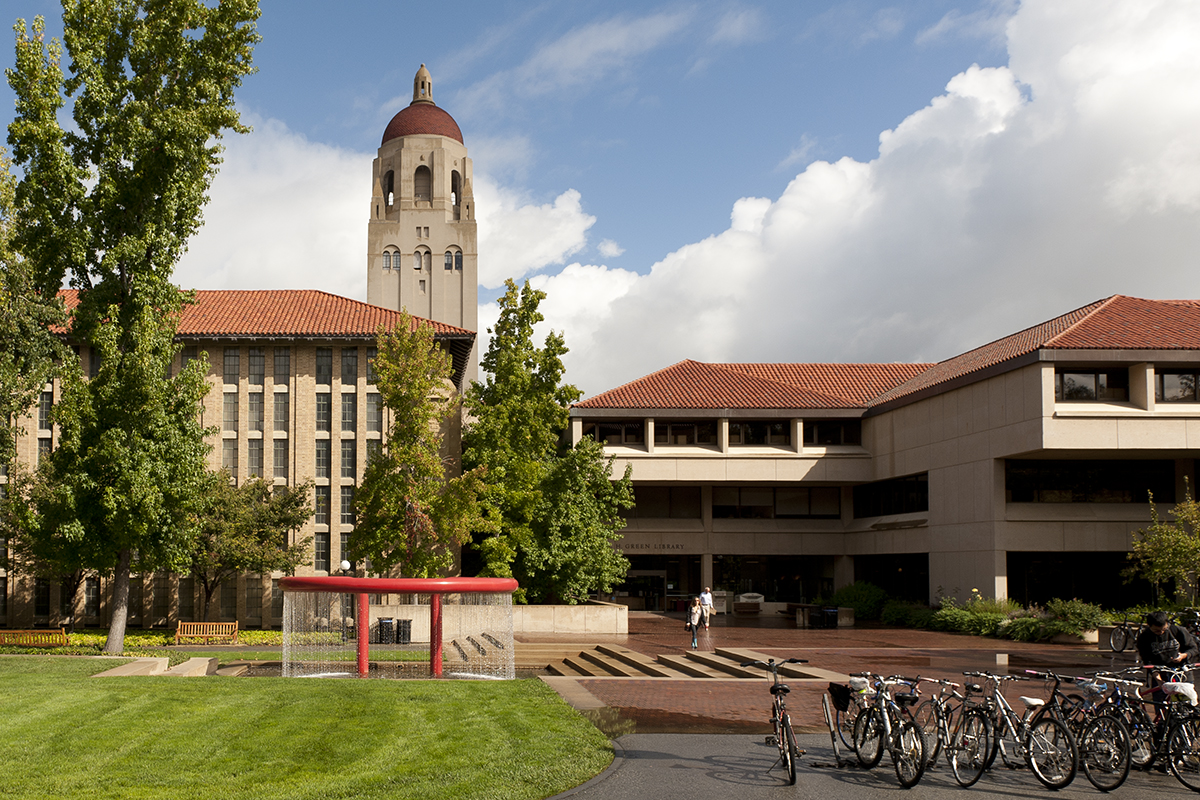
An exhibit in the lobby of Green Library’s east wing titled “Undergraduate Showcase: The Senior Reflection in Biology” presented capstone projects on biology and life sciences throughout the 2026 winter quarter.
The projects came from “The Senior Reflection,” a three-quarter biology department capstone series where students “undertake in-depth creative projects” that fuse artistic and scientific passions into a comprehensive final product.
“It’s getting a bunch of biology students who are all super passionate about whatever specific field they’re in and then being like, ‘Represent your work or your passion in some sort of artistic medium,’” said Nicholas Rodriguez ’25 M.S. ’26, whose work is featured in the exhibit.
Rodriguez’s project displayed an embroidery of several insects. Although he hadn’t done any sewing or embroidering before he chose his project, he said he found the work methodical and relaxing, and enjoyed incorporating his individual interests into his work. “[Studying insects] was always a hobby,” he said. “I originally came here for physics, and then completely did a 180 and ended up going down the ecology track instead.”
Rodriguez said the structure of the class, which allowed for open-ended projects that were graded more leniently, helped foster passionate and cohesive capstones. “Whatever I turned in, I knew my professors would be supportive of and happy with,” he said, noting that he thought this flexibility motivated his classmates to create the project they would be most proud of in the future.
Ian Miller ’25 M.S. ’26’s project focused on a topic he has long held an interest in: biomimicry, or the application of biological systems into engineering projects. His project was a surfboard inspired by the jet propulsion mechanisms present in squid.
“[Biomimicry is] something I saw when I was a kid, I was like, ‘Oh, it was pretty cool,’” he said. “Coming into Stanford it’s something I’ve thought about, but the class gave me an opportunity to explore that.”
Miller, who was recently accepted into medical school, appreciated the opportunity to do a project more focused on design and engineering than assignments for other classes he had taken.
Miller echoed Rodriguez’ sentiment that an open-ended capstone based on personal interests was more conducive to a fulfilling project. “It was more learning for the sake of learning rather than for the sake of doing,” he said.
For his project, prospective medical student Nathan Hidajat ’25 created an informative card containing details on common medical topics and instructions on utilizing public transit to reach free local clinics. He was able to use his project to both serve others and interact with a variety of providers.
“Reaching out to the clinics… really gave me a lot of hope and pride in the community, because all the clinics were so willing to let me put their locations on the cards and hand them out as much as possible,” he said.
Hidajat added that the direct feedback from both the clinics and patients he collaborated with was both critical to perfecting his project and a meaningful part of the production process.
The students also reflected on the division between the arts and sciences. Rodriguez thought that more majors, capstones and other academic pursuits should be more willing to bridge the two. “As the years go on, we’ve hyperfixated into ‘You’re either a scientist or an artist, and you can’t be both,’” he said. “It’s nice to have a whole class of people dedicated to showing that that’s possible.”