
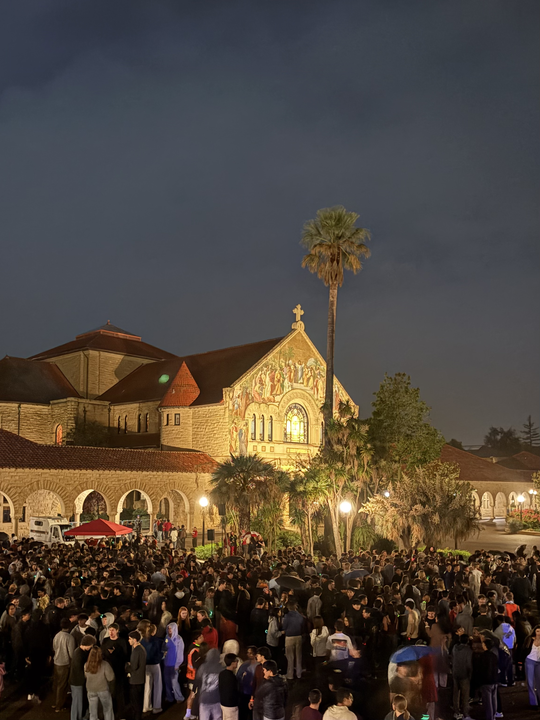
More than 2,000 students gathered on Main Quad on Wednesday night for the annual Full Moon on the Quad (FMOTQ), a hallmark of Stanford. Despite the rain, students expressed excitement as they exchanged kisses, hugs and roses. The event featured a body paint station, a countdown to midnight by the Mendicants, dessert from Street Meat and tabling by co-ops and the Sexual Health Peer Resource Center (SHPRC).
This year’s FMOTQ emphasized consent, safety and participation across campus communities. The event, which began in the 1940s, originally consisted of senior men giving roses and kisses to freshman girls. The exchange was believed to turn them into “Stanford women.” The event has been reimagined since its 2024 renewal, though organizers are committed to preserving its quirky roots.
“We’ve been through a couple of different iterations. The one that happened right before COVID was a $30,000 fest funded by the Office of Student Engagement with food courts and vendors. Sixty years ago, it was senior guys lining up to kiss the freshman girls. The first time it happened since COVID was in Winter Quarter 2024,” said organizer and Junior Class President Madhav Prakash ’27.
Participants wore different-colored glowsticks to signal comfort levels. Students had the option to wear red, yellow or green wristbands to indicate their wish to observe, exchange hugs or receive kisses, respectively. They were asked to read a consent sign before entering and accept a participation requirement.
“Full Moon on the Quad used to be a more casual event. Now there’s a lot more coordination. We worked with a bunch of different teams, including Stanford security, EMTs, the Office of Substance Use Programs Education & Resources (SUPER) and the Sexual Harassment/Assault Response & Education (SHARE) Title IX Office,” said fellow organizer Eva Lacy ’27.
Freshmen were eager to witness the storied tradition for themselves. “I wanted to be part of a tradition. I didn’t want to miss out on anything my freshman year, and I’m really happy that I decided to come,” Bishishta Acharya ’29 said.
Some first-time participants were surprised by the lack of kissing at the smooch-forward event.
“It sounded very animalistic to me, which is not how it’s gone. There aren’t very many people doing what the proposed goal of the activity is,” Olive Pacal ’29 said.
Lauren Yu ’26 felt that the event was similarly restrained, but said that it had improved during her time at Stanford. “The event is tamer than I used to hear about, but it’s also gotten better over the years,” she said.
Despite the change, students still had a largely positive experience.
“I’m glad a lot of people showed up, even if a lot of people are not engaging with the tradition in the typical way. People are having a great time, and that’s all that matters,” Kailash Elumalai ’28 said. Elumalai, a Medicant, was a performer at the event.
“We would like this to be a space where everybody feels welcome, which is why there’s an option for a wristband where you can just observe. There’s something for everyone. If you’re coming to make out, to make friends or to see the Mendicants perform, you can,” said Prakash.
Prakash and Lacy, both part of the Social Life and Inclusivity team for the Associated Students of Stanford University (ASSU), were second-time event organizers. The 2026 event was a welcome departure from the chaos of last-minute organizing in 2025.
“Last year, the onus was pushed on the [current] junior class presidents, but they didn’t have the capacity,” said Prakash. “We realized that we had a couple of weeks of spring left, and one of them had a full moon. We grabbed onto that date and jumped straight in.”
“It’s been nicer to have so much more time to figure everything out and make sure we can get as many student groups tapped in as possible,” added Lacy.
“One criticism I hear often about social life [on campus] is that it’s segregated. The Greeks always hang out together, the co-ops are always together and the frosh don’t know what’s going on. We tried our best to build a coalition and involve as many groups as possible,” Prakash said.
Audrey Knowles ’28, who was serving hungry attendees with Street Meat, was happy to support an all-campus event. “There are way more people here than I had anticipated. I couldn’t go last year, so this is cool to see,” she said.
As part of their push to involve freshmen, Prakash and Lacy reached out to the six candidate slates running to be Sophomore Class Presidents. Prakash and Lacy are running to be ASSU Executives under the “No Brakes” ticket.
An advertisement for FMOTQ was posted on Instagram by No Brakes’ campaign account in collaboration with official ASSU accounts and Prakash’s personal Instagram. The ASSU Elections Commission found the posts to be in violation of ASSU election guidelines and ordered the slate to “either delete the post or remove @nobrakesforstanford as a collaborator,” according to an ASSU email obtained by The Daily.
Lacy said that the account was removed as a collaborator on the post within half an hour of receiving notice from the elections commission.
“[Prakash and I] were eager to use any communication channels available to us to encourage people to attend the event, including personal and organizational Fizz accounts, Instagram, email, Partiful, flyers and individual outreach. We are overjoyed with how the event turned out, and thank the community for their participation,” she said.
Corrections: This article has been updated to clarify that No Brakes removed its account as a post collaborator in compliance with an order by the ASSU Elections Commission. A previous version of this article also misspelled Bishishta Acharya’s name. The Daily regrets these errors.