
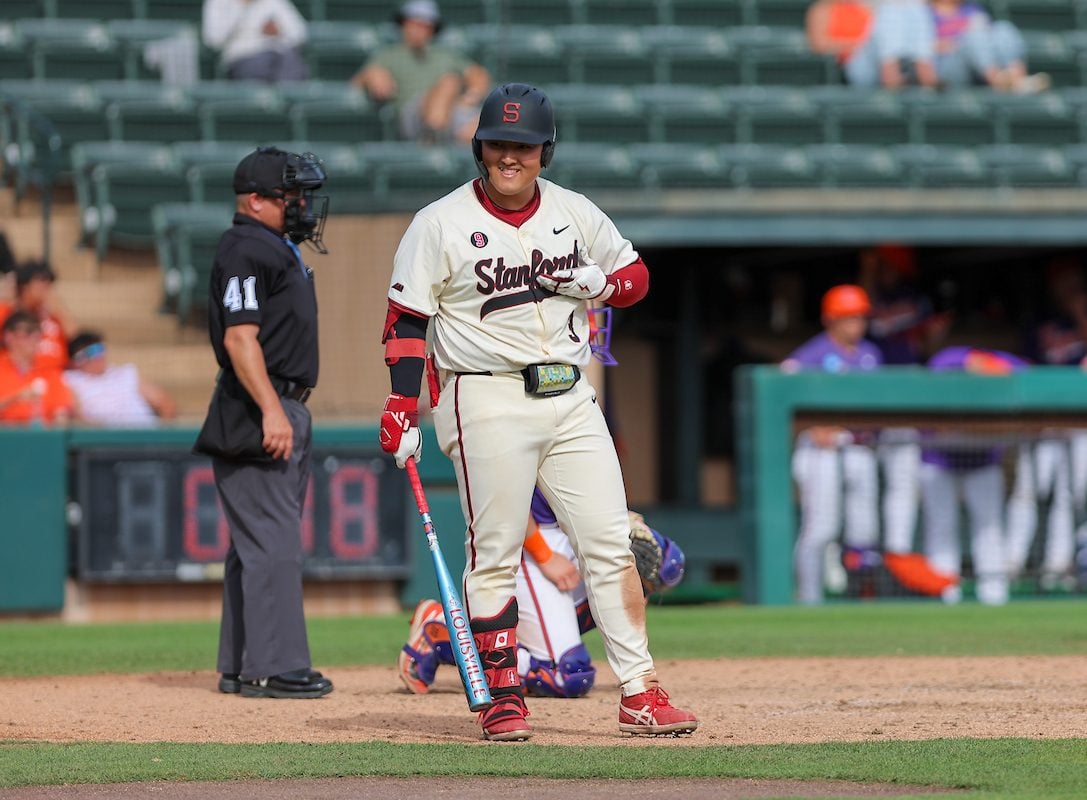
If you walk in the vicinity of Sunken Diamond, you might hear the loud crack of a metal bat before you see it. There’s a good chance that’s sophomore Rintaro Sasaki obliterating a baseball.
Last week at Virginia Tech, the Stanford baseball first baseman and leadoff hitter drove a ball during batting practice that traveled so far Statcast would not have been able to register the distance. The ball punched a clean hole between the T and E of “Tech” on the Hokies’ scoreboard.
In the actual series, the Japanese phenom went 4-for-11 (.364) with two home runs totaling 750 feet, three RBIs and five walks, good for a .563 OBP, helping the Cardinal secure their first ACC series win of the season.
Regarding the start of his second season of college ball, Sasaki told The Daily, “I think I’m doing well compared to last year.” At the end of his freshman year, he told The Japan Times that he would grade his academic and baseball performance as a three out of 10.
Not only was Sasaki navigating his first season in collegiate baseball last year, but this was his first time living in an entirely new country. Why did he, and many in the baseball world, have such high expectations for a 19-year-old?
In high school, Sasaki hit 140 home runs for Hanamaki Higashi High School, surpassing the record previously held by fellow alum and global sensation Shohei Ohtani. Sasaki’s own father, Hiroshi Sasaki, is the coach at Hanamaki Higashi who molded Ohtani into a two-way player and developed Los Angeles Angels pitcher Yusei Kikuchi. Kikuchi considers Rintaro Sasaki his younger brother — he even babysat Sasaki when he was just three years old.
The traditional path for a player with Sasaki’s profile was relatively straightforward: first be drafted by the NPB and eventually enter the MLB. At the age of 18, Ohtani made his debut for the Hokkaido Nippon-Ham Fighters before coming to the Major League, where he eventually signed the largest contract in professional sports history at the time, for $700 million with the Los Angeles Dodgers. Kikuchi played in the NPB out of high school for seven years before his successful MLB career.
If Sasaki opted to go this route, he would have likely been drafted No. 1 overall in the NPB and earned six figures a year, with media endorsements on top of it all. So when the Japanese phenom decided to forgo this orthodox path, it was a contrarian decision, to say the least.
In choosing to play collegiate baseball for the Cardinal and pass up prestigious SEC programs along the way, Sasaki faced immense pressure and skepticism for delaying his professional career. He was not driven by monetary incentives, nor enticing eligibility pathways to the MLB. He sought a new adventure, one that blended Division I baseball with an American education.
“I came here since it would be a good experience for me. That’s how I feel,” Sasaki told ESPN.
Sasaki collected countless preseason accolades, finding himself on Baseball America, D1Baseball and ACC lists before even arriving to the college baseball scene. If you watched a game at Sunken Diamond last season, you might have noticed a small media crew with extensive film equipment roaming the stadium — they were already capturing footage in preparation for a future documentary on Sasaki.
At the time, he had also just started learning English.
Most Japanese players who reach the majors rely on interpreters, helping them navigate the press, media and clubhouse. Sasaki made a deliberate choice to go without one.
“If you ask him a question in English, he wants to answer it in English,” said Stanford baseball communications director Tyler Geivett. “When he came over, he’s learning English by going to class, talking to the team in the clubhouse.”
Sasaki’s goal is to be the first Japanese MLB player who doesn’t use an interpreter. Still, navigating a new language while simultaneously transitioning to the student-athlete lifestyle has not been an easy task.
“Last year, everything was a challenge,” Sasaki said. “Stanford life, my first year in the United States. I’m not speaking English. Classes, general conversation, everything has been hard.”
He started all 52 games as a freshman, slashing .269/.377/.413 with seven home runs and 41 RBIs, a strong debut for any player in their first year. For Sasaki, this was not up to his own standards. But he is firmly committed to challenging himself, both on and off the field, and far from oblivious to the lifestyle he has chosen.
“I took risks in going to Stanford. Baseball is top level and I am challenged in academics too. It is hard, but I want to do that… that’s what I choose,” he said. “I keep showing up, even if I have a bad or great day, I try to be the same guy.”
Sasaki also did his due diligence before his long-anticipated decision to play collegiate baseball. On his recruiting visit to Stanford, he met with Nico Hoerner — now the Cubs’ second baseman — and spent 20 to 30 minutes asking him about the balance between athletics and academics. He talked with Ohtani and Kikuchi, with whom he continues to message over text.
“[Ohtani and Kikuchi] gave me advice about U.S. life, U.S. baseball and what I should expect of American baseball,” Sasaki said. “I think they were the biggest reason for why I decided to go to the U.S.”
As for his own team, he credits junior catcher Luke Lavin with helping him adjust to this new life, along with the entire staff.
“I want to say thank you and appreciate the whole baseball team and coaches. Everyone’s so kind,” Sasaki said.
Now, two years after moving 5,150 miles from home, Sasaki is settled in and embracing the American college experience.
“I’m just trying to be a student-athlete,” he said.
His baseball idols are Barry Bonds and Shohei Ohtani, while his favorite restaurants are Gott’s and In-N-Out. “Double-Double, every time. Animal fries. Milkshake. That’s my routine for In-N-Out,” he said.
Sasaki remains undecided on a major but loves exploring what Stanford has to offer. He took a favorite psychology and sports class last quarter, along with a few economics and human biology courses. He also loves the West Coast, California weather and the proximity to Japanese culture in the Bay Area.
“Asian towns, Japan towns… We can get our culture [in California],” Sasaki said.
Above all, Sasaki hasn’t lost sight of the unusual path he decided to take.
“As baseball culture in high school in Japan, nobody gets to Division I baseball after high school… It’s a pioneer thing, what I’m doing right now,” he said.
Despite the constant limelight, he’s unbothered, focusing on the day-to-day and doing things his own understated way.
“Now I’m here, so that means I’m kind of doing well.”