
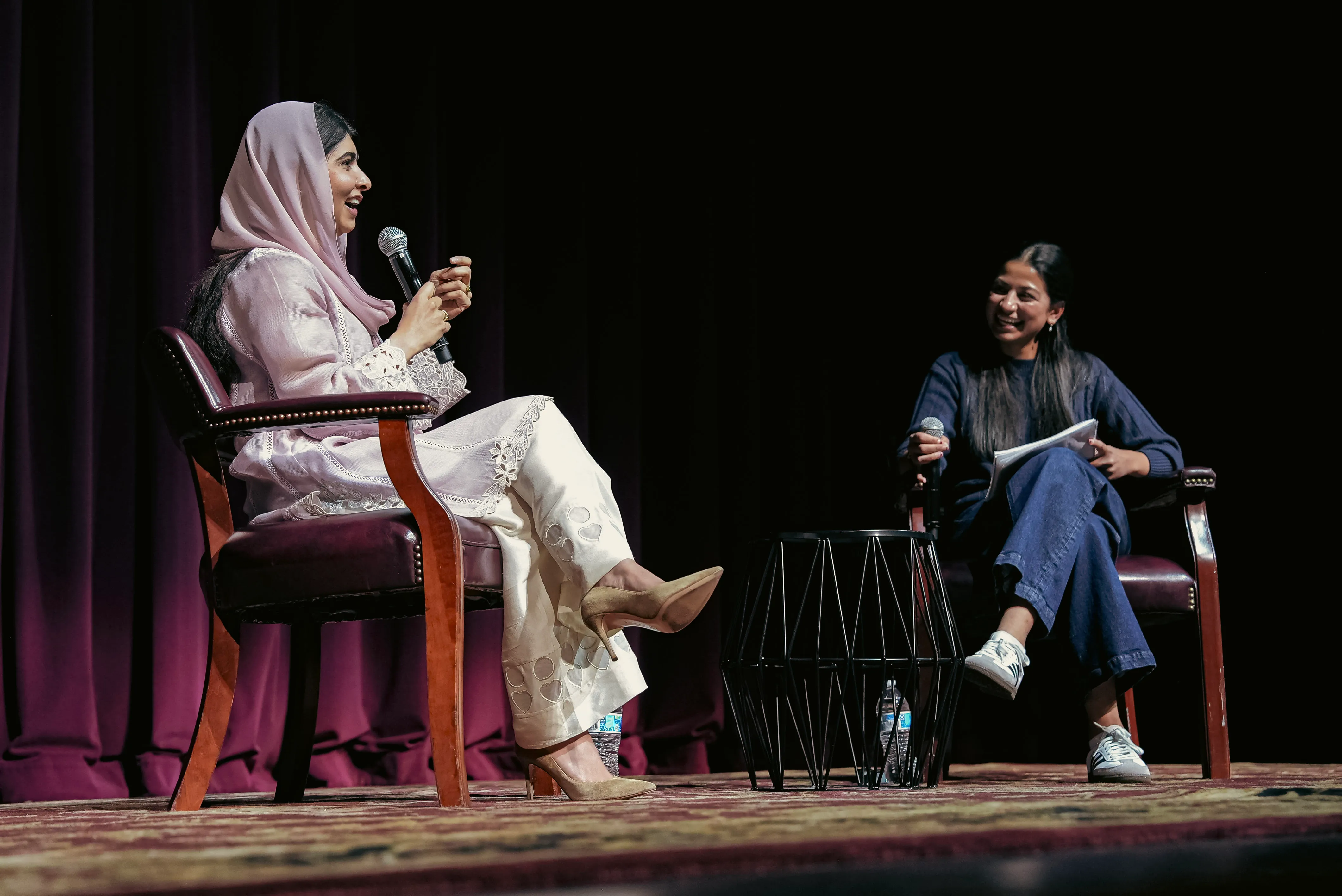
Malala Yousafzai, a Pakistani activist and the youngest Nobel Peace Prize winner, said her work for human rights, girls education and women’s rights is far from complete at an event on Saturday evening.
“I think the 11-year-old Malala would be upset that it’s been such a long time and there are millions of girls out of school,” she said. “But I would tell her that I still try to dream as big as her, and this is a long journey, but we’re not giving up.”
Stanford Speakers Bureau (SSB) hosted the event at Memorial Auditorium in conjunction with the frosh dorm Lantana. The talk was partly funded by the Riddell Endowed Fund, a grant endowment that enables dorms to bring speakers to campus, and moderated by Pakistani-American Lantana resident Malaika Ali ’29.
Yousafzai’s new memoir, “Finding my Way,” was a focus of the event. Yousafzai said writing the book was a form of therapy for her. “It felt that I was owning and reclaiming all of these things [major events] that were a part of my life,” she said.
By sharing her mental health journey in her memoir, Yousafzai hoped others would feel a little less alone. “I wanted to share my story because I was thinking about girls who were just like me,” she said. “I wished that I had heard someone’s story to make me feel like it was going to be okay.”
During the event, Yousafzai addressed the status of women’s rights — especially educational access — across the globe.
She described the Taliban’s rule in Afghanistan as “gender apartheid.” For her, this case of systemic discrimination shows there continues to be substandard protections for women and girls and little response from world leaders.
Yousafzai voiced her support for the campaign to recognize gender apartheid as an international crime, saying it matters for women and girls everywhere. “I want it to be a crime for… women’s rights to be taken away in Afghanistan and anywhere else in the world,” she said.
She went on to criticize American politicians. “We have seen how all of these presidents and their administrations have made compromises on women’s rights,” she said. “It makes me frustrated, but it also reminds me that we still have a long way to go.”
Throughout the event, Yousafzai spoke about the challenges she faces as an activist.
One such challenge is dealing with the misperception that she is a voice for everyone. Once, while speaking at a conference at the age of 14, someone in the crowd protested that she wasn’t doing enough for girls in neighboring communities. She responded by saying that we need more activists in order to represent every community.
“I don’t think we have to go with this idea that we can only have one hero and one villain at a time,” she said, reflecting on this memory. “I think we can have many heroes, we can have many voices, and that is the true way of activism, because the complete experiences of every person are so different.”
Yousafzai was also candid about navigating the pressures that come with being a public figure. She said she constantly balances Pakistani and Western culture, recalling online criticism over a photograph of her wearing jeans while studying at Oxford.
“When I wear something different, it becomes a huge concern for the whole community that somehow we have to be representatives of everything,” she said. “So I said, no. I said, the best way for me to respond to this is to keep wearing jeans.”
She handles these challenges by staying true to herself and her beliefs. “There will always be some sort of criticism anyway,” she said. “Then two, three days later, the noise just goes quiet.”
Yousafzai also discussed her relationships with her family. As a child, she did not want to be like her mother, who was dependent on her husband and never received an education. But once Yousafzai grew older, she developed more empathy and asked her mother what her dream for herself was.
“She had no answer. And that’s what made me realize that there has been this generation of women before us who were not even given the opportunity to dream something for themselves,” Yousafzai said.
Yousafzai expressed gratitude for her father’s supportiveness, sharing that there were other girls at her school who wanted to advocate for their right to receive an education but were held back by male relatives. Another female student volunteered to write a blog post for the BBC, yet her father would not allow it. 11-year-old Yousafzai offered instead, and wrote a blog post that brought her into the international spotlight.
This story resonated with SSB co-president Annika Joshi ’28, who helped organize the event. “She made it very clear that anyone can be an activist or an advocate for whatever issues they’re passionate about,” she said. “But… sometimes there are things that are stopping other people from that.”
Joshi added that “Finding My Way” might speak especially to Stanford students. “A lot of it talks about her experiences at university, and dealing with a double life of being a student but also being an activist,” said Joshi. “I think [that] makes it particularly relevant for students here, a lot of whom are doing this really, really incredible work, but are also ultimately just students that want to make friends and have fun.”
SSB co-president Anish Anne ’28 was grateful for how “appreciative” Yousafzai was backstage, spending time after the event speaking to all the people who helped put together the event.
“There are a lot of speakers that come to Stanford that project themselves on a stage as these super down to earth, insightful people. And then you go backstage and they’re like, ‘Okay, I want to leave now… I don’t have time for you.’ And Malala was not like that,” he said.
Anne said Yousafzai appealed perfectly to the student demographic, with 5,000 people registering interest and all 1,900 tickets selling out. “I think we really hit the Goldilocks on this one,” he said.
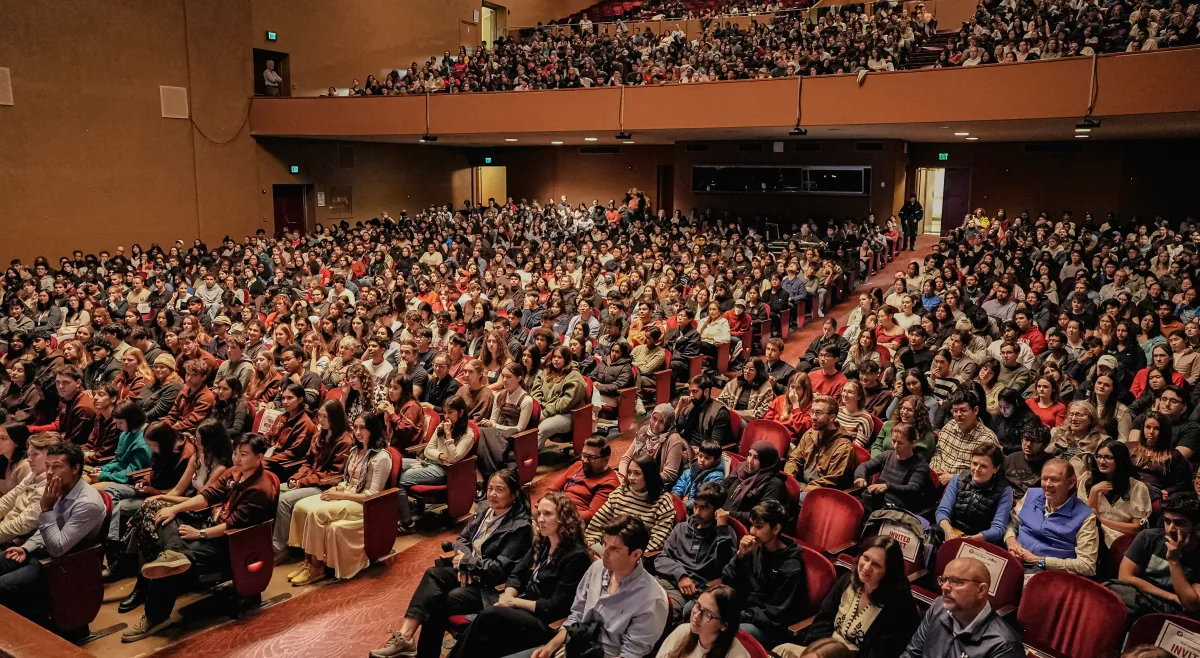
For attendee Yannick Mofor ’27, the event humanized an iconic individual.
“I know Malala as [someone] who sadly had to undergo extreme trauma, but is now a champion for women’s education around the world,” said Mofor. “Although that is what she primarily stands for… I feel like I got a lot more of a nuanced view of who Malala is outside of her activism.”
Ali said her goal in moderating the interview was to highlight the side of Yousafzai that she explores in her memoir through asking creative questions.
“After the event, nothing felt more rewarding than hearing Malala say it was one of the best talks she’s attended. I was thrilled that she — and her husband — enjoyed it, and it’s safe to say I did too,” Ali said.
At the end of the night, Yousafzai spoke directly to Stanford students, encouraging them to cherish their time at college, which she said helped her transform from a girl living according to others’ expectations to an adult who realized who she really wanted to be.
“These are important years. Enjoy them. Have a lot of fun,” she said.
While the talk mainly focused on Yousafzai’s role as an activist for girls’ education, she also sees herself as part of a larger movement. “I’m also there for everyone else who is also doing the work for justice,” she said. “We are all part of the same fight.”