
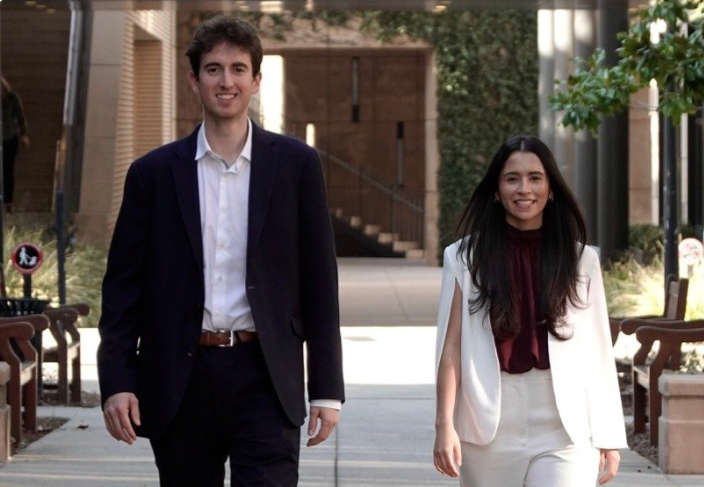
Jared Hammerstrom ’27 and Celeste Vargas ’27 were elected president and vice president of the Associated Students of Stanford University (ASSU) Saturday. The pair, who ran under the “FARM-RAISED” ticket, will be joined by a new slate of Undergraduate Senate (UGS) and Graduate School Council (GSC) senators on Monday.
“We are grateful for all the students who supported us and exercised their right to vote,” Hammerstrom wrote to The Daily. “Celeste and I have a very clear vision of the future: we intend to leave Stanford better than we found it. We’re ready to get started on day 1!”
3,912 students voted in this year’s ASSU elections, comprising 23.23% of the 16,841 distributed ballots. 2,935 undergraduate students voted, reflecting a turnout of 41.02%, while graduate students saw a 10.09% voter turnout with 977 total votes. This marks a jump from last year’s total voter turnout of 17.79%. Graduate student turnout jumped from 5.81% in 2025.
All annual grants — 135 joint, 109 undergraduate and 38 graduate — were approved. Despite receiving a supermajority of votes in both cases, neither of the two constitutional amendments on the ballot were approved. The first constitutional amendment would have removed a funding process clause that the ASSU said has not been used since 2022, amending Sections 6, 8, 9 and 10 of Article 5 in the ASSU Constitution. The second would have required clubs to return unspent annual funds into a general pool each year.
Executives
Following a campaign focused on their past leadership in student government, campus life advocacy and student input, Hammerstrom and Vargas initially received 1255 votes (42.44%). After five rounds of instant-runoff voting — which eliminated write-ins and ultimately Madhav Prakash ’27 and Eva Lacy’s ’27 “No Brakes” campaign — “FARM-RAISED” ended with 1617 votes (58.21%). Jake Hofman ’27 and second-year Ph.D. student Angikar Ghosal initially received 967 votes (32.70%) under the banner “BUILT DIFFERENT,” while “No Brakes” received 690 votes (23.33%). After all rounds of instant-runoff voting, the total for “BUILT DIFFERENT” stood at 1,161 votes (41.79%).
“As someone usually busy with research and coursework, it was exhilarating to push myself out of my comfort zone,” Ghosal wrote to the Daily. “Easily the best memory at Stanford so far. I hope the conversations regarding AI and education policy I started will continue.”
Lacy shared a statement on behalf of No Brakes. “Thank you to everyone who showed up for us during our campaign and voted,” she and Prakash wrote. “We had a ton of fun and are very grateful for the experience. We wish Jared and Celeste good luck!” Lacy also confirmed that she personally congratulated Hammerstrom and Vargas on their victory.
All undergraduate and graduate students were eligible to vote for the ASSU executive offices.
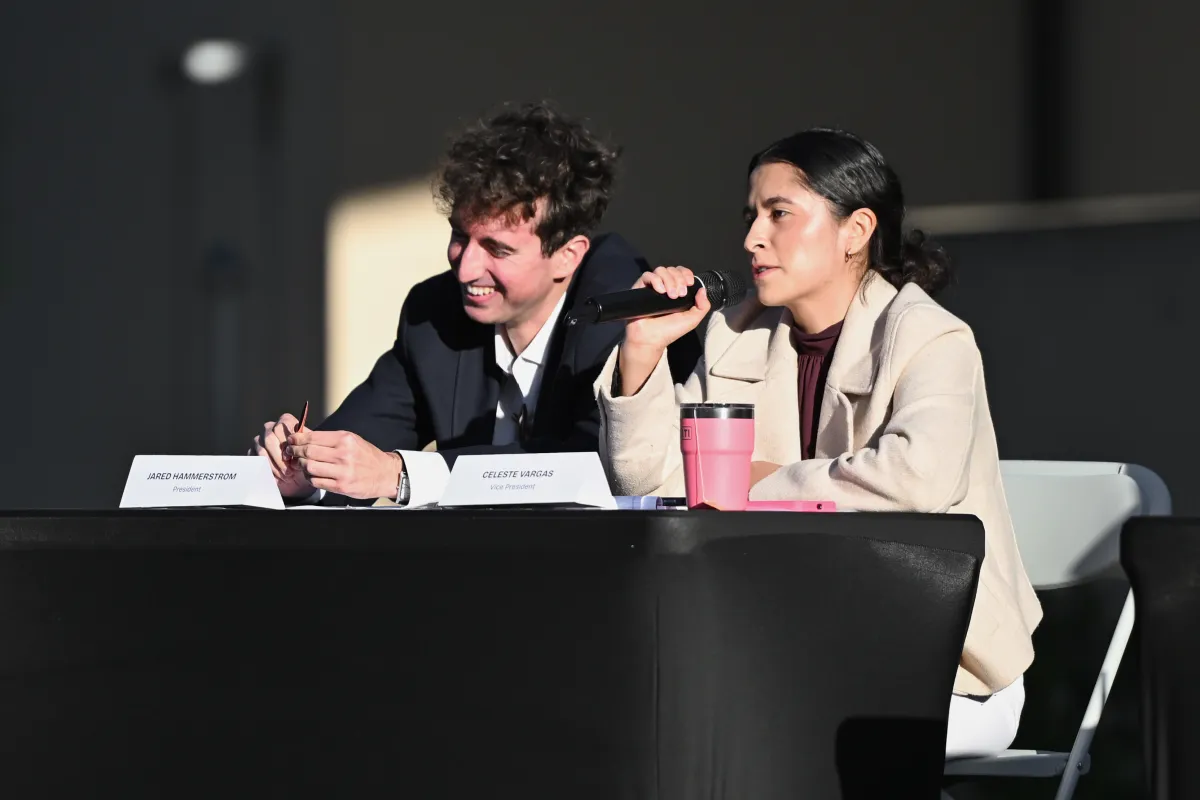
The ASSU Elections Commission investigated 7 conduct incidents during the campaign. The Commission issued “No Brakes” a campaign violation for using “official communications channels,” including the ASSU Executive, Class of 2027 and Class of 2028 Instagram pages, to promote their campaign. While no sanction was applied for the first offense, the Elections Commission mandated that No Brakes “repost a campaign video from both other tickets for 24 hours.”
The Elections Commission also examined allegations of a campaign violation by former UGS co-chair Gordon Allen, who “[endorsed] Farm-Raised from a verified Fizz account that represented itself as the ‘official account’ of the former UGS Co-Chair.” No sanction was applied for the alleged offense, as “no coordination could be found between Farm-Raised and Allen,” the Commission determined.
Prakash has also filed a complaint accusing FARM-RAISED of colluding with current UGS Chair David Sengthay ’26. Sengthay, writing on behalf of several student organizations, endorsed Hammerstrom and Vargas in a Wednesday email that noted his current position as UGS chair. Sengthay wrote to The Daily that his endorsement was made in a purely personal capacity. The Elections Commission has declined to label the incident a violation. The ASSU Constitutional Council is currently weighing the case.
Undergraduate Senate
Fifteen students were elected to the UGS out of a 32-candidate field. Princess Ochweri ’27, Intisar Alkhatib ’28 and Minji Cho ’28 led the senatorial election with 795, 588 and 557 votes respectively. Ochweri, Alkhatib, Cho, Troy Harris ’27, Dan Kubota ’28 and Laila Ali ’28 will be returning as senators. Nason Li ’29 (406 votes) beat out Eddy Duran (369 votes) for the fifteenth seat. Write-in candidates took just 0.51% of the vote.
All undergraduate students were eligible to vote for UGS positions.
The Commission issued three campaign violations during the UGS election. It found that Hoyoon Song ’28 had “[affixed] a poster to a campus sign,” which violates Stanford’s postering policy. The Commission declined to penalize Song for this incident, noting that “the incident was low impact and the candidate was able to quickly remedy the violation.” The Commission also found that Song’s campaign had failed to report his poster expenses on his campaign expenditure form. The Commission again declined to penalize Song for this incident, as the violation took place only after the candidate had lost the election.
Class Presidents
Stanford SKY won the sophomore class presidential race, garnering 22% of the original vote (224 votes). They prevailed after a seven-round instant runoff over second-place Levin’s Grandkids (19.02%, or 194 votes) and third-place We Speak for the Trees. Didi Umeukeje ’29, Braun Endicott ’29, Nadine Padrigon ’29 and Terry Shen ’29, who compose Stanford SKY, promised expanded social and pre-professional opportunities, transparent representation and office hours catered to different student communities.
SPARK, this year’s sophomore class leadership, was re-elected to represent the class of 2028 next year. Composed of Anura Bracey ’28, Asad Gilani ’28, Angela Li ’28 and Jasper Karlson ’28, SPARK won 464 votes, a dominant 96.667% supermajority. The group has vowed to continue its role as event planners while emphasizing class connectivity. Samuel Chen ’28, whom SPARK included as a proxy member, was not listed on the ballot.
SUMMIT took home the senior class presidential race, with a 56.37% vote share (366 votes) beating out STOKED’s 43.45% (282 votes). Mandarava Kaiya Jamyangling-Kawaguchi ’27, Sam Arias ’27, Yosef Aklilu ’27 and Angela Williams ’27 ran on a platform of “fun,” “consistency,” “integrity” and “community,” promising class merch and the restoration of beloved senior traditions, among other events.
Students’ eligibility to vote in each race was based on their class year.
The Commission investigated four potential violations during the sophomore class presidential race, and one potential violation during the senior class presidential race, though none were ultimately found.
Graduate Student Council
Graduate students voted on seven district representatives, in addition to six at-large representatives. The Graduate School of Business (GSB) elected Aristotle Economon M.B.A. ’27; the Doerr School of Sustainability elected second-year Ph.D. candidate Mofopefoluwa Ajani ’25; the School of Engineering elected third-year Ph.D. candidate Andrew Couch and write-in candidate Jermey Merritt M.A. ’26; the School of Humanities & Science elected fourth-year M.A. candidate Elena Vasilache and third-year Ph.D. candidate Casey Chan; the School of Law elected Rodrigo Moreno J.D. ’27; and the School of Medicine elected Brian Zhang M.D. ’29.
In the GSC at-large election, Claire Ho M.B.A. ’27, David Pantera ’21 M.B.A. ’27, Joshua Bishop J.D. ’28, Aayushi Kachalia M.B.A. ’27, Rayen Wang M.B.A. ’27 and Gurchit Chatha ’28 were elected to the council. Chan, Moreno, Economon, Vasliache and Ajani were also ranked among the top candidates, but were elected as district representatives instead.
The seat for the Graduate School of Education remains vacant with a six-way tie. Under GSC bylaws, the elected members will break the tie by exhaustive ballot following a two-minute candidate statement and a two-minute Q&A session.
This article has been updated to add the final vote count for “BUILT DIFFERENT.”
Correction: A previous version of this story misstated Ghosal’s year in school. The Daily regrets this error.