
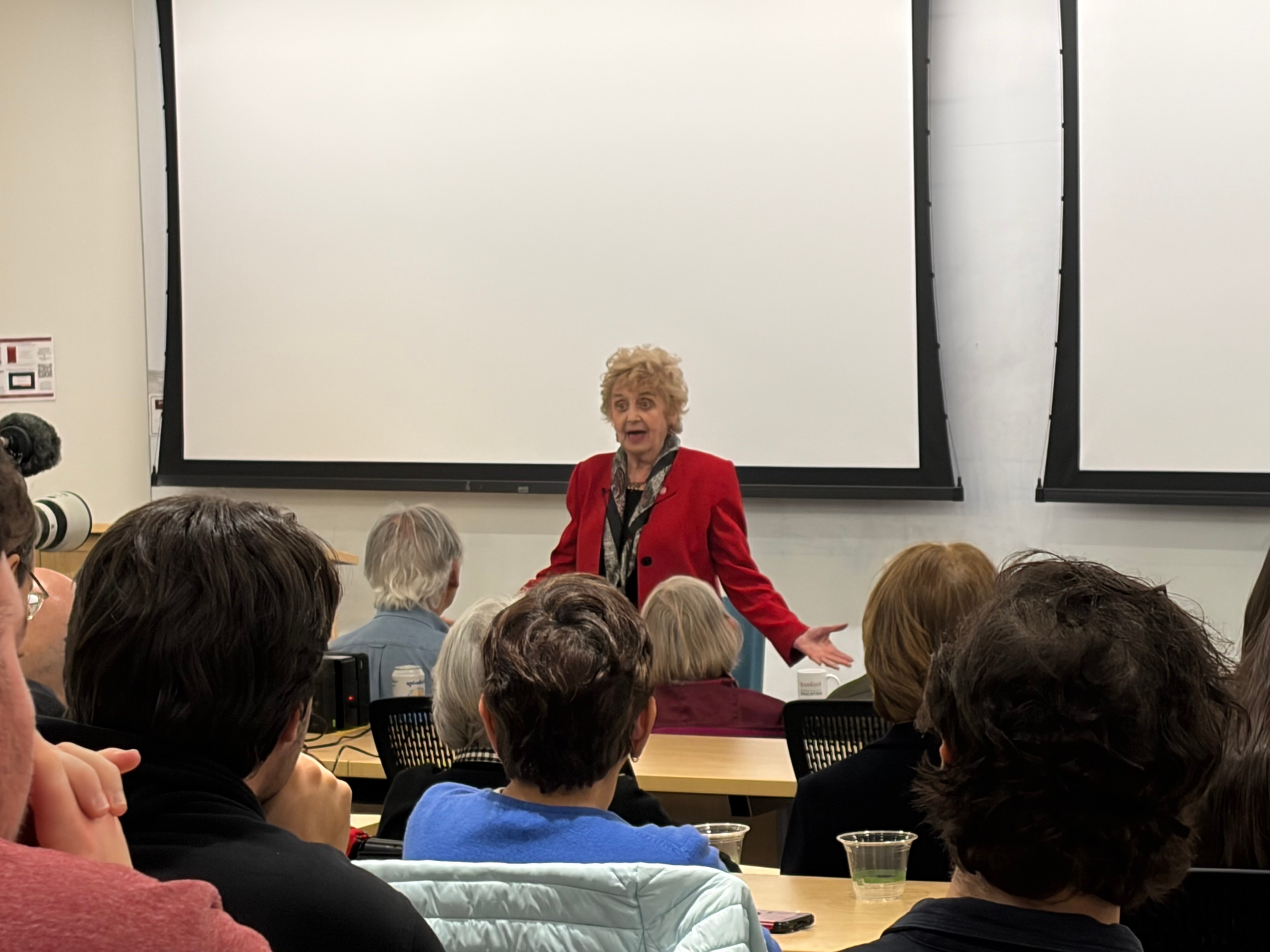
Tova Friedman, one of the youngest survivors of the Holocaust, recounted the details of her experiences as a child during the Holocaust, during a talk at the Graduate School of Education (GSE) Monday.
She described her journey from the invasion of her town in Poland to being relocated to a ghetto then being imprisoned at Auschwitz-Birkenau, the largest concentration and extermination camp.
The event was hosted by the Concentration in Education and Jewish Studies, GSE, the Taube Center for Jewish Studies, Hillel at Stanford and Stanford Chabad.
Friedman emphasized the suffering of the Holocaust, particularly the starvation. “When you saw ‘Schindler’s List,’ it [was] a walk in the park,” she said. “There is no description.”
To kill a group of people, Friedman said you have to first destroy them psychologically and physically. She said the Nazis did this by killing children and elderly, breaking up families and leaving people aged 20-40 isolated, feeling as if there is no more point to living.
At the concentration camp, Friedman said she saw no other children.
“I thought I was the last Jewish child on earth,” she said.
Throughout her story, Friedman frequently emphasized the importance of her mother. “Do you know that one person in this world, that person that you know will protect you? That was my mother,” she said.
She recalled how her mother taught her how to behave and survive on a daily basis. She taught her to never cry out loud and show weakness. Her mother also practiced with her every morning to not run from the German soldiers and their dogs, but to stand still and avoid eye contact, being as invisible as possible.
Friedman noted that she remembers so much about the Holocaust because her mother would talk to her about what was going on around them, as she felt that Friedman would be protected by knowing as much information as possible.
When the Nazis rounded up the prisoners at the end of the war to go on the Death March to Germany, her mother hid her with a corpse and told her not to breathe when the Nazis checked if she was alive.
“She looked at me and she said…‘I don’t want you to survive by yourself. I don’t want you to live on your own, you can’t do that. I’m staying in Auschwitz, I’m gonna hide. If we die together, we die. If we stay, we’ll be here.’ I said, ‘yes’ that wasn’t even a question in my mind… I would have done whatever she wanted,” Friedman said.
She avoided the Nazis’ final check of the camp, and her mother came for her just as the concentration camp was set on fire.
All of Friedman’s mother’s siblings and their many children died in the Holocaust. She attributes her mother’s young death, at age 45, to the trauma living in her head. She frequently talked about her siblings to Friedman, trying to cope with the fact that she didn’t know what happened to them. “She was trying to keep them alive, to the very day of her death. She was trying to keep her dead family alive,” Friedman said.
Friedman attributed her survival of the Holocaust to pure luck during a series of events.
When people were rounded up from the ghettos and packed in a train headed to Treblinka, another extermination camp, she and her mother were in a line that the Nazi’s shot at. By pure luck, the two survived.
Later, when her train arrived at Auschwitz, she wasn’t killed immediately like most children, since they arrived on a Sunday and the soldiers didn’t want to work. “It’s another miracle,” Friedman said.
When asked about how religion played a role in her coping with the traumatic events, she said her relationship with religion is complicated.
“People ask me if I believe in God, and I have to say it depends on the day,” she said. “How could anybody pray to a God that allowed this?”
Friedman said she did not see any remorse in German soldiers as they carried out the atrocities, and does not understand how they dealt with it psychologically.
“I think that they had to be convinced that we’re not humans,” she said. “That is why they gave us numbers. It’s easier to kill someone with a number than somebody with a name.”
Friedman said the Holocaust is still relevant today, which is why she keeps sharing her story. She said people must be aware of it so that they see it will never happen again.
After the Holocaust, she said she was afraid to go to Germany. But she appreciates all Germany has done for Israel.
Friedman called today a “strange world for Jews,” alluding to current events and the prevalence of anti-Semitism.
“We never expected that we would be hated again,” she said. “When I got out of Auschwitz with my mother, the gates closed behind, my mother said to me ‘remember.’ When I arrived in America a few years later… I said to myself now I’m going to be able to raise a family, a Jewish family, without any kind of fear ever… Things have changed drastically and very quickly.”
She recalled how her grandson recently asked her if he should hide his Jewish star under his shirt. “What is happening to us again?” she said. “It’s like either way, we are to blame.”
Friedman told the Jewish community to be visible.
“We will be here, while some of the many nations would like to get rid of us. We are here and we’re gonna stay here, and this too shall pass,” she said.
Rabbi Eliezer Weinbach from Stanford Hillel emphasized how special it was to have a Holocaust survivor speak on campus.
“It’s a rare opportunity and I’m grateful that Stanford was able to have this opportunity,” he said.
Audience member Emily Sehati ’28 was struck by how Friedman said she can feel the number tattooed on her arm from the concentration camp, yet “she has reclaimed her story and is committed to her people’s history.”
“As the final generation to hear direct witness testimony from the Holocaust, it is essential that as students we engage and listen to the difficult truths from Tova’s time. In unprecedented times of anti-Semitism, especially in college campuses, her story is a grave warning,” Sehati said.
Rabbi Jessica Oleon Kirschner, also from Stanford Hillel, said that it was inspiring to be in the presence of such a resilient person.
“The texture of lived experience is so much sharper and richer than the big stories we often resort to in order to understand history, and there are fewer and fewer opportunities to hear these narratives directly from the people who lived them,” she said. “…The Holocaust is an important Jewish story, and it is also an important human story.”