
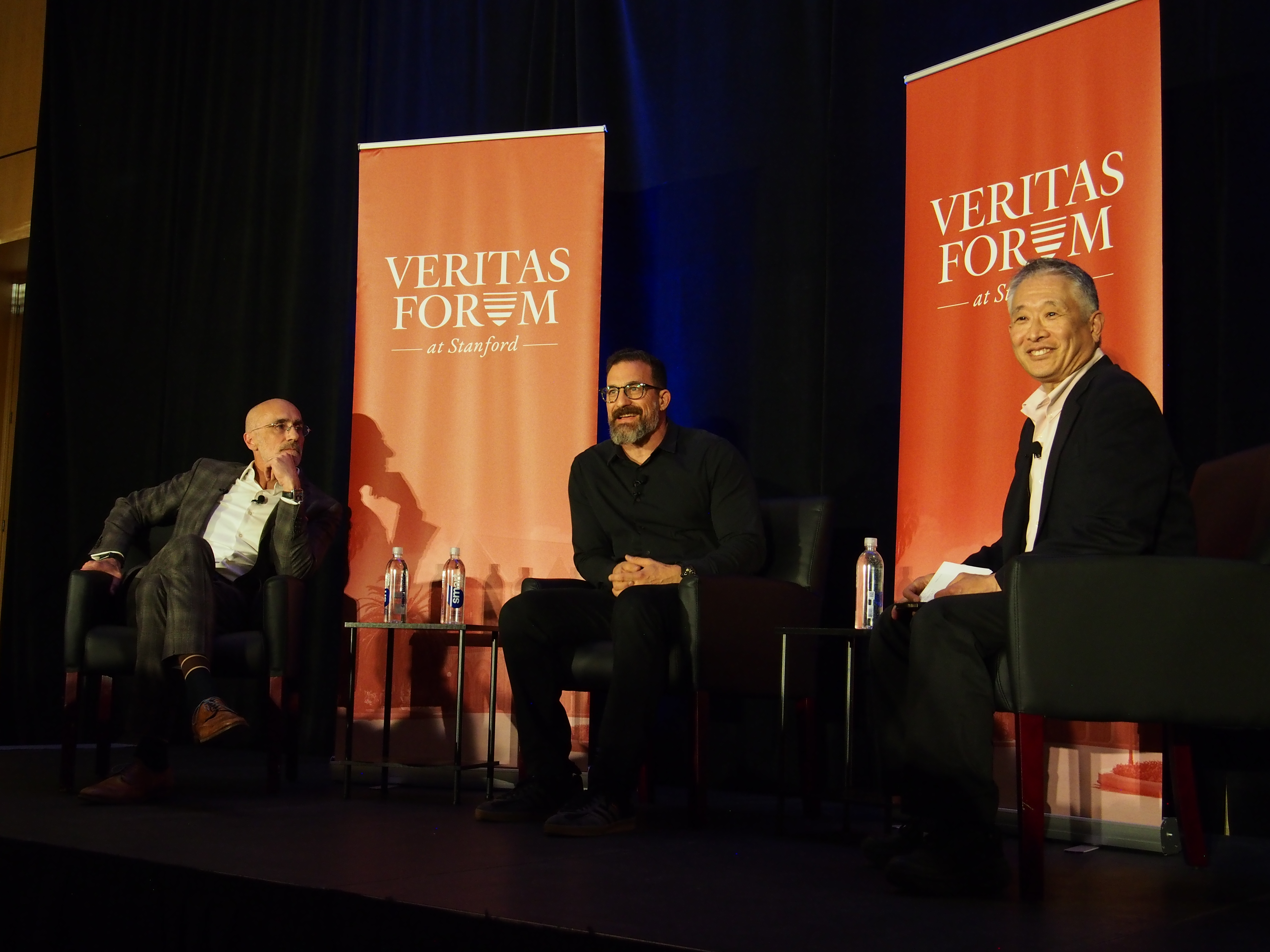
Harvard Business School professor Arthur Brooks, and Stanford neurobiology and ophthalmology professor Andrew Huberman shared their scientific expertise and personal anecdotes from their journeys to a fulfilling life — and the role of faith within it at a Wednesday night event.
The forum, “When Will I Be Satisfied?”, was hosted by Stanford Veritas Forum, a group dedicated to “bringing conversations to campus about life’s biggest questions,” said Veritas co-president Milly Wong ’27. Veritas is a Christian organization, and according to co-president Gabriel Bo ’27, its goal is “to strike dialogue between Christians and non-Christians for the pursuit of truth.”
Inspired by the fast-paced nature of life on Stanford campus, organizers hoped to provide students with an opportunity to take a breath and ponder when they will feel satisfied — and what they can do to get there.
“There’s always some goal Stanford students have, and many of the times Stanford students do well in achieving it,” said Bo. “But once they achieve it, there’s some type of missing satisfaction that students don’t end up getting.”
According to Huberman, one can derive satisfaction from setting and achieving goals — a statement he says is “grounded in science.”
“We can’t really attribute our drive to accomplish things and to do things to one particular feature of us, but we can generally assume it has something to do with the brain,” Huberman said.
Using the example of a child or a puppy, Huberman noted that there are certain times of day or night when they are more active than others. “We wake up after sleep, maybe with some grogginess, and then we have this propensity for action. That’s our autonomic nervous system,” said Huberman.
Huberman said that anyone can use natural “propensities for action” — such as energy after a good night’s sleep — to “find things that make you feel good.”
Eventually, though, Huberman said that people move beyond these natural impulses to search for greater meaning. “Whether people admit it or not, they arrive at the question, ‘What is this all about?’” said Huberman.
Brooks cited four practices of the “happiest people”: taking care of spiritual or philosophical life every day, having family, having real friends and pursuing meaningful work. Work, in this context, is not valued by how much money you make or your position, said Brooks, but by the belief that you are earning your success and knowing that you’re creating value.
Though the practices that contribute to happiness and the neuroscience behind ambition can be researched, both men also focused on the power of mysteries, love, and the influence of a higher power.
“One of the first things you learn in 12-step [alcohol addiction recovery programs] is you don’t have total control of your behavior,” said Huberman. “What’s the solution? You have to give control of your behavior to a higher power…they could not control their behavior, and then they give the process of control to God, and they get and stay sober. That’s a miracle.”
Brooks expanded on this saying that what Huberman was speaking of was “submitting to divine love.” Where peace and happiness reside, Brooks said, is in “the ultimate love of something that transcends us.”
Following a 50-minute discussion moderated by accounting professor emeritus Charles Lee, Huberman and Brooks answered audience questions on how God could co-exist with tragedy, how one could maintain drive while also being satisfied and whether they believed God was the same in all religions across spirituality.
Though the group is based in Christian faith, Veritas did not seek to provide only one answer to the path to satisfaction and fulfillment with this event.
“I think we want to share what we believe, but the main thing is we want people to start questioning: do they really have satisfaction in their lives, or are they still chasing after the next big thing, and is it ever going to end? What does it truly mean to be fulfilled and satisfied in their lives?” said Bo.
For second year Ph.D. student Dimitri Trifunac, who grew up Christian, the event provided an opportunity to reconnect with faith while learning more about Brooks and Huberman’s perspectives. “I felt like this forum is a really good way to reconnect with faith in general, not just through Christianity, but in the more general sense of philosophy,” said Trifunac.