
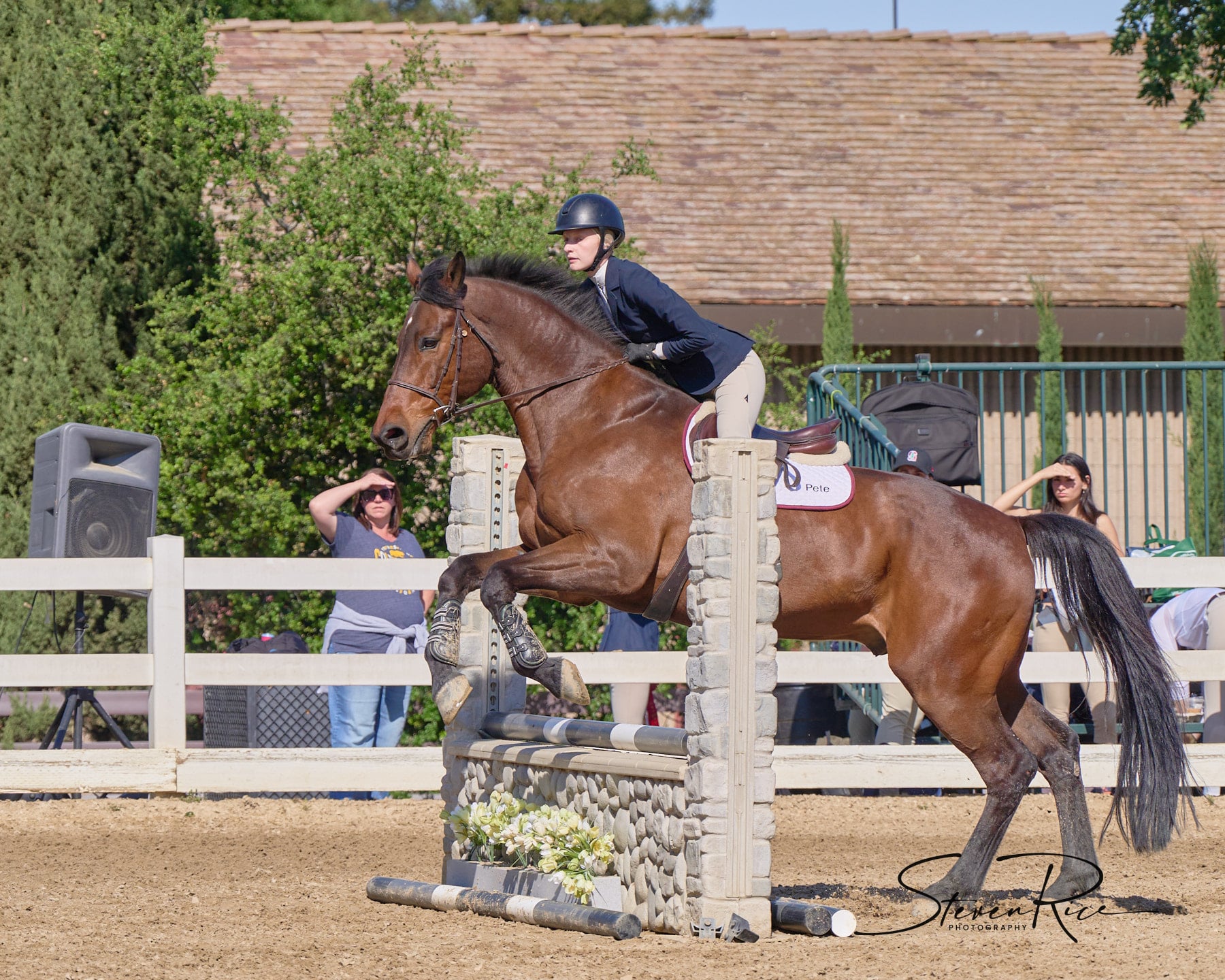
Long before students were biking down Palm Drive and hosting picnics on The Oval, The Farm was an actual farm. The Palo Alto Stock Farm, located on Leland and Jane Stanford’s 8,000 acres of land, was used to breed and train championship horses.
At its height, the stock farm included two dozen buildings and eight trotting tracks, employing 150 employees and boarding 600 horses. Today, two of those buildings still exist: the Victorian Red Barn and the brick stable.
The Red Barn, which was renovated and reopened as the Red Barn Equestrian Center in October 2005, is now home to the Stanford Equestrian Team — one of the most dominant programs in collegiate riding.
Made up of 35 to 45 active members riding Hunt Seat Equitation, Dressage and Western Horsemanship, the Stanford Equestrian Team has competed in the Intercollegiate Horse Show Association (IHSA) in all divisions for more than 30 years. IHSA competitions are based on “catch riding,” with riders drawing a horse at random provided by the host school. The team hosts shows at Stanford and also travels to other schools in its Zone 8, Region 1 area.
While the nature of competitions has evolved over time, the team’s guiding principles have remained the same: a commitment not only to excellence, but also to accessibility.
Unlike varsity riding programs that can recruit and offer scholarships, Stanford equestrian is a co-ed club sport that relies on a combination of University funding and fundraising efforts. At the beginning of each academic year, the team hosts tryouts, which are open to everyone from experienced competitors to complete beginners.
“The cool part about club riding is that we bring in people who have never ridden before,” said Rafi Wolf ’27, the incoming Hunt Seat team captain. “That is something super special about the team, that we get to have people of all different levels and learn from each other, making riding accessible when it typically is not.”
The Red Barn plays an integral role in the riders’ growth. Located just minutes away from campus housing, it offers athletes the opportunity to practice multiple times a week — something that is very rare among even varsity collegiate teams.
“You walk five minutes away from your dorm, and then suddenly there are horses everywhere,” said Emma Lorimer ’28, the program’s incoming co-president. “It feels like a different world.”
The team’s consistency at the Red Barn has led to success across all three disciplines. The Dressage team finished in the top-10 at the Intercollegiate Dressage Association (IDA) National Championships in Lake St. Louis, Mo., this past weekend. It is the first time the entire team has qualified for the championships since before the Covid-19 pandemic.
For the Western team, Mckenzie “Nick” Quinn ’27 won first place at the IHSA Semi Finals in Las Cruces, N.M., making her the first rider to win at Semi Finals since 2009.
Likewise, the Hunt Seat squad, of which Wolf and Lorimer are both members, recently won its 20th-straight IHSA Hunt Seat Regional Championship (and 19th-straight Zone Championship), giving it the longest active winning streak in the country out of 350 collegiate teams.
Wolf does not feel the pressure of such a long-lasting streak, though.
“Although there is a general expectation of excellence given that we have been so successful in the past, I think it is motivating rather than stressful,” she said.
For head coach Vanessa Bartsch, the 20-year streak reflects the unique team culture, which values every aspect of the riders’ identities.
“We try to let them be students first and show a different model of athletics, where their mental and physical wellbeing is prioritized above all else,” Bartsch said. “There’s so much pressure on our student athletes that we want to create a space where they feel supported and excited to compete at the highest level.”
That philosophy will be on full display this weekend. On May 1-3, 11 athletes, including Wolf, Lorimer and Quinn, will head to Tryon, N.C. to compete in the IHSA National Championships.
“It’s a really diverse group of riders going,” said Bartsch.
Also among the group are Lily Amaturo ’25 M.S. ’26, an introductory rider who joined after taking a Physical Education (PhysEd) class, and Skye Adams ’27, a transfer student from UC San Diego who had not previously competed for the Tritons.
With so many new faces at Nationals, Wolf is the only rider on the team that has competed there before. Last year, she was Reserve National Champion in Open Fences, and this year she is returning in Team Open Fences, Team Open Flat and Individual Open Flat.
“My goal as somebody going back is to make the environment really comfortable,” Wolf said. “I just want to be a positive team member and remind my teammates that they’ve been practicing up to this point, that they’re very capable of success and very capable of living up to their own expectations.”
Wolf’s words are more than a message; they are a mindset. As the riders prepare to leave for North Carolina, they will carry with them not just their training, but confidence, resilience and a shared belief in one another — values that have defined Stanford equestrian for more than three decades.