
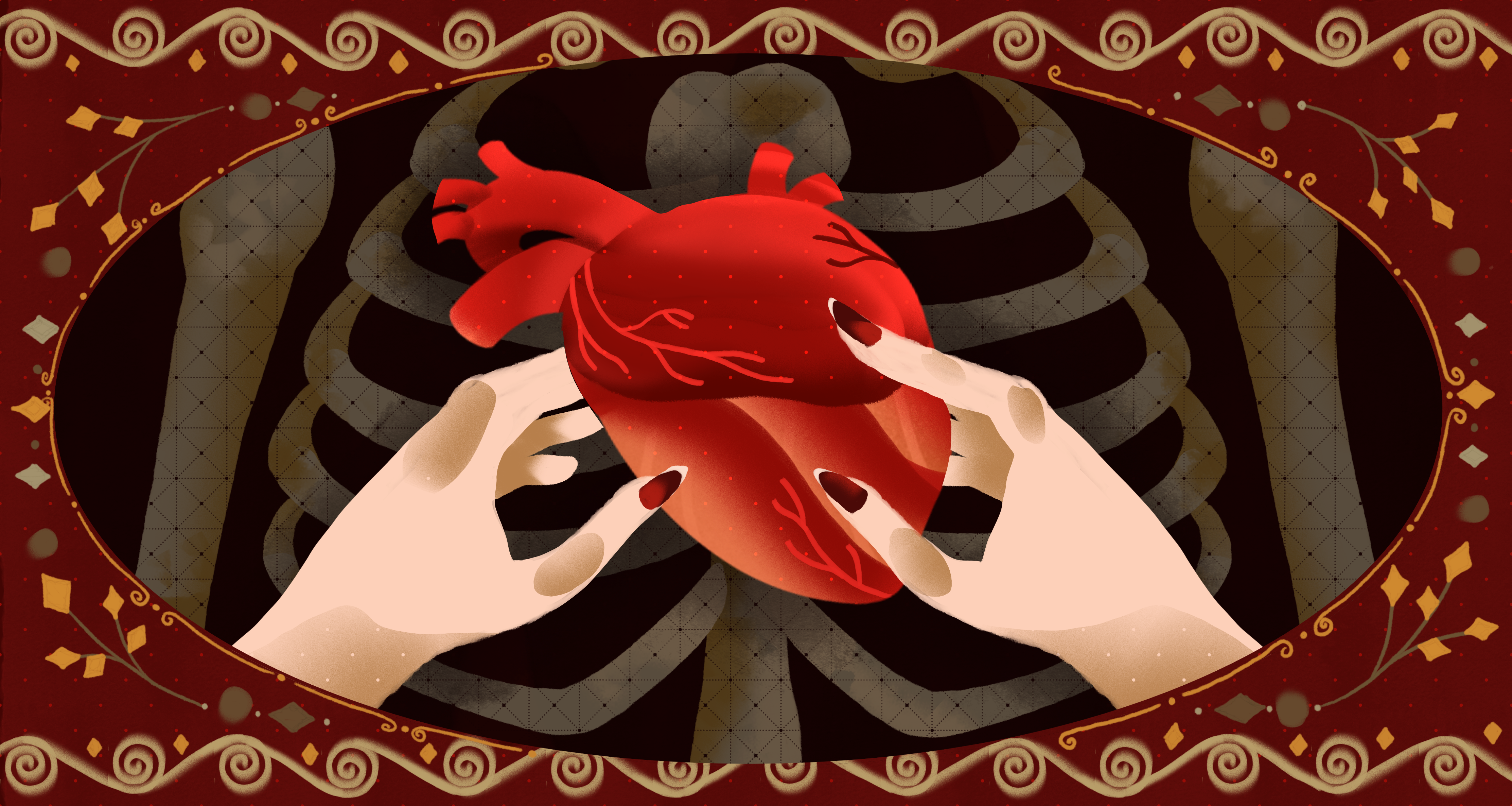
In “Dirty Hungry Homosexuals,” columnist Dayanara Yepez Ramirez ’28 reviews gothic horror literature that spotlights queer women.
Editor’s Note: This article is a review and includes subjective thoughts, opinions and critiques. It also contains spoilers.
Content warning: This article contains descriptions of mental illness.
My mentally ill sapphics, this one is for you. Well, actually… I’m a mentally ill sapphic, and even I was concerned for the narrator in “The Moth Diaries.” Between you and me, reading this gothic horror novel reminded me immensely of one of my exceedingly toxic ex-friends: It’s as if the author made a copy of her and slapped it onto the page. Needless to say, the book definitely hit home. Therefore, if your wish is simply to check that you’re not on the brink of losing it and lashing out on other people, I suggest you pick up Rachel Klein’s novel.
“The Moth Diaries” begins with our unnamed narrator pondering her psychiatrist Dr. Wolff’s suggestion to publish her diary entries from when she was 16. While the protagonist is initially resistant, Wolff is adamant, suggesting they create pseudonyms so no one will know the entries have anything to do with her. The narrator eventually complies, publishing her journal, which covers her thoughts as a boarding student at an exclusive school from September to May. “The Moth Diaries” covers those months, during which she dealt with undiagnosed borderline personality disorder (BPD), psychosis and depression as a result of her father’s suicide.
Within the first few entries, the narrator’s relationship with her roommate and best friend Lucy raises alarming red flags. Not to worry, my high school hyperfixation on mental disorders instantly categorized Lucy as the narrator’s “favorite person” (FP), a professional term denoting a relationship that becomes the center of the world for someone with BPD, wherein the FP’s behavior disastrously affects the person with BPD.
This dynamic becomes clearer with the introduction of Ernessa. To the narrator, Ernessa is both familiar and a mystery. They are both Jewish, a rarity at the school which makes them victims of racist discrimination from other students and staff members. Ernessa also seamlessly succeeds at whatever the narrator struggles with, from playing piano compositions to being seen as an intellectual equal by the other girls. These similarities only add more tension as Lucy hangs out with Ernessa, excluding the narrator. As everyone at school starts to notice Lucy and Ernessa’s close bond, the protagonist writes, “Just saying [Lucy’s] name makes me feel better. It brings her close to me. I have her, if only for a few seconds while the sounds are on my tongue.”
The narrator starts to notice some… quirks about Ernessa. She never sees her eating food, leading to the narrator’s theory that Ernessa is in fact a vampire. A dog’s barking irritates Ernessa, and her teacher Miss Bobbie’s discrimination makes it harder for Ernessa to get away with subpar academic effort. They both then die rather mysteriously — at least through the narrator’s eyes. One of the narrator’s friends, Dora, also perishes after having crawled on the gutters right in front of Ernessa’s room. The narrator associates Ernessa with these deaths, leading her to believe she has a real case. Though she’s grasping at straws, she began to convince me a bit.
Given the reader’s knowledge of the narrator’s psychosis, along with the narrator’s natural human bias, it was incredibly hard for me to distinguish what parts of the narrator’s recollections were true and which were not. I came to view the narrator in the same way the narrator views Ernessa: with suspicion and intrigue. When Lucy falls ill, the protagonist convinces herself this is Ernessa’s doing. “Lucy only has the energy to breathe,” she writes. “She is getting weaker and Ernessa is getting stronger. Lucy’s energy goes to nourish Ernessa.”
After much tribulation, Lucy inevitably dies. Yet this only causes more confusion, as the narrator claims Ernessa took Lucy outside into the cold, while the other schoolgirls believe the narrator actually dragged Lucy out to her death.
At this point, I wanted to throw the book across the room. Everyone in the novel has some version of mental illness, so who exactly am I meant to believe? I’m mentally ill too, so I can’t even trust myself. What a treacherous fate. Having no knowledge of the truth made me consider dramatic theories, such as the narrator’s responsibility for all the other deaths, killing others so she could mentally blame Ernessa. While likely not the case (at least I hope not), it’s an enthralling possibility to ponder.
As a fiery end, the protagonist sets the school on fire and is sent to a psych ward. Now, the other characters begin envying the main character, wishing to be a pitiful figure like her. Truly, this novel makes you question everyone’s sanity, including your own. It’s a must-read for anyone who wants to see a darker, spiteful depiction of young girls’ thoughts in handling friendships, grief and jealousy.
Though “The Moth Diaries” does not grant the readers many answers, its many enigmas allow readers to drown in their own questions, feeling the same way the narrator feels about her own life. The tale is a gripping, tantalizing depiction of a mental spiral.