
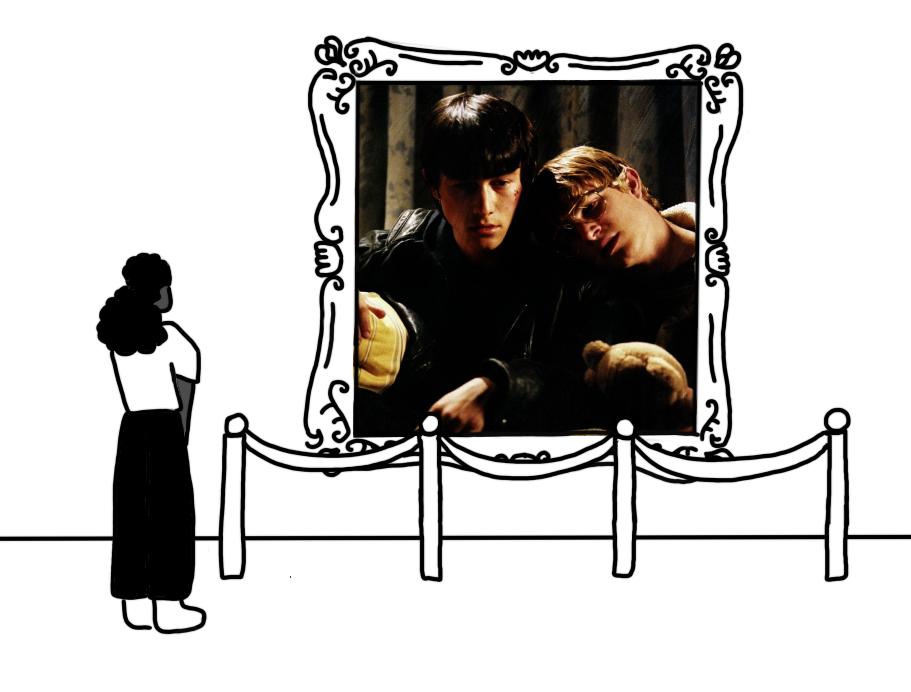
In her column “As Ribka Likes It,” Ribka Desta ’27 introduces her favorite pieces of media and justifies how and why they have taken up her time and invaded her mind.
Scott Heim ended his debut novel with these sentences:
“It was a light that covered our faces, our wounds and scars. It was a light so brilliant and white it could have been beamed from heaven, and Brian and I could have been angels, basking in it. But it wasn’t, and we weren’t.”
With those words, Heim took the rest of my life with him, raising my standards for all media to follow.
Before I watched “Mysterious Skin” in Jan. 16, 2022, I had an entirely different perspective on just about everything that matters to me now. I did not identify much with film nerds, and I had a greater interest in books and television. My love of TV was a recurring disappointment, as I had bad luck investing in TV shows that were prematurely cancelled: “The Society,” “American Vandal,” “Grand Army,” “The Wilds” and others. As a result, I had a horrible habit of never trying anything new and retiring to a cinematic universe of re-lived, recycled viewing experiences. Each time a show or movie was recommended to me, it took a number and walked all the way to the back of the line.
Yet that January day, I remembered mindlessly scrolling through TikTok to postpone my retreat into the large stack of work I had to do that weekend. I came across an edit to the film featuring “I Know the End” by Phoebe Bridgers (which was how I began listening to one of my favorite artists!). In that moment, I was possessed — by a spirit other than procrastination, I swear — that told me I had to drop everything and watch the film that instant. 15 minutes in, I already knew that my life would shift from a regular timeline into two distinct phases: before and after I watched the movie.
In the after: I ransacked my contact list in order to find someone, anyone who had watched the movie and would understand their moral obligation to abandon their plans for the next few hours and discuss it with me. For months I deep-dove through a sea of clueless people for someone converted to this faith, but my fingers came up pruned and empty. In my time as the sole fan of “Mysterious Skin,” I understood what it would feel like to be the founder of a religion, or the first to insist on the existence of a heliocentric universe.
I read the original book about a week after I first watched the movie. The movie is a remarkably faithful adaptation, thanks to Scott Heim’s involvement in the production and his friendship with its screenwriter and director, Gregg Araki. I typically care much more for interesting characters than I do an interesting plot. This story was the first time I’ve felt true awe at the capacity of the human mind to craft a plot — who could conceive of something like this?
“Mysterious Skin” centers on two boys, Neil and Brian, who were sexually assaulted during their youth, and how their lives have developed 10 years after the event. While Neil remembers each detail intimately, Brian has limited memory of the event and misinterprets the details he can recall as evidence of a brief abduction by aliens.
Brian’s repression and reinterpretation of the event as an alien intrusion acts as a unique coping mechanism, one that could be interpreted as a metaphor which parallels the inhuman nature of the assault. Considering most films would set up this truth to be a plot twist, I appreciate the choice to make the reality behind Brian’s “abduction” clear from the get-go. The dramatic irony allows us to become increasingly emotional as we watch Brian become more invested in an investigation we know will have devastating consequences. There is great intention in every choice the film and book makes. I find it incredible, top to bottom.
Heim has a gift for using his personal experiences as the foundation of fictional masterpieces; he has commented on the fact that real-life events have inspired moments in both this novel and the stellar book “We Disappear.” I also envy Heim’s ability to write poetically without sacrificing any comprehension or key elements to a story; his incorporation of gorgeous figurative language never hinder the reader’s understanding of events and plot.
As someone who primarily writes poetry, I have much to learn from Heim’s skill for using poetic techniques naturally in prose and turning his life into art. I feel inspired to re-enter the realm of prose with Heim’s work as a reference.