
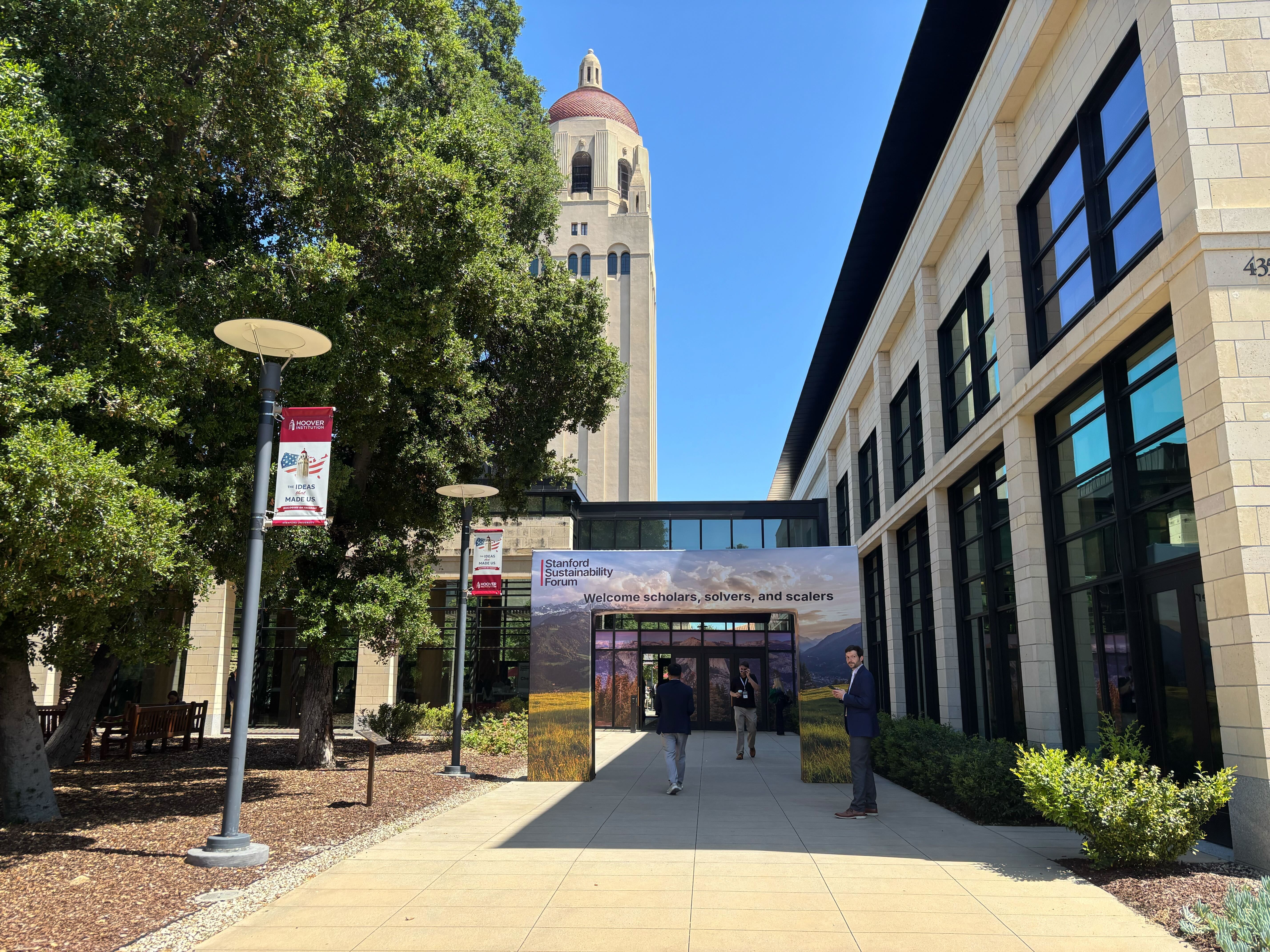
The Stanford Doerr School of Sustainability hosted “Adapting to a Changing World,” a dialogue that illuminated climate change-induced crises reshaping life on Earth.
The Wednesday afternoon session was a part of the inaugural Stanford Sustainability Forum, which included student research presentations and a live conversation with experts on the front lines of climate adaptation.
Assistant Professor of oceans and electrical engineering Halleh Balch opened the afternoon session by highlighting how ocean research is critical to climate challenges, as the seas are “the largest habitat on Earth.” Her research group is developing antennae that can be deployed on autonomous ocean robots to manipulate light at the sub-wavelength scale. The goal of these technologies is to bring high-quality molecular measurements into field research and connect this data to global oceanic satellite coverage.
Following Balch’s introduction, two Stanford Ph.D. students presented their research. Earth Systems Science researcher Emily Paris M.S. ‘25 Ph.D. ‘26, described microbial life in the deep basins of the Gulf of Mexico. The environment is so extreme it has been proposed as a permanent carbon storage site. Using a single-cell measurement instrument called the NanoSIMS, Paris found that “the basin is teeming with life,” containing organisms that break down organic matter and release CO2, making carbon storage there more difficult.
Second-year Ph.D. student Danny Collins presented a discovery about coral bleaching recovery, which found that bleached coral placed in contact with a healthy coral can recover completely within a single week. The mechanism behind its recovery was coral tissue fusion, which allows the healthy coral to send symbiotes — microscopic algae that enable reef growth — directly to its bleached neighbor.
“Contact is key for this recovery,” Collins said, calling the finding “a glimmer of hope for coral reefs.”
Next, the session shifted to a conversation between two experts navigating climate hazards on opposite sides of the globe.
Ann Patterson, a policy scholar at Stanford’s Woods Institute, spent seven years as senior counselor to Governor Newsom. She recalled that on the morning of the Palisades fire, she was with the governor outside Palm Springs when a text arrived: a new fire, currently ten acres, expected to reach 200 acres in ten minutes. Two hours later they were on the ground in Los Angeles.
“It was like red snowfall because the embers were coming at us,” she said. “That whole neighborhood was gone within 20 minutes.”
The disaster unfolded after the city’s second driest period on record. “It hadn’t rained for eight months. Unfortunately, because of climate change, that is becoming our new normal in California,” said Patterson.
Patterson compared building climate resilient communities to the concept of herd immunity, where individual building resiliency is insufficient if nearby structures remain vulnerable. Thus, she said it is important to inform the public of affordable, climate and wildfire resilient housing options, such as pre-fabricated houses that avoid highly flammable materials.
Jamshyd Godrej, managing director of Godrej & Boyce, spoke about the urgent cooling challenge in India, where 50 cities surpassed 40 degrees Celsius or 104 degrees Fahrenheit before summer.
“You have to have affordable cooling,” he said. “To make it really affordable, innovation is the only answer.”
Scott Fendorf, senior fellow at the Woods Institute and professor of earth system science, closed with a presentation on an underestimated hazard within the wildfire crisis: smoke.
“As bad and as devastating as the actual fire is, there is this insidious problem that we get from the smoke,” he said. “Wildfire smoke is far more toxic than other forms of air quality degradation.”
His research found that current Air Quality Index measurements miss both the ultrafine particles that penetrate directly into the bloodstream and the toxic metals, such as chromium and lead, that vary based on the geology where a fire burns. To address this critical information gap, he proposed the widespread deployment of an Air Toxicity Index, paired with drone sensors to provide first responders and the public real-time, predictive data.
The afternoon’s range of topics, from deep-sea microbes to coral fusion to wildfire chemistry, reflected the Forum’s central premise that the climate crisis demands collaboration between a wide variety of researchers, policymakers and students.
As Patterson put it, “This problem is here, it is very real” so it is imperative to understand “how [to] keep communities safe in the face of what is here.”