
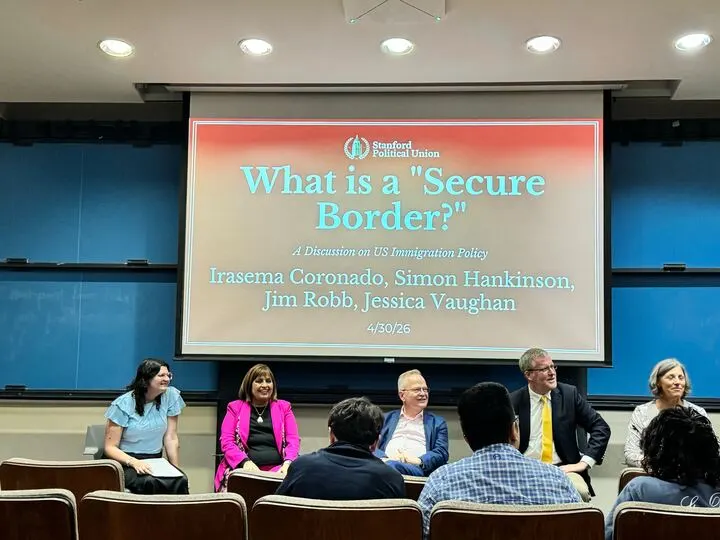
The Stanford Political Union (SPU) hosted a panel bringing together views from scholars in immigration policy to raise new perspectives on America’s approach to immigration and border enforcement on Thursday.
The panel featured Irasema Coronado, director and professor of the School of Transborder Studies at Arizona State University, Simon Hankinson, research fellow in the Border Security and Immigration Center at The Heritage Foundation, Jim Robb, vice president of Alliances and Activism at NumbersUSA and Jessica Vaughun, the director of Policy Studies for the Center for Immigration Studies.
“We always try to find topics that are relevant to the campus community, and both in the election and just broadly, immigration is a highly relevant issue,” said SPU president Nathan Kuczmarski ’26. “We wanted to put together something that would catalyze discourse.”
The panelists’ varied backgrounds in immigration policy informed their perspectives on the topic. “I worked a lot with community-based organizations… with some of our students, who themselves are undocumented, and so that informs a lot of my work,” Coronado said.
The panel opened with a short dinner and small group discussion between the panelists and audience, where spectators rotated between speakers and could learn more about their background, immigration focus and interests. While SPU has hosted immigration discussion events before, Kuczmarski noted that the organization hasn’t hosted an immigration panel for the past two years and that the “dine and dialogue” format was a new addition for the group.
“We’ve brought in the speakers to be in small groups with students, so people can engage with them in a more intimate setting,” Kuczmarski told The Daily.
After the dinner, the panel was moderated by Amira Hutcherson ’28 before the floor was opened to students.
Robb’s approach to immigration policy centered particularly on the economic impacts that immigrants have, ensuring the working class remains stable. “My primary interest is to make sure that new people coming in are not disadvantaging people who are already here… in my polling, one of the groups that are really anti-illegal-immigration are Texas Hispanics who’ve been here a long time.”
Hankinson recounted his experiences growing up as a French immigrant to America, learning American history and culture and how to “be an American, from scratch.” He pulled from his time working as an immigration officer interviewing travelers to the United States.
“It’s not a universal right that anybody can go wherever they want. You see that all over the world: you can’t go from one African country to another, or from India to Pakistan without a visa, and I wanted to see that it was done right,” he said.
Vaughun, who had also served as an immigration officer, recalled how perspectives on the American approach to immigration shifted following 9/11. “That certainly has elevated the issue of national security and the importance of knowing who is coming to the United States and why,” she said.
Panelists called for general reforms to immigration law, particularly to de-incentivise immigration for economic gain by criminalizing illegal employment.
“I would like to see more attention to removing the magnet of illegal employment, and to hold employers responsible for enticing people to come here unlawfully,” Vaughun said. She claimed that unlawful hiring not only oversaturated the American workforce but also abused individuals immigrating for work.
“[These employers] are hiring people without the benefit of documents, who are taking advantage of their labor, who are paying them lower wages, are not giving them benefits,” Coronado said, echoing Vaughun’s thoughts.
Hankinson also added that incentivizing immigration for work affected those immigrating for political purposes. “People coming from Cuba, from China, they have legitimate reasons … they’ve been through it.” He stated that immigrants hoping to escape political strife would have far longer wait times due to the visa lottery system America utilizes, as the system was “gummed up” by the amount of “economic refugees.”
Johnny Alameda ’28, who attended the event, enjoyed the casual conversations present at the dinner, and was glad to hear about modern issues plaguing immigration politics. “Both parties want to claim a big victory and they want to say that their side won, and so we’re in this deadlock where nothing has really changed.”
Across the board, panelists hoped that there could be reform to the immigration system, but cited increasing political derision as making this extremely difficult. They noted how they hope to see more cooperation between political parties on the topics surrounding immigration policy to clear up the complexities.
“Legislating now [has] an ‘all-or-nothing’ approach, rather than a ‘let’s find common ground’ approach, to the great detriment of our public policy on many areas,” Vaughun said.