
There was a time when actress Arden Cho, best known for playing the lead character Rumi in Netflix’s hit movie “KPop Demon Hunters,” thought she was going to be a missionary.
As a fresh-faced college graduate, Cho found herself on a medical mission trip in Kenya. “I want to help people. I [felt] like ‘this is where I’m supposed to be,’” she said.
Then, an actual missionary reshaped her outlook. “He challenged me,” said Cho. “[He said] if you think performance or music or art brings you joy, and that is your gift to the world, you should do it.” This was one of the moments that drove her to acting.
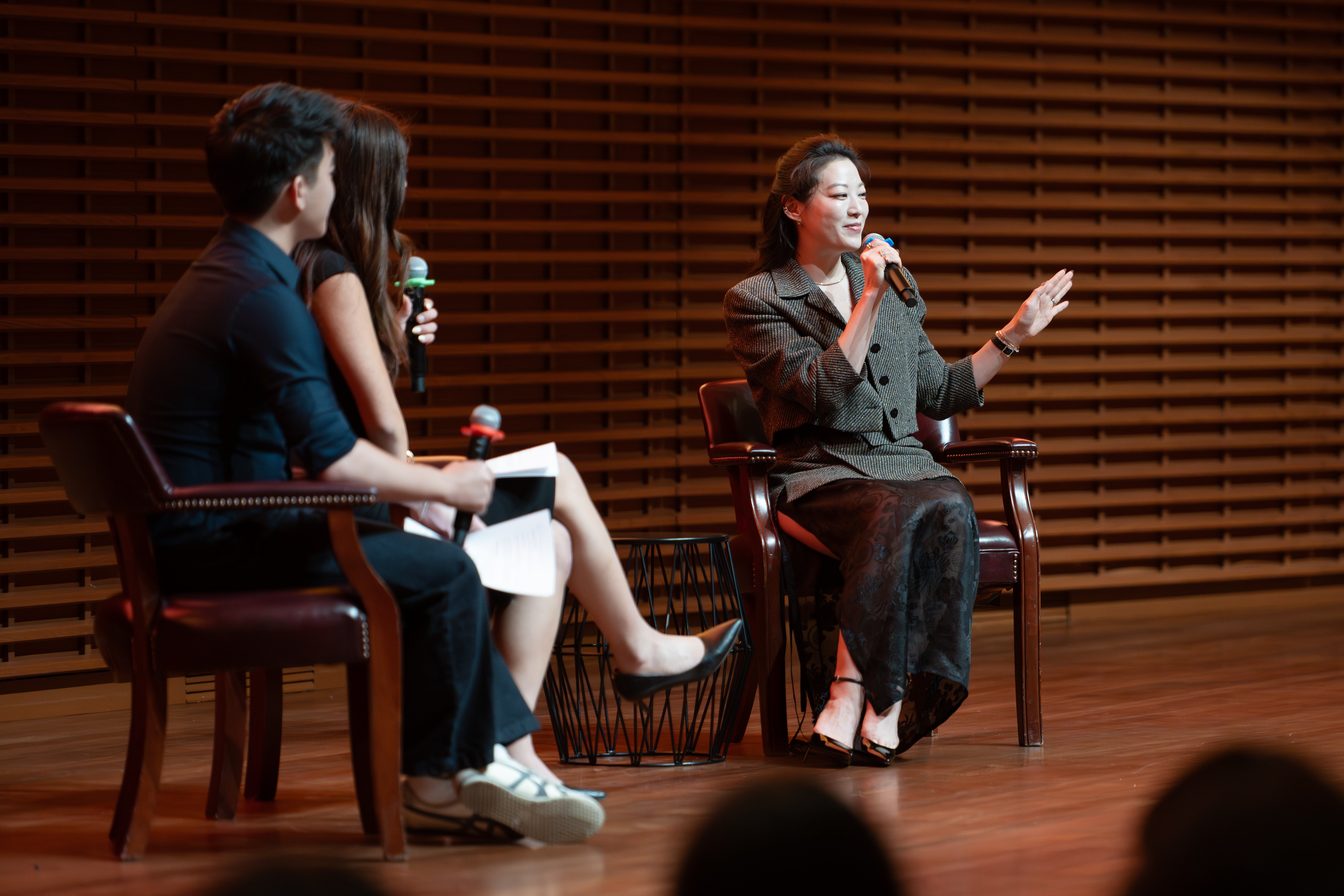
On Sunday, the Asian American Students Association (AASA) collaborated with the Stanford Speakers Bureau (SSB) to host Cho as part of the 30th annual Listen to the Silence Conference (LTS). In a fireside chat with Vincent Chung ’27 and Mary Yoon ’28, Cho reflected on her experience as an Asian American actress.
Cho spoke about how acting stood in sharp contrast with her “model minority” upbringing. “I was always told to be perfect and to not be so big with your emotions,” she said. “Acting is interesting, because like an onion, you want to peel all the layers back to really get to that core.” Cho said acting also helped her overcome “trauma” to parse out her own identity.
Much of that trauma stemmed from her Asian American identity. “I grew up feeling like there was a standard of beauty, and I wasn’t it,” Cho said. She attributed her insecurity to a lack of diverse representation, particularly in entertainment. “I see young girls who are like, ‘Oh my gosh, I love being Asian. I love being Korean,’” she said. “It took me 30 years to feel that.”
May-Lynn Lee, a non-Stanford-affiliated attendee at the event, said that she appreciated Cho’s unique perspective on identity. “She did a really good job… imparting her wisdom of what the Asian American experience is like,” Lee said. “And how most people don’t really understand the difference between being Asian and an Asian American.”
Today, Cho feels a sense of “responsibility” in bringing Asian American characters to life. “The first 15 years of my career was saying no in a lot of tough situations,” Cho said. “There were a lot of opportunities, but there were things that I just felt [like], ‘I don’t know if this helps us as Asian Americans.’”
Cho also criticized Asian typecasting, which she described as “overcorrecting” for previous racism.
“I became an actor because I want to tell stories and step into other people’s shoes, and do these fun things,” Cho said. “I don’t want to keep playing a 30-year-old Korean girl.” At the same time, she acknowledged that she was lucky to provide representation in entertainment.
One show that Cho did take on in 2022 was Netflix’s “Partner Track,” in which she stars as aspiring New York attorney Ingrid Yun. Cho described filming the show, which centers on Yun’s struggles with her own female Asian American identity, as “triggering” for how many similar moments she had experienced in her own life.
Still, Cho appreciated that “Partner Track” helped her male friends better understand the female experience, especially in industries like Hollywood where such voices are often ignored. Then the show was cancelled after one season, and Cho said that she “pretty much quit [acting].”
It was “KPop Demon Hunters” that brought her out of the woodwork. Despite initially auditioning for Celine, the film’s mentor figure, she was ultimately cast in the part of Rumi. Yet the film’s immense popularity presented its own challenges, and Cho experienced anxiety and panic attacks during red carpet events.
“Nobody trains you for this,” she said. Cho said she has struggled to take credit for Rumi’s popularity, which she credited to the various artists, animators, designers and Kim “Ejae” Eun-jae, who provided Rumi’s singing voice. But she acknowledged that “[Rumi] would have been different with someone else.”
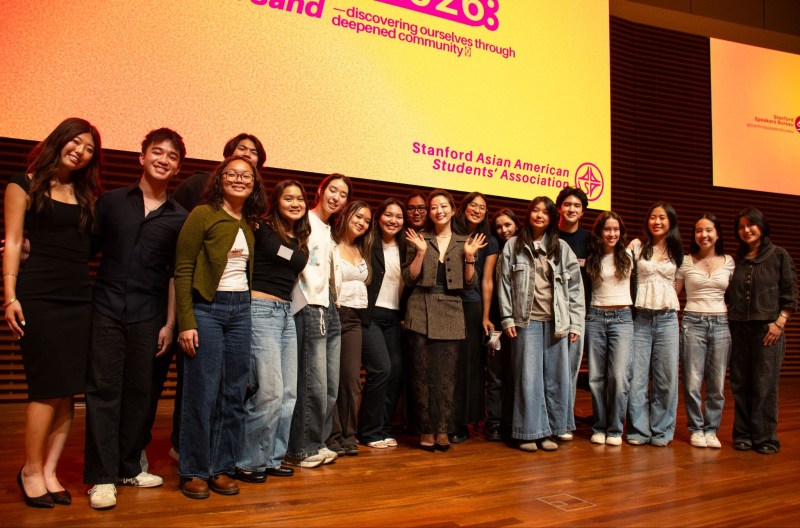
After the conversation, Cho hosted a meet-and-greet, doling out signatures and snapping photos with fans. Many of the attendees came from off-campus, fully equipped with collectable “K-Pop Demon Hunters” trading cards, notebooks and other memorabilia. The event’s student moderators, Chung and Yoon, told The Daily that they appreciated non-Stanford visitors.
“LTS not only seeks to foster space on campus for an open dialogue, but also to foster space where diverse communities can come together,” said Yoon. Chung said that AASA wanted to “emphasize notions of shared humanity, connection and friction,” and credited Cho as an example of those values. The two also loved her perspective on identity.
For Yoon, what shone through was how Cho “used struggle and adversity as a catalyst for self-awareness.”
“Arden was our first choice from the get-go,” said Chung, who thanked SSB for connecting AASA to Cho’s agent. “We didn’t build the theme around Arden, but Arden definitely ended up influencing the theme.”
Before the conversation, Chung and Yoon had done extensive research, mapping out flowcharts in an attempt to design the cadence of the conversation. But Chung said that a backstage interaction with Cho helped ease some of the nerves of moderating.
“We looked at each other, and we put our questions down. And we just took the conversation as we went,” said Chung.