
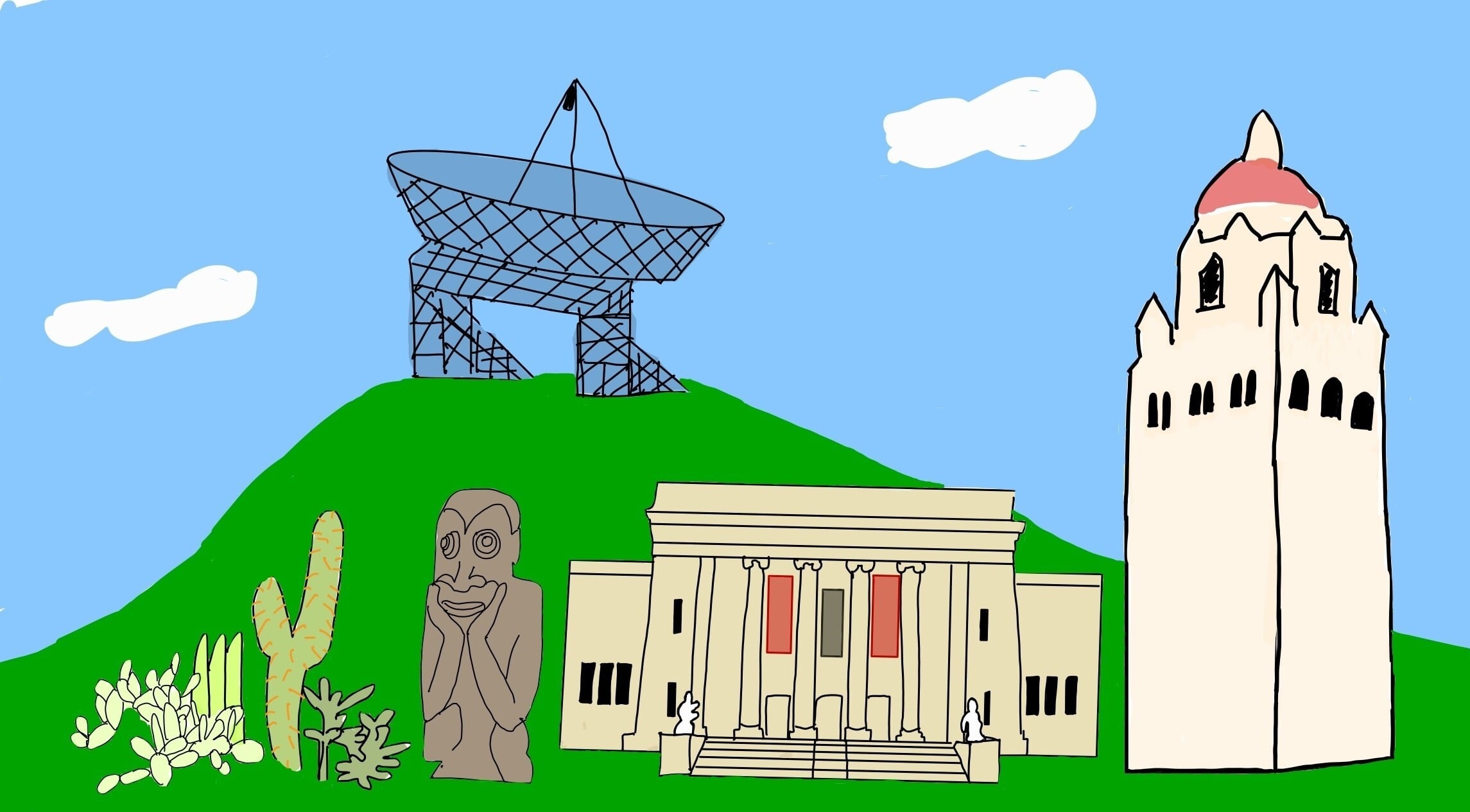
In her column “No More Excuses,” D’Souza stops postponing her visits to Stanford landmarks and finally makes time to experience the campus she’s been rushing through.
YO, have you ever been to the Cantor Arts Center?
With works spanning different cultures, time periods and regions, the museum offers a glimpse into worlds entirely different than Stanford’s. As someone who loves to randomly go to art museums, I acknowledge that this visit was long overdue. Cantor is just past CoDa and STLC, which are parts of my everyday schedule, and it is completely free to visit. There were really no excuses.
I decided to check out Cantor right after class one day. Not only had I been trying to explore more places, but I was also trying to become more spontaneous in the way I did it.
As I approached the building, I passed its signature yellow “YO” sculpture and the Rodin Sculpture Garden just beside it. The art center was much larger than I expected, stretching across two floors with exhibits branching out in various directions. Since I came straight from class, I still had my backpack on, which wasn’t exactly convenient for a museum visit. It felt like a burden, but I kept walking.
I expected to be stopped at the entrance, maybe asked to store my bag. Instead, they just told me to wear it on my front so I wouldn’t bump into anything.
That was it.
No friction. No excuse.
After checking in, I pulled up the digital map. The layout was almost overwhelming. So many rooms to visit across two floors with no clear path. At first, I tried to optimize my route, planning the most efficient way to cover every exhibit in the least distance. But I quickly decided to let that go.
My last class was done. My next p-set wasn’t due for another week. There was nowhere urgent I needed to be. All I had to do was keep walking, changing directions if I ended up somewhere I’d already been.
I took my time wandering around the museum, taking smaller strides than I do while rushing between classes. Some pieces pulled me in immediately, others I passed more quickly, but all of them carried a quiet kind of beauty.
The first floor felt familiar, with paintings, sculptures and woven baskets on display. Interesting, but expected. My favorite exhibits were on the second floor. With darker painted walls and winding walls, the second floor felt less like a public display and more like a secret for me to explore.
One exhibit, “Animal, Vegetable, nor Mineral” by Miljohn Ruperto, stood out for its use of unconventional mediums. Featuring everything from animated rabbits and minerals to a VR experience that immerses you in a simulated natural world, this exhibit lets one connect to nature through technology. The space itself was open and quiet, bringing a sense of calmness that is often associated with nature. I appreciated this modern, technological interpretation of nature. We often think nature and technology are mutually exclusive, but this exhibit showed the two working in harmony to create a novel experience.
My favorite room, though, was the Robert Mondavi Family Gallery.
It was filled with large European and American paintings depicting historical scenes. The walls were lined with detailed, larger-than-life portraits, capturing people in some of their most intense moments. From the distressed girl in “Penitent Magdalene” to teary-eyed St. Peter in “Devotion and Doubt in the Spanish World,” the nuanced lighting and intentional brushstrokes of each painting made these figures feel alive.
I’ve always enjoyed works like these because of how extreme everything feels. You’re looking at moments of real consequence — conflict, survival, loss — all condensed into a single frame.
Standing there, I couldn’t help but compare that to the kinds of things I usually stress about. Each painting served as a reminder that not everything needs to feel so dire all the time. I continued through the rest of the museum, taking my time to ensure I made the most of my visit.
After a little over an hour, I decided it was time to get some work done. But instead of heading back to CoDa or Green Library, I tried something different. I went to Tootsie’s, the cafe within Cantor Arts Center.
I bought a slightly overpriced fruit cup, sat down and pulled out my Math 53 homework. It wasn’t long before they closed and I had to relocate, but for those few hours, I had a pleasant lock-in.
I wasn’t just working. I had changed the environment around my work. And that small shift made something as routine as studying feel refreshing.
I’ve always treated work and exploration as separate — either I’m being productive, or I’m doing something new. But they don’t have to be. I don’t need to carve out time to “go do something new” every time I want a break from my schedule. I can just change where that schedule happens. Instead of defaulting to CoDa or Green Library every time, I realized I could try a café or a random building — somewhere I wouldn’t normally sit down and work.
It may not always be easy, but it sure does make each day feel a little less predictable.